



The NFL should consider contraction.
Not fewer teams; fewer pounds.
Let's face it, the NFL needs to go on a diet. Send the players to Jenny Craig, sign them up for fat camp or Jillian Michaels, eliminate seconds at the training table, get serious about drug penalties — do whatever it takes.
Look, this sounds like a wacko idea, and it will never be seriously considered by the league because it makes way too much sense, but the NFL should adopt weight limits for players. Put them on a scale before each game, like boxers and wrestlers. With the much-publicized health problems of overweight NFL players, combined with the recent outbreak of explosive collisions and injuries, why not?
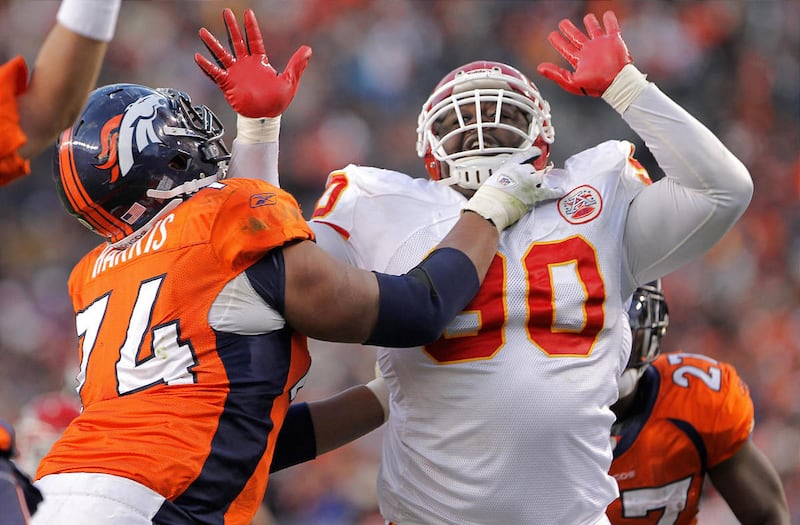
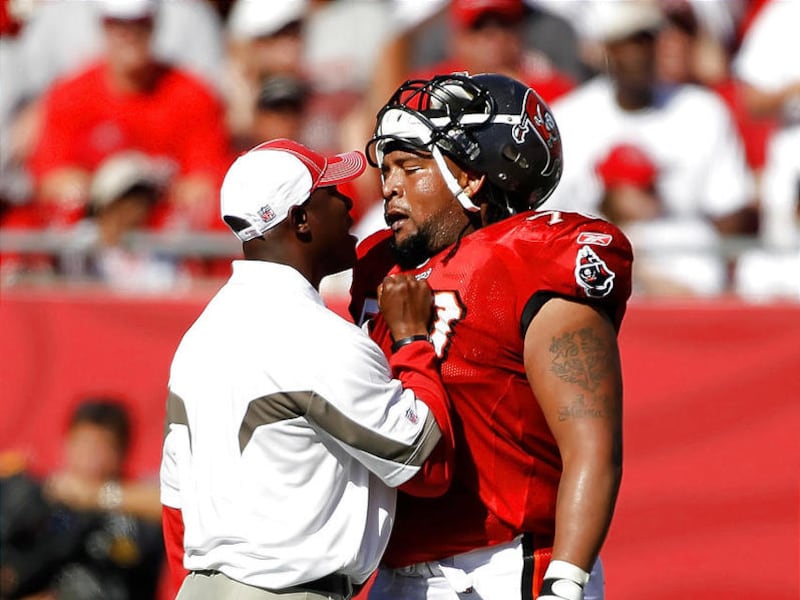
The players are too big and many of them too fat. It exposes them to health risks on the field and off. It's time to end the NFL's version of the arms race — everyone getting bigger so they can compete with everyone else who is getting bigger.
In 2006, the Palm Beach Post studied the size of NFL players by compiling data from NFL rosters beginning in 1920 (a total of nearly 40,000 players). The newspaper reported, "From 1920 to 1984, there were never more than eight players in any season who weighed 300 pounds or more. This year, there were 570 players who weighed 300 or more listed on 2006 NFL training camp rosters, nearly 20 percent of all players."
The Associated Press reported the increase in 300-pound NFL players: one in 1970, three in 1980, 94 in 1990, 301 in 2000 and 394 in 2009.
Look at the roster of the 1967 Green Bay Packers, winners of the first Super Bowl. Their biggest player weighed 260 pounds. Now look at the roster for the 2009 New Orleans Saints, winners of the last Super Bowl. They had 11 players who weighed between 294 and 343 pounds.
This trend toward battleship-size players has been emulated in the college and high school ranks. BYU's roster includes 14 players who top 300 pounds, with several more who are one Big Mac away from joining the club.
Where will it end? Some players are already approaching 400 pounds. Next stop: 500?
The increase in size far outstrips the increase for the general population. That's because, for the most part, it is manufactured weight. Players intentionally pack on the weight with supplements and meals that consist of 6,000 or 8,000 calories, and, yes, steroids and human growth hormone.
"The question they have to ask is, 'How big is big enough and when do we stop getting bigger and think more about getting stronger and healthier and better?'" Michele Macedonio, nutritionist for the Cincinnati Bengals, told AP.
By bulking up, players are risking their health and a few years of their lives for fame, money and the thrill of playing the game. A study conducted by Dr. Stephen Baron for the National Institute of Occupational Safety and Health, found that linemen had a 52 percent greater risk of dying from heart disease than the general population.
The results of a 2006 Scripps Howard study of 3,850 pro football players who have died in the last century revealed the following: One of every 69 players born since 1955 is dead; 22 percent of them died of heart disease; 77 percent of those who died of heart diseases qualified as obese, even during their playing days; only 10 percent of deceased players born from 1905 through 1914 were obese while active players.
"Clearly, these big, fat guys are having coronaries," Charles Yesalis, a Penn State professor of health policy and sport science, told ESPN.
University of North Carolina endocrinologist Joyce Harper published the results of a study in the Journal of the American Medical Association that revealed 56 percent of NFL players were obese according to their body-mass indexes — the government weight standard for height and weight. Some believe the BMI is inaccurate for athletes because it doesn't take into account muscle mass, which weighs more than fat. Yesalis refutes that notion.
"When you get that big — regardless of whether your body is muscle or fat — your heart is stressed," he says.
Besides, according to AP, Macedonio cited one study that showed a sampling of university offensive lineman averaged 27.4 percent body fat.
Another study revealed that the average life span of NFL players who play for five or more years is 55 (52 for linemen). They lose one to three years of their life expectancy for every year they play in the league.
The bottom line: Players are getting bigger and unhealthier. The average weight in the NFL has grown by 10 percent since 1985 with an average of 248 pounds; the heaviest position, offensive tackle, went from 281 pounds 25 years ago to 318 pounds.
"Is it good for guys to be that big? Of course not," said Yesalis. "I fully support a weight limit of 275 pounds. It would reduce injuries and have a positive effect on the short- and long-term health of these men."
A league-mandated 275-pound weight limit would not be any more unfair to those who weigh too much than it is for those players who get turned away because they don't weigh enough. The weight limit would affect linemen almost exclusively — the players who are at the greatest risk for heart disease, diabetes and stroke, according to Mark Shilstone, the director of health and fitness for the Ochsner Clinic Foundation who has evaluated the condition of more than 300 NFL players. "(Linemen) are the walking dead," Shilstone told USA Today. "They just don't know it."
The supersizing of NFL players has almost certainly contributed to another problem: Injuries. Today's players are not only bigger, but they are faster than ever. Do the physics — bigger and faster players means harder collisions. Many of the most publicized collisions are occurring in the secondary, but 14 quarterbacks have been sidelined this season, several with concussions, because they were crushed by behemoth linemen. From a practical point of view, can the league afford to have so many players at its marquee position on the sidelines?
The other part of the weight-gain phenomenon the NFL must address more seriously is the use of steroids and human growth hormone. The league likes to boast of its testing procedures and its suspensions. It is na?e to point to drug testing and the relatively few failed tests as proof that steroids aren't much of a problem in the NFL. This has been stated repeatedly, but it's worth noting again that Olympic sprinter Marion Jones managed to pass every drug test she took (160) and then confessed to using steroids.
Does anyone find it strange that the NFL — whose athletes who have the most to gain by becoming bigger and stronger — has relatively few drug suspensions, while track and cycling continue to churn them out? Stranger still is the league's weak penalty for drug use. The World Anti-Doping Agency and the IAFF — the governing body for track and field — suspend first-time offenders for 2-4 years second-time offenders for life. The NFL suspends first-time offenders for four games, which makes steroid use worth the risk, since the penalty is weak and there is little chance of being caught anyway.
The league will dispute that contention, but one thing is certain: The NFL has a Size-XXXX problem.
e-mail: drob@desnews.com