

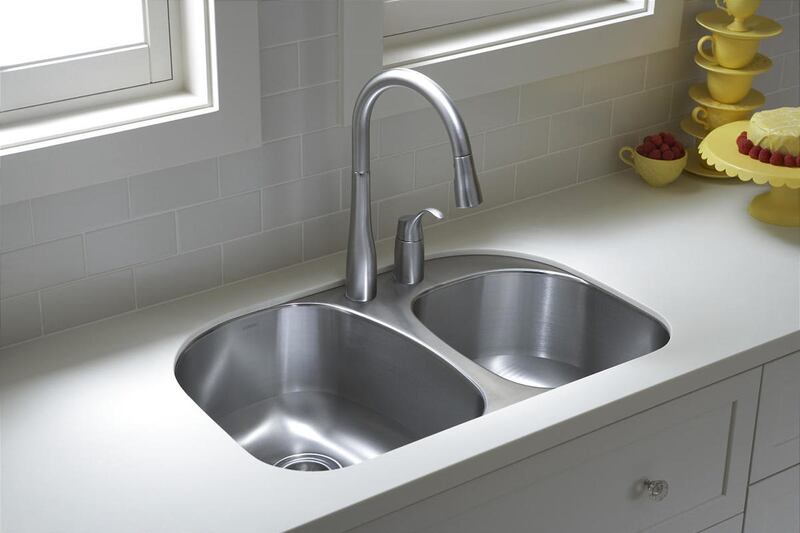
Q: I'm a hard-core handyman around my house, and my new project is to install a new countertop with an under-mount sink. What's the easiest way to install an under-mount stainless steel sink? Also, what's a quality "gauge" thickness for a stainless steel sink? Any other tips about stainless steel sinks will be welcome. Thanks! -- Barry, Kansas
A: Nothing gets by me; I'm getting the vibe that you're going with a new stainless steel sink. Stainless steel sinks have long been thought of as the budget choice, but times have changed. Today's high-end stainless steel sinks feature beautiful brushed finishes, noise-reduction technology and, most important, premium "gauge," a number referring to the stainless steel's thickness. The lower the number, the thicker the steel. Premium stainless steel sinks can carry a heavy-duty gauge number of 18 or 19, while lower-end versions may be 22 or 23.
Especially for under-mounting, I recommend going with a heavy-duty stainless steel sink.
As far as the under mounting itself, recent breakthroughs in kitchen sink designs make it a little easier. As matter a fact, some of these sinks are called "cinch" sinks because of their quick installation.
The traditional way to install an under-mount sink was to basically brace up the sink from the bottom, install the countertop over the sink, then drill faucet holes through the countertop to mount the faucet. Drilling faucet holes in a new countertop can be a challenge, especially if you're installing stone counters. New "cinch" sinks feature an integrated deck with predrilled faucet holes in the deck. This eliminates any countertop drilling. Simply put, the faucet holes are in the sink body, not the counter. From a plumber's point of view, this can also make faucet installation easier. Installing a faucet to a thinner sink deck can be a lot less stressful than attaching a faucet to a thick countertop.
My final tips are about maintaining stainless steel. You should clean a stainless steel sink at least once a week. Don't use steel wool, wire brushes or abrasive cleaners. Always apply a stainless steel cleaner and/or polish with a cloth or sponge. This will keep your sink looking nice and new. Don't worry if your sink scratches from time to time; scratches tend to blend in over time.
Good luck with your project, and I hope I didn't bowl you over with all this sink information.
(Master contractor/plumber Ed Del Grande is the author of "Ed Del Grande's House Call" and host of TV shows on Scripps Networks and HGTVPro.com. Visit eddelgrande.com or write eddelgrande(at)hgtvpro.com. Always consult local contractors and codes.)