

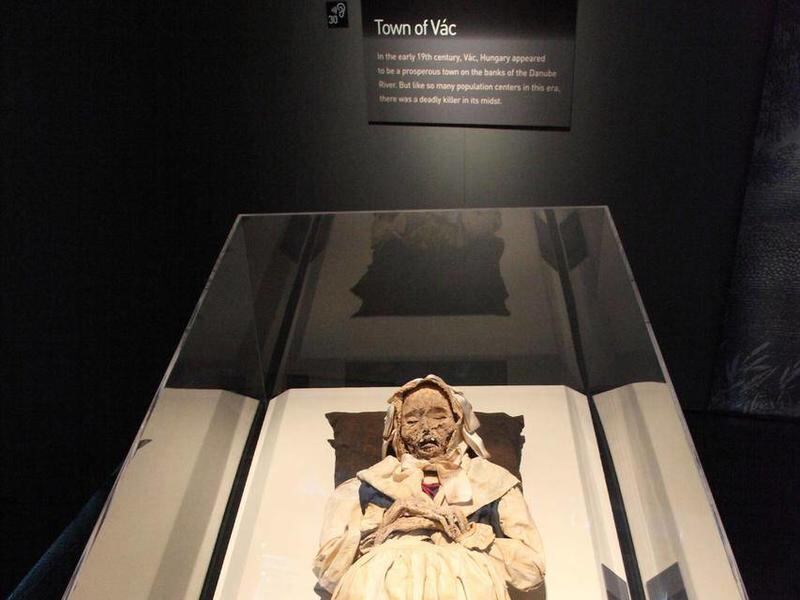
MILWAUKEE — Veronica Orlovitz died in 1807 in Hungary at the age of 38 and put in church crypt in Hungary.
Her body mummified naturally over the centuries and was discovered unexpectedly along with hundreds of other coffins during a 1994 remodeling project. Now, researchers are taking her body, clothed in a white dress, to a Milwaukee hospital Friday where a CT scan will be performed to try to determine her exact cause of death and details about her life and community.
"Using medical imaging is the only way we can look at these people without doing them any physical harm," said Dr. Heather Gill-Frerking, scientific research curator of the German Mummy Project, which is based in Germany. "It's both respectful and provides a vast amount of information for us."
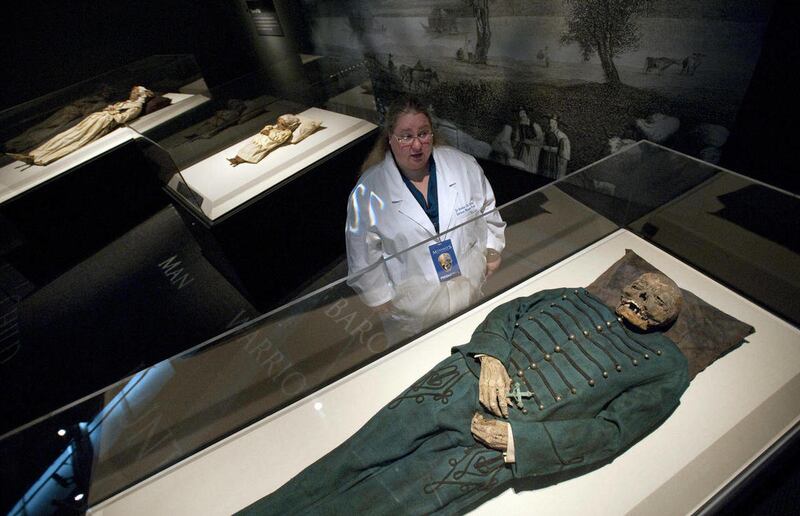
The project's research is included in the exhibit "Mummies of the World," which opens at the Milwaukee Public Museum Dec. 17 and runs through May 30.
Orlovitz's first husband and one of her three children are also in the exhibit, which started at the California Science Center in Los Angeles this summer and will be touring the country for three years. A CT scan was done on Orlovitz' husband in Los Angeles.
Called the largest traveling exhibition of mummies ever assembled, it features 150 human and animal mummies and artifacts from 20 museums in seven countries.
Dr. Ellen Censky, senior vice president and academic dean for the Milwaukee museum, said the South American mummies seemed to be the show stoppers in Los Angeles. Those include a 10-month-old Peruvian child who lived about 6,500 years ago and a woman with a tattoo on each breast and one on her face
The other highlights include a 17th-century nobleman, a youngster with a facial tumor and a mummified dog, cat, lizard, fish and monkey. It also explains how mummification occurs.
CT scans of mummies are fairly common, said Dr. Jonathan Elias, director of the Pennsylvania-based Akhmim Mummy Studies Consortium, which directs CT scans of mummies and archives the research.
He said researchers have used them since the 1970s, but it's only the last decade or so that the scans started providing them with fast, high quality data, making them more attractive to researchers to perform.
"The process of imaging mummies is still experimental," he said. "We are still learning with every scan that we do."
What's unique about the scan in Milwaukee is the age of the body, only being about 200 years old, he said. He said most scans are done on Egyptian mummies from thousands of years ago.
DNA analysis proved that Orlovitz had tuberculosis, which worsened over time, but it's unclear if that is what ultimately killed her, Gill-Frerking said. There were about 300 crypts found in the church, with many bodies preserved.
That was due to a constant air flow temperature of about 50 degrees, she said. Also, almost all the bodies were laid on wood chips, which absorbed body fluids, and in pine coffins, which may have prevented the spread of bacteria. The coffins and the wood chips were part of a normal burial practice and there's no evidence the church was trying to mummify the bodies, Gill-Frerking said.
Researchers not only hope to learn about Orlovitz's cause of death but details of her environment, she said. For instance, if they see evidence of a disease in large percentage of population, it gives researchers an idea on how closely they lived and their nutrition.
Gill-Frerking said the German Mummy Project has done about 40 CT scans of mummies through the mummy project, the results of some can be seen in the exhibition.
They will have some preliminary data after the scan but other data will take months. Gill-Frerking wasn't sure what information, if any, would be available on Orlovitz to include in the Milwaukee exhibit. Columbia St. Mary's Hospital is donating the scan to help further research, said spokesman Greg Hartzog.
One of the more famous tests done on mummies was in 2009, when researchers did DNA tests and CAT scans on the world's most famous ancient king, the young Pharaoh Tutankhamun. It showed Tut had a genetic bone disease and malaria, which combined with a severe broken leg, could have been what killed him about 3,300 years ago at age 19.
The "Mummies of the World" exhibit was curated by the Reiss-Engelhorn Museums in Mannheim, Germany and the mummies are from Hungarian Natural History Museum.