

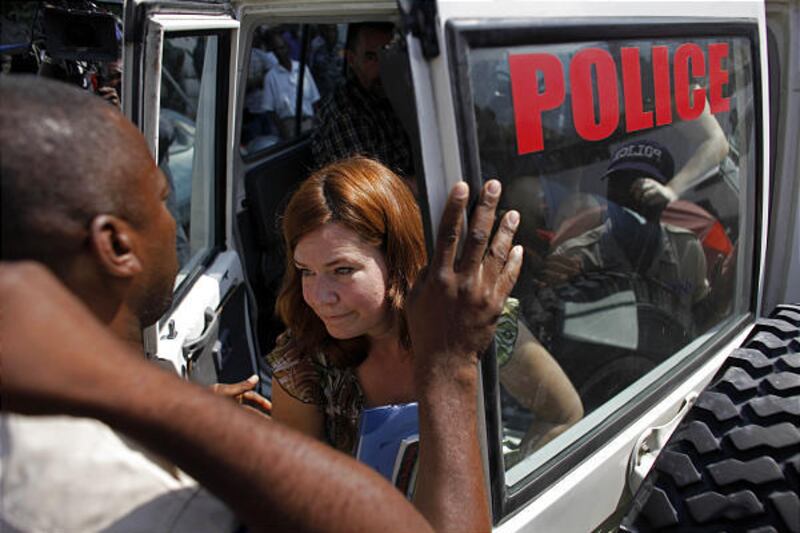
BOISE — In the days after the Haiti earthquake, Laura Silsby made a series of calls around the country to mobilize a trip to rescue orphaned children from the disaster.
She enlisted members of her Baptist church and told them she had all the necessary paperwork. She even found a Kentucky couple, Richard and Malinda Pickett, who had been trying to adopt three siblings from Haiti and told them she could get the children out.
The Picketts say they politely declined, figuring the youngsters were safe and would soon be evacuated to their new home.
"My wife told her that under no conditions should she try to move the kids — that would just interfere with our plans. But she called two more times, and the last time she called, on the 25th, she said she was getting on a flight and would like to pick up our kids," Richard Pickett said. "My wife, for the third time, told her no way — stay away from them."
A few days later, Silsby and nine other Americans were charged in Haiti with kidnapping for trying to take 33 children out of the country without proper documentation. The 10 defendants remain in jail in Haiti.
The Haitian and U.S. governments are investigating Silsby and her group, trying to determine why they were rounding up children, many of whom were not orphans. Silsby and her supporters say they just wanted to save youngsters from the chaos, disease and uncertainty of quake-ravaged Haiti. Others, like the Picketts, aren't convinced.
A closer look at Silsby shows that the adoption fiasco followed a certain pattern seen in her life. The 40-year-old businesswoman and mother of three has been known to make big promises and big plans that often give way to questionable behavior and legal action.
Court records show she has a habit of failing to pay employees, creditors and taxes. In the last year alone, she saw her home go into foreclosure and watched a number of legal proceedings against her and her business wend their way through Idaho's courts.
All of this happened as she became highly passionate about helping kids in the Dominican Republic, according to those who know her.
"She had explained that she felt absolutely driven in her heart to open an orphanage in the Dominican Republic," said Nancy Batteen, owner of a children's second-hand clothing store in Boise where Silsby shopped.
Silsby showed her knack for achievement early, earning a high school diploma at 15, according to an old news release from her company. She went on to study business administration and accounting at Washington State University, graduating summa cum laude in 1991.
She took a job with Hewlett Packard in Boise, working for six years in financing and Internet marketing positions.
In 2000, Silsby and a man named James Hammons patented a method for creating and operating a personalized Internet store. She used the method to found a company that would do business under the name Avenue Me. The goal, Silsby told associates, was to create an online personalized shopping experience for those too busy to dig through several stores or Web sites.
She hired Boise multimedia marketing company Wirestone to build her Web site, but soon stopped paying the bills, said Mark Salow, a former Wirestone manager. Wirestone ultimately sued after Silsby fell tens of thousands of dollars behind in paying for the work, Salow said.
"She was always telling us, 'We had this great meeting, and you'll be paid soon,'" Salow said. "There was always some investor that was going to come in and save the day."
Those promises didn't sway a judge, who ruled in Wirestone's favor. The business seized computers and office furniture from Avenue Me to settle the debt in a pennies-on-the-dollar deal.
In 2004, Silsby filed for divorce from her husband, Terry Silsby. The divorce became final in 2007, but the two sides are still fighting in court.
In 2008, she bought a newly built five-bedroom home on a half-acre lot in Meridian — which the bank foreclosed on last December.
At the same time, several employees of her company — now called Personal Shopper after a trademark dispute — were filing claims against Silsby over unpaid wages. One former employee, Robin Oliver, said she was hired for $110,000 a year and sued after Silsby fell five paychecks behind.
Oliver said Silsby kept telling her that new investors had agreed to fund the company, but the cash never showed up. Oliver's attorney said Silsby claimed at various times that potential investors included NBC, a private equity firm and a high-powered public relations expert.
Silsby contended that Oliver drastically cut her own hours and was working ineffectively and had to be fired. Silsby also noted that although she had faced a series of other wage claims, all those cases had been settled. Oliver's lawsuit is set to go to trial Feb. 22.
"For many employees who chose to work for startup companies, getting an immediate paycheck can, and often does, take a back seat to other priorities: seeing the company succeed, getting in on the ground floor, getting paid more later in the form of stock options and bonuses, to name just a few," Silsby wrote in court documents.
It is not clear if her money problems were related in any way to the adoption effort in Haiti, but the financial aspects of the trip will clearly be scrutinized during the investigation.
The Picketts said they were immediately suspicious of Silsby. The Kentucky couple didn't need her help — the government had already given them permission to go pick up the children. But Silsby persisted, they said.
She showed up at the Compassion for All orphanage in Haiti, asking to collect the Picketts' three adopted children and claiming to be Malinda Pickett's friend, according to Richard Pickett.
When the orphanage told her the children had been moved, Silsby went on to ask for any other kids she could have, Richard Pickett said. She paid a worker to take her to other orphanages in the region and translate for her.
"She asked for kids at each of the orphanages, and at the end of the day, when no one would give her any, she cried," Richard Pickett said. "Why would you cry after you see these kids are being taken care of?"
The Picketts' adopted children are now with the couple in Bowling Green, Ky. Richard Pickett said he was recently interviewed by an agent with the Department of Homeland Security who is helping investigate the Silsby case.
The Haiti effort was not Silsby's first attempt to help children overseas. She worked with a local teacher to create a nonprofit group called Kids Changing Lives With the Gift of Smile. Through the organization, schoolteachers encouraged their students to raise money for Operation Smile, which performs surgery on children to correct cleft palates and other facial deformities. Operation Smile spokesman Scott Vooss said Silsby and schoolchildren have raised nearly $40,000 so far — enough to cover about 166 operations.
"I absolutely don't question their motives, but who knows?" Batteen said. "There's no question in my mind that they weren't trying to traffic children. Anybody that knows them knows that."
Silsby's sister, gift shop owner Kim Barton, declined to comment on Silsby's charitable work or her business. But she gave The Associated Press a written statement on behalf of Silsby's family and friends.
"We want the world to know that Laura is a good, caring, and loving human being," it said. "We know that her deepest desire is to help — never to harm — the children whose lives were turned upside down by the earthquake in Haiti."
Meanwhile, Haiti issued wildly conflicting death tolls for the Jan. 12 earthquake on Wednesday, adding to confusion about how many people actually died — and to suspicion that nobody really knows.
A day after Communications Minister Marie-Laurence Jocelyn Lassegue raised the official death toll to 230,000, her office put out a statement quoting President Rene Preval as saying 270,000 bodies had been hastily buried by the government following the earthquake.
A press officer withdrew the statement, saying there was an error, but re-issued it within minutes. Later Wednesday, the ministry said that due to a typo, the number should have read 170,000.
Even that didn't clear things up. In the late afternoon, Preval and Lassegue appeared together at the government's temporary headquarters.
Preval, speaking English, told journalists that the number was 170,000, apparently referring to the number of bodies contained in mass graves.
Lassegue interrupted him in French, giving a number lower than she had given the previous day: "No, no, the official number is 210,000."
Preval dismissed her.
"Oh, she doesn't know what she's talking about," he said, again in English. Whatever the death toll, there is no doubt it is one of the highest in a modern disaster.
A third of Haiti's 9 million people were crowded into the chaotic capital when the quake struck just to the southwest a few minutes before 5 p.m. Many were preparing to leave their offices or schools. Some 250,000 houses and 30,000 commercial buildings collapsed, according to government estimates, many crushing people inside.
For days, people piled bodies by the side of the road or left them half-buried under the rubble. Countless more remain under collapsed buildings, identified only by a pungent odor.
No foreign government or independent agency has issued its own death toll. Many agencies that usually can help estimate casualty numbers say they are too busy helping the living to keep track of the dead. And the Joint Task Force in charge of the relief effort — foreign governments and militaries, U.N. agencies and Haitian government officials — quotes only the government death toll.
That toll has climbed from a precise 111,481 on Jan. 23 to 150,000 on Jan. 24, to 212,000 on Saturday, to 230,000 on Tuesday. Preval's count of 170,000 bodies buried in mass graves may represent only a piece of the toll — but nobody at his office was available to clarify.
It's common in major disasters to see large discrepancies in death tolls: Governments may use lower figures to save face, or higher figures to attract foreign aid. In Haiti's case, however, where the very institutions responsible for compiling information were themselves devastated, reaching a death toll is particularly difficult.
Even some officials express skepticism that the government is keeping count.
"I personally think that a lot of information being given to the public by the government is estimates," said Haiti's chief epidemiologist, Dr. Roc Magloire.
Many citizens are even more cynical, accusing the government of inflating the numbers to attract foreign aid and to take the spotlight off its own lackluster response to the disaster.
"Nobody knows how they came up with the death count. There's no list of names. No list of who may still be trapped. No pictures of people they buried," said shop owner Jacques Desal, 45. "No one is telling us anything. They just want the aid."
A few days after the quake, the state-run public works department, known as the CNE, began picking up bodies from the streets and dropping them in trenches dug by earth movers in Titanyen, just north of the capital, amid rolling chalk and limestone hills that overlook the Caribbean Sea.
The trenches are 20 feet deep and piled 20 feet high.
Preval said the government has counted 170,000 bodies during those efforts, and that the number does not include people buried in private ceremonies. But at Titanyen on Wednesday, worker Estelhomme Saint Val said nobody had counted the bodies.
"The trucks were just dropping people wherever, and then we would move in and cover them up," he said. "We buried people all along the roads and roadsides. It was impossible to do a count."
And although the government death toll jumped by the thousands from Saturday to Tuesday, Saint Val said at noon Wednesday that only one truck had arrived this week, and it carried two bodies. He said workers received 15 truckloads of bodies a day just after the quake, but the numbers dropped off about 10 days ago.
Lassegue, in announcing the Tuesday death toll, refused to say how it was calculated.
"For the moment, we count 230,000 deaths, but these figures are not definitive," she said. "It's a partial figure."
U.N. humanitarian spokeswoman Elisabeth Byrs in Geneva, who has often cited Haitian government figures, said Wednesday that she said she doesn't know how Haiti is calculating the death toll: "We cannot confirm these figures."
Finding someone who can is difficult.
The government says the CNE is orchestrating the count. The CNE referred questions to the prime minister's office. The prime minister's chief of protocol referred questions to the prime minister's secretary-general. The prime minister's secretary-general could not be reached.
A report by the U.N. on Tuesday attributed the death toll to Haiti's Civil Protection Agency instead of the CNE. Civil Protection director Alta Jean-Baptiste referred questions to the Ministry of Interior. Interior Minister Paul Antoine Bien-Aime said Wednesday that the Civil Protection toll is "217,000-and-some deaths," despite the higher number given by his government.
"Civil Protection, before giving out the numbers, really is doing a precise count, and the numbers that they give out are numbers that are proven," he said.
He would not say how that count is being done.
A death toll of 230,000 would equal the number of people killed in the tsunami that devastated a dozen countries around the Indian Ocean following a magnitude-9.2 earthquake on Dec. 26, 2004. That disaster generated an outpouring of international aid — in part because of the number of dead.
An extremely high toll "probably elicits more public sympathy, so it might generate more visibility, more funding," said Chris Lom, a spokesman for the International Organization for Migration.
But Byrs says inflating numbers can backfire.
"Regarding every estimate, we have to be very careful because we could lose credibility with donors, with humanitarian partners," she told The Associated Press. "If you boost the figure, it's counterproductive. It doesn't help when you try to match assistance to needs."