

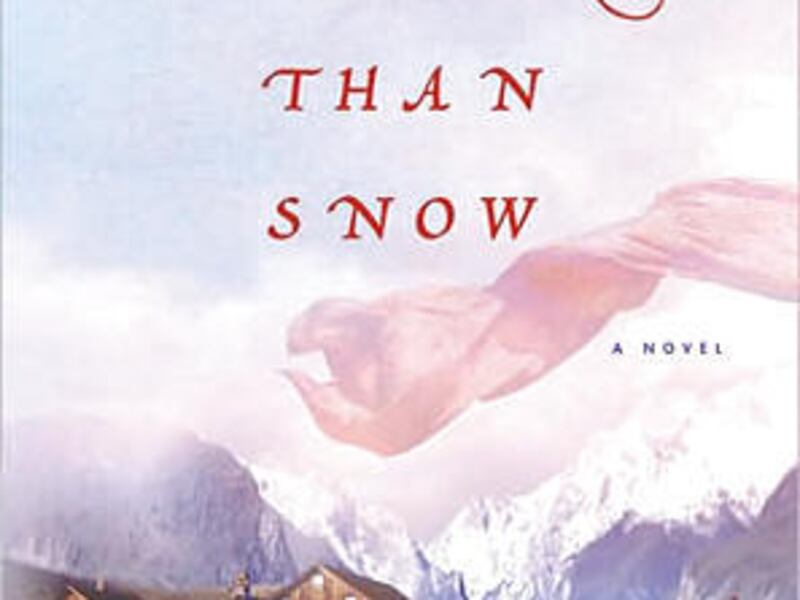
"WHITER THAN SNOW," by Sandra Dallas, St. Martin's Press, 304 pages, $24.99 (f)
All it takes is one moment, and life can change forever.
In Sandra Dallas' latest book, "Whiter Than Snow," a New York Times best-seller, that moment breaks barriers and creates bonds in ways never thought possible.
The year is 1920, and it's a beautiful spring day in the small mining town of Swandyke, Colo. The sun is out, and the snow is melting. It seems that the residents can finally put the harsh winter behind them.
But remnants of the winter still linger, and with warming temperatures, a hidden danger is lurking.
Just before 4 p.m., a large split of snow separates from Jubilee Mountain and roars down the slope. The massive slide consumes everything in its path, including children who are walking home from school. Of the nine students caught in the avalanche, only four survive.
Dallas takes readers into the lives of the children's families, giving their histories prior to moving to Swandyke. Because of this, "Whiter Than Snow" feels like a collection of short stories — not a bad thing — unified by the town and avalanche.
Readers first learn about Lucy and Doly Patch — sisters who had been as close as they could be when younger, but whose relationship was torn asunder when a fair-weather man came between them.
Also present is Joe Cobb, the only black man living in Swandyke. Joe grew up in Alabama, where lynching was part of everyday life. When events surrounding his wife's death turn dangerous for him, his only care is his daughter. It's for her that the two flee to Colorado.
Grace Foote is the wife of the mine's manager. Grace grew up with all the comforts society could provide. Her only real job was to marry someone of equal rank and greater fortune. But Grace has secrets of her own, and when the opportunity to marry her husband presents itself, she jumps at the chance.
Civil War veteran Minder Evans is still haunted by the events of that horrific war. It's those events that eventually bring him to Swandyke, where he is raising his orphaned grandson.
Finally, there's Essie Snowball. Born Esther Schnable, Essie was raised by conservative Jews only to run away with the love of her life as part of a dancing act. Through no fault of her own, Essie soon finds herself pregnant and in a precarious position. In order to provide for her child, Essie moves to Swandyke and takes work as a prostitute, all the while hiding her daughter's parentage from the world.
These seemingly unrelated stories come together with themes of fate and chance and love, creating a cohesive hole and an enticing story.
Dallas is able to bring a sympathetic quality to each of her characters, though none of them are without flaws. And though some of the story lines and characters have unappetizing elements, "Whiter Than Snow" is clean and only hints of necessary details are present.
Like Dallas' "Prayers for Sale," "Whiter Than Snow" is a fast and engrossing novel that will capture readers' hearts from the first few pages.
e-mail: jharrison@desnews.com