

SALT LAKE CITY — Most Utahns like the caucus-convention-primary process the state political parties use to select their nominees, but they don't care for the fact that a popular incumbent can be driven completely out of office at a party convention, a new poll shows.
Three-fourths of voters said they don't like the fact that they may not get to vote on a candidate because he or she was eliminated at convention — before a primary — and say they prefer a direct primary where they know they'd get a say at the ballot box, finds the survey by Dan Jones & Associates.
The poll was conducted for the Deseret News and KSL-TV to measure voters' opinions on Utah's unique party candidate nominating process.
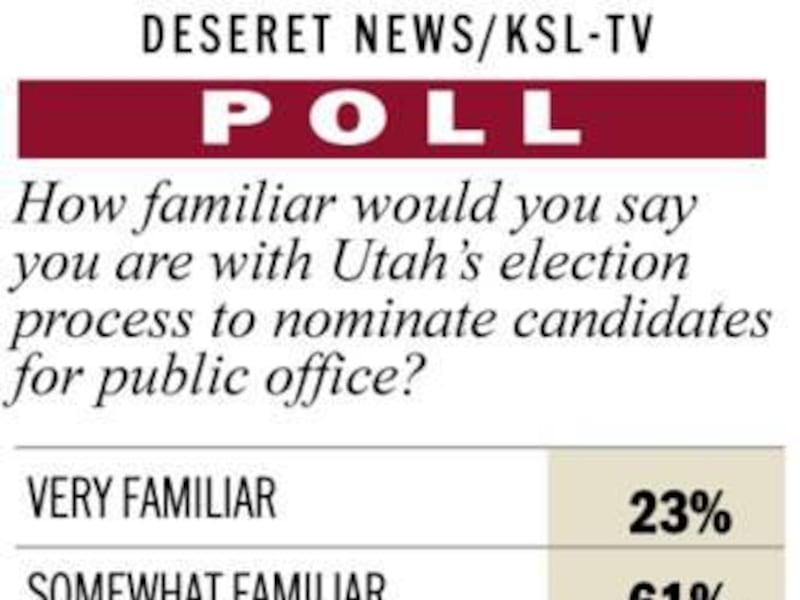
Eighty-four percent of voters told Jones they are familiar with Utah's nomination system. And 56 percent favored it.
That opinion changed over some specific aspects of Utah's system — like the fact that any candidate, even a popular incumbent with a strong chance to win a primary or a general election, can be eliminated from the election at the state party convention if 60 percent of convention delegates vote for someone else:
58 percent disapprove of delegates being able to eliminate candidates at convention.
72 percent "definitely" or "probably" prefer a direct primary election system.
Half "definitely" like a primary election where all voters could participate.
It's not a partisan issue, Jones found. A direct primary system was preferred by 63 percent of "strong Republicans," and 97 percent of "strong Democrats."
A previous Jones poll recently found that U.S. Sen. Bob Bennett, R-Utah, could be eliminated from his re-election bid this Saturday at the state Republican convention. Bennett may not be able to muster the 40 percent needed to advance to a primary election.
Thirty-eight states have a direct primary system: Candidates in different parties file for office, then voters pick a party to vote in on primary election day. In some cases, if no candidate gets more than 50 percent of the vote there is a run-off primary. In other cases, the top vote-getter in the only primary is the party candidate.
Utah has a bifurcated system.
Utahns meet in neighborhood caucuses (previously called mass meetings). In those March caucuses, party rank-and-file members elect county and state delegates.
County delegates vote in county party conventions for candidates for county office and for state legislative candidates whose districts are wholly in a county.
In the state party convention, state delegates vote on federal, state and legislative candidates whose districts cross county lines.
In both the county and state conventions, if any candidate gets 60 percent of the delegate vote, he or she is the party nominee and advances directly to the November general election. There is no primary election.
If no candidate gets 60 percent, then the top two finishers in the convention vote advance to a primary in late June. The primary winner moves on to the general election ballot to face candidates from other parties.
Not surprisingly, those who run the GOP and Democratic parties in Utah like the current system.
They argue it is open to anyone — you just have to have the gumption to go to the party caucuses in your area. Anyone, in theory, can be elected a county and/or state delegate.
Then you become one of about 3,500 Republicans who get to vote on candidates in the GOP state convention, or one of about 2,500 Democrats who get to vote in that party's state convention.
Utah GOP chairman Dave Hansen said it's important delegates — the most faithful and active grass-roots members of a party — get a say on candidates.
Delegates are engaged, they know the candidates and the issues, Hansen said. And Utah has been well-served by this process, producing a well-managed state with successful and popular governors like Republicans Norm Bangerter, Mike Leavitt and Jon Huntsman Jr.
Other political observers, like University of Utah Hinckley Institute of Politics director Kirk Jowers, say it is clear that Utah's caucus-convention-primary system produces candidates on the extreme — more conservative Republicans, more liberal Democrats.
Once a state controlled by Democrats, Utah has become overwhelmingly Republican. The Utah Legislature is more than two-thirds Republican, and conservatives are stronger than ever. One moderate Republican, Rep. Steve Mascaro, R-West Jordan, fell in the Salt Lake County GOP convention, soundly beaten by a conservative challenger.
e-mail: bbjr@desnews.com