

KANSAS CITY, Mo. — Fun with tires: You have no idea.
Corey Scott grips a truck tire with both hands and stands with his back to a brick wall. He lifts the tire while rotating his upper body and slams it against the wall over his left shoulder.
The kickback is impressive, but he regains his balance and immediately swings the tire diagonally downward, hitting the wall about knee level on his right side.
Up. Bang. Down. Bang. And again. And again.
"It's grueling," he says.
Scott, 39, is a fitness trainer who grew up on a farm near Plainville, a really honest name for a burg in northwest Kansas. But his agricultural origins only partly explain this tire thing. It's not as if he and his buddies used to swing, toss and flip tires back home.
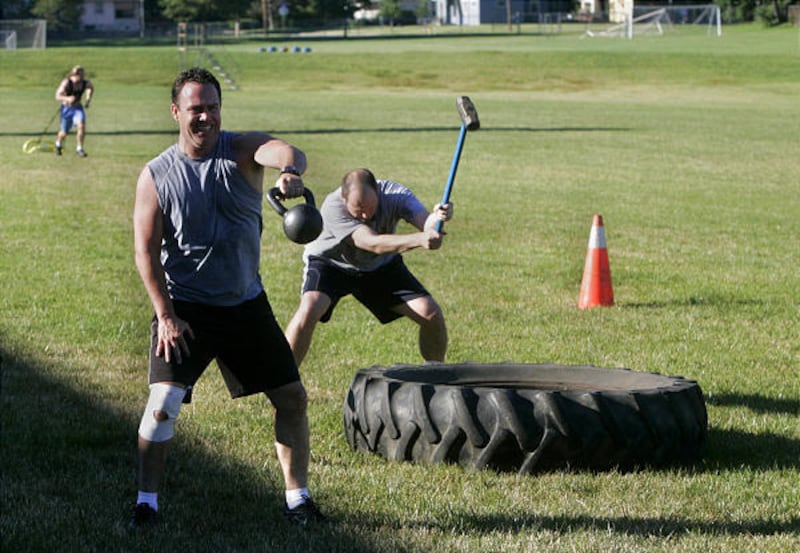
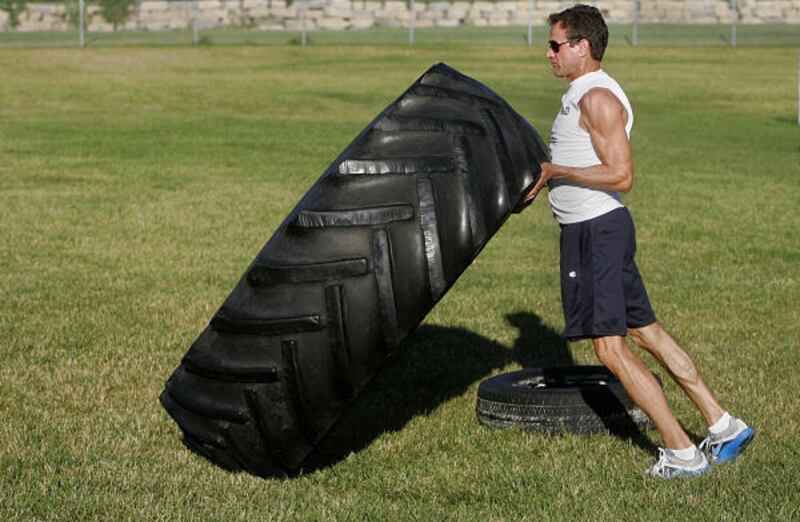
Which is exactly what's going on here, in a field near Bishop Miege High School in Roeland Park, Kan. A few friends meet once or twice a week for a "functional strength" workout that makes interesting use of Scott's tire collection, which includes a 300-pounder.
Squatting, turning, throwing, lifting, swinging, jumping: These are "total body" exercises long favored by athletes and pushed in recent years by fitness experts as better conditioning overall than simple weight machine workouts.
Among the business people, firefighters and students in the tire-strewn field recently was 53-year-old cardiologist James O'Keefe, director of the preventive cardiology program at St. Luke's Mid-America Heart Institute. He's an avid exerciser, a friend of Scott's and has been in on the tire workout from the beginning.
"I realized a lot of strength training with weights is done with exercises that don't really translate well to everyday life," O'Keefe said.
Exactly right, Scott said.
With better conditioning, people can gain the strength and resiliency they need to get through their day with more ease of movement and without undue fatigue and joint and body pain, he said.
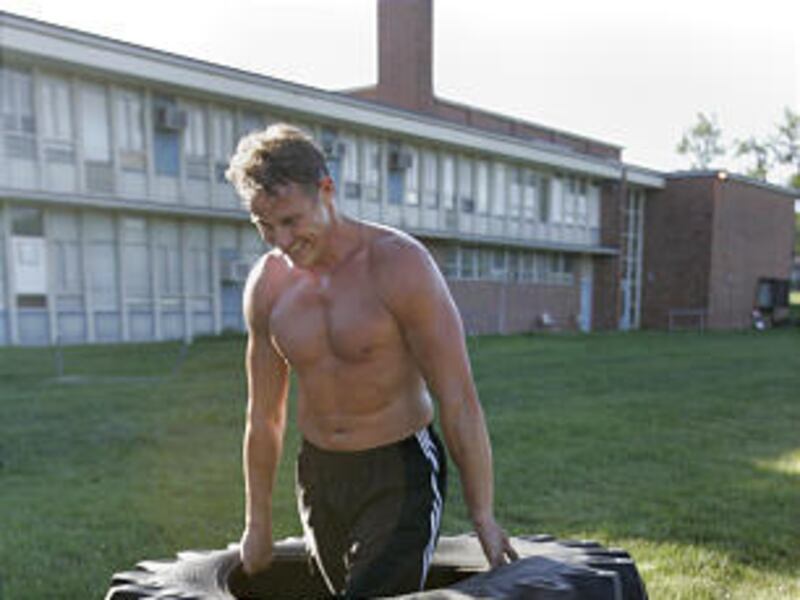
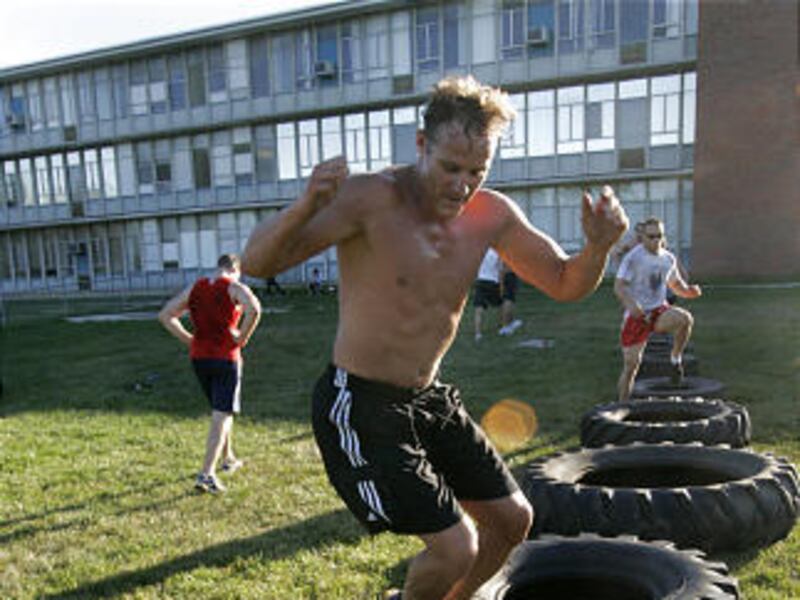
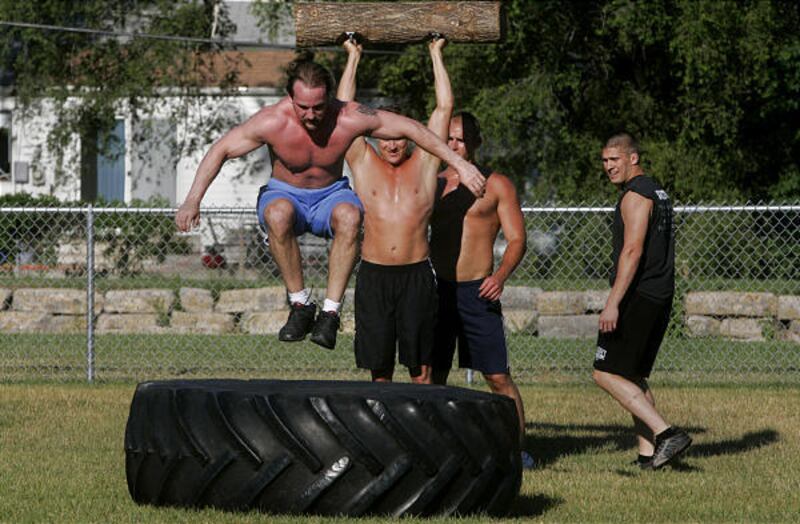
Messing around with tires is a rigorous way to get there: One by one on a recent Wednesday evening, Scott and several others squatted and lifted the biggest tire, the 300-pound one, flipped it over, then hopped into and out of the center of it.
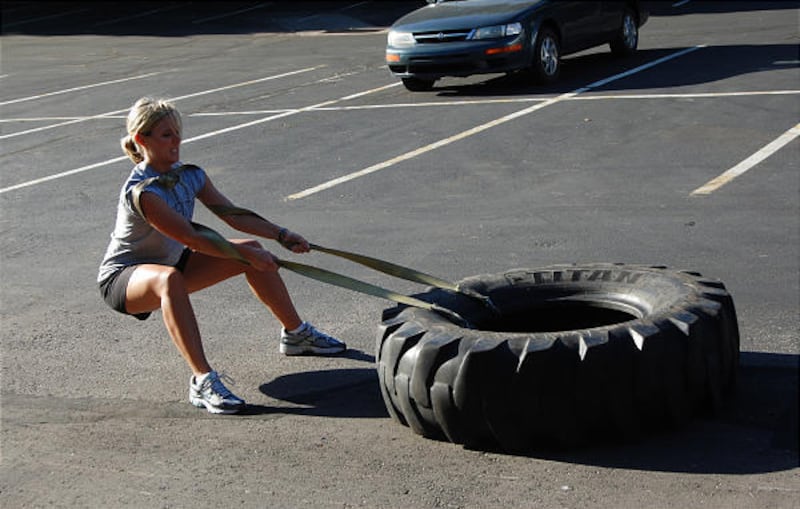
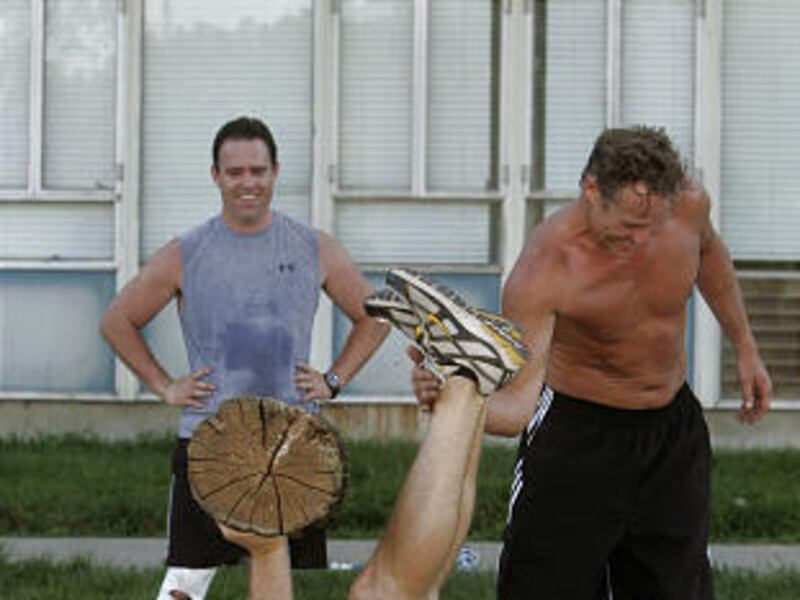
A few feet away, two others had picked up sledgehammers and were alternately swinging them over their heads and battering another tire, which lay defenseless on the ground. One fellow had attached straps to a large tire and, moving backward, bent his legs and pulled the tire along the ground.
It was about a year and a half ago that Scott, who lives in Prairie Village, Kan., was back at the family farm when he noticed a giant tire in a neighbor's frozen pasture. His plan to develop a tire workout had been bouncing around in his head, and here was Exhibit 1.
Scott tried to explain to the neighboring farmer his exercise idea — the man was perplexed — and asked to buy his tire. The farmer said the old tire was no use to him and used his tractor to help load it into Scott's F150. He charged $10 for the trouble.
The tire routine started in Scott's driveway and expanded to the street, which drew both onlookers and participants. He accumulated tires of different sizes, 10 in all, and moved the workout to the parking lot of his studio nearby. But police told him that some folks in the adjacent neighborhood were troubled by the activity, so he relocated to the field near Miege, Kan.
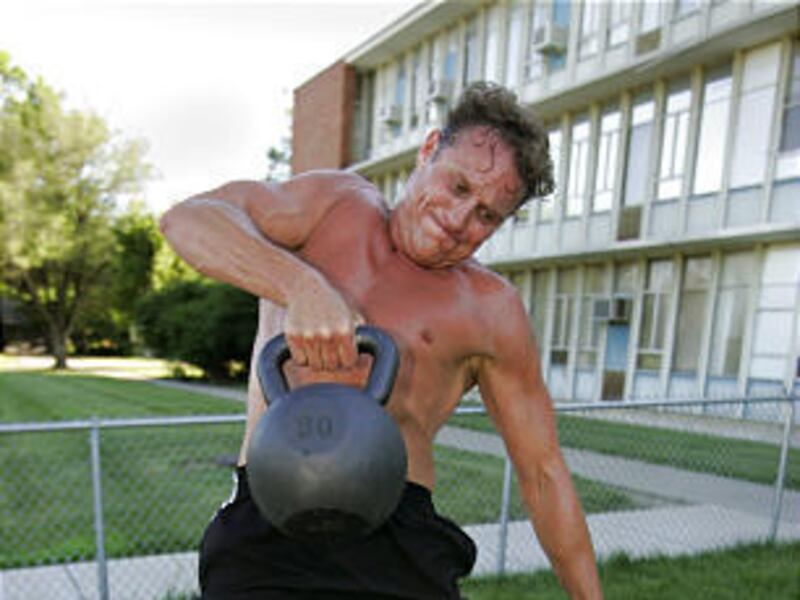
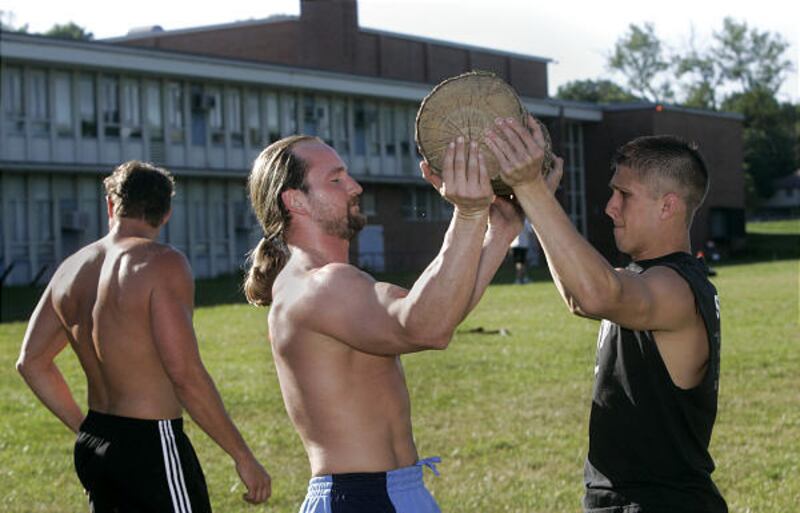
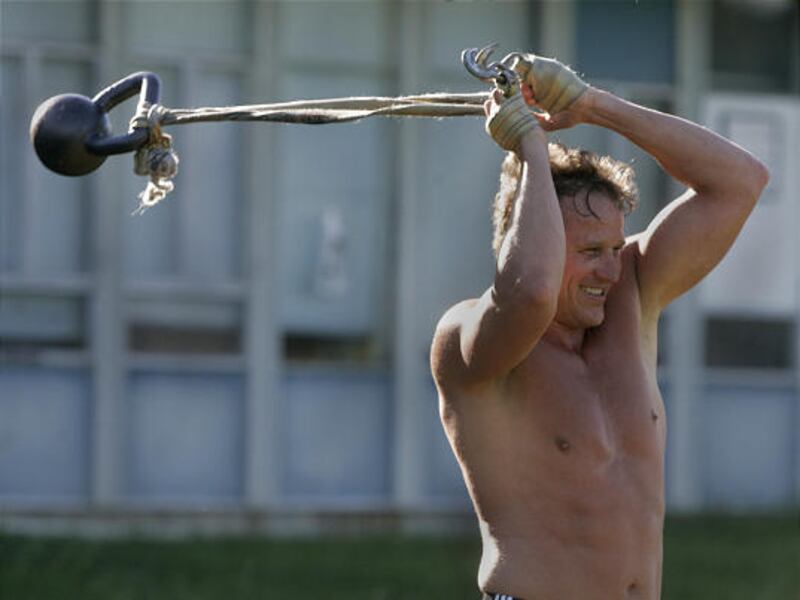
Other equipment he hauls there: kettlebells (old-style ball-shaped weights with handles), 4-foot logs with metal hand grips bolted to them, jump ropes and a sled with a chest harness.
Although Scott doesn't exactly direct the tire workouts, he doesn't mind being a motivator. Well into a recent 90-minute session, he noticed the collective energy was flagging.
"We're slowing down," he called out. "Keep moving."
"Corey, I'm done," said Frank Reardon, a 21-year-old accounting student.
"You've got another half-hour in you," Scott said. "You know, some of you were late."
John Plute, a 39-year-old database administrator and father of three from Kansas City, said the tire workout was a fresh alternative to the gym, which he has never really enjoyed. But he knows his limits.
"I don't go anywhere near that big tire," he said.
When Ashley Herman of Parkville, Mo., a 30-year-old director at a real estate company, saw the tires and the other equipment, her first thought was, "This could be interesting." She likes to take spinning classes and does some gym weight training. To her surprise, she felt capable at several drills, particularly at the tire pull.
"I held my own," she said. "It was fun competing against the tires. And it was fun, too, that I don't think I used any of the equipment the same way twice."
For now this is a gathering of workout friends and not a formal exercise class, but Scott is considering a tire class. A high school wrestler and former wrestling coach, he said "total body " or " functional " exercises improve the body's large muscle groups rather than focusing on isolated muscles. They also "confuse" and thus challenge the muscles more. And they burn a lot of calories, he said.
"And working isolated muscles is just not the way life is," he said.
In technical lingo, the body is made to function in three planes: sagittal, frontal and transverse. Or put another way: forward/backward, side to side and rotating. Many weight machines and free weight workouts and, of course, walking and running, are performed mostly "straight ahead."
Trainers are incorporating more functional workouts at gyms and health clubs, although traditional machines, treadmills and stationary bikes still take up much of the floor space. Trainers also offer total body regimens at indoor and outdoor "boot camp" classes.
Exercise tools, such as stability balls, can integrate rotating, jumping and body-stabilizing moves into workouts.
Justin Price, a San Diego functional fitness expert and author, highlights several pieces of equipment in "The Complete Idiot's Guide to Functional Training," which came out in December.
They include kettlebells; medicine balls; resistance bands; TRX, a system of suspended straps with handles and foot cradles; and BOSU, which looks like a cut-in-half stability ball with a platform on the flat side. The tools are found at many health clubs and are available at sporting goods stores.
Anyone beginning functional training should get a fitness assessment, Price said, and many people should start with exercises that use only one's own body weight. If you can't bend and twist without hurting yourself, you're not ready for more resistance, he said.
"Can you move in all three planes correctly before adding more stress?" he said.
To avoid injury, Scott, a "corrective exercise specialist," said the tire workout, like any exercise regime, should begin with what's easy. That's one reason for the array of tires, which range from "donut" spare tires up to farm machinery giants. Resistance should be increased slowly.
The other reason for the different tires: exercise variety. Ever throw a donut tire like a discus?
Scott enjoys the tires, sledgehammers and logs but knows a lot of people will prefer the kind of bending, rotating, jumping and stabilizing exercises he can put them through with functional exercise tools at his studio. Still, for him the "work" of the tire workout is a big part of the allure.
As a youngster on the farm, he and his brother hauled alfalfa bales, the old rectangular kind. Scott's brother was older and drove the tractor, which left him to do much of the lifting and throwing.
"I think that's what I love about the tires," he said. "It reminds me of regular work. It's just real strength."
(Learn more about fitness trainer Corey Scott at www.justmoveyourbody.com.)
©The Kansas City Star