

BONNEVILLE SALT FLATS — In the beginning, the thinking was the bigger the motor, the higher the speeds.
After 62 years of racing, owners and drivers who gather for the annual Speed Week on Bonneville Salt Flats are finding being "slippery" is just as important.
Slippery refers to an aerodynamically perfect car that can slice through the air like a knife … no lift, no drag, no resistance at all. All the power goes directly to the ground.
George Poteet of Memphis, Tenn., talked about his car, about being aerodynamically slippery and how because of it, he was able to get his streamliner upto a speed nearly seven times that allowed on a freeway — 436 miles per hour — with an engine, "half the size of those capable of similar speeds."
Terry Nish of Salt Lake City will try again to grab a record he's been chasing for more than a decade with an aerodynamic car, a big motor and, he hopes, a lot of luck.
There are two more speed trials scheduled this year on Bonneville where drivers can break land speed records. The first will be a private staging next week involving about a dozen high-speed cars. The second is the World Finals, Oct. 6-9, put on by the Southern California Timing Association.
Nish and team will be on the salt Sunday, making a run early Monday at a record of 409.27 mph set by the Summer brothers in 1965.
The brother team — Bob and Bill Summer — put together a streamliner with four 600 horsepower Chrysler engines, one engine for each wheel for a total of 2,400 horsepower. Each engine was naturally aspirated, meaning it ran without a power boost from a blower or turbocharger or supercharger.
Over the years, many drivers have targeted the Summers' record, and they've come close, but it still stands.
Nish will be running a naturally aspirated single engine capable of producing up to 1,800 horsepower. (See accompanying story.)
Poteet and partner, Ron Main of Chatsworth, Calif., will be among those on the salt next week. Their target speed is 450 mph.
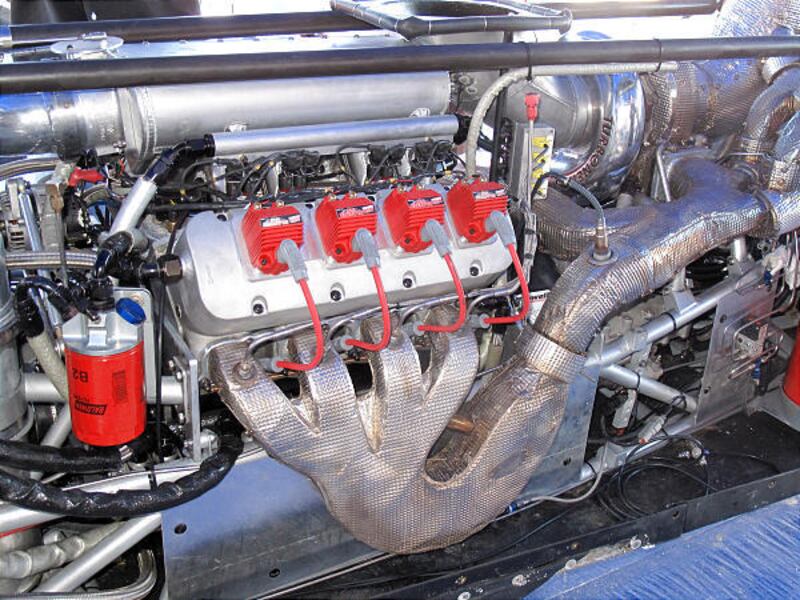
Poteet feels both his car and turbocharged engine are capable of those speeds. But it will take support from every piston, nut, bolt, hose, spark plug and valve. One failure and it's over.
On his record attempt last month during Speed Week, which had an entry list of more than 500 cars, trucks and motorcycles, a drive shaft released at 416 mph. "I didn't even feel the vibration when it broke," Poteet said. "The car has been on fire three times and I never knew it until I stopped. The car is that well designed."
Charles Nearburg of Dallas, Texas, will be entering the race next week going for a 409 record in his streamliner.
The car claimed high honors during Speed Week by posting a top speed of 404.56 mph.
A possible entry will be Lynn Goodfellow of Nevada. He came to Bonneville in 2008 to set a record for a diesel-powered car. He set a record of 314 mph, but at the end of the run, his streamliner caught fire and he was seriously burned. He's back in the racing game and said he may attend next week's event.
Although there were 192 new land speed records set during Speed Week, it took 2,852 run on three track and six days of racing to claim those records.
Owners and drivers know it doesn't take a major breakdown to turn a record run into a washout. It could be something as simply as a hose or a bolt or a spark plug.
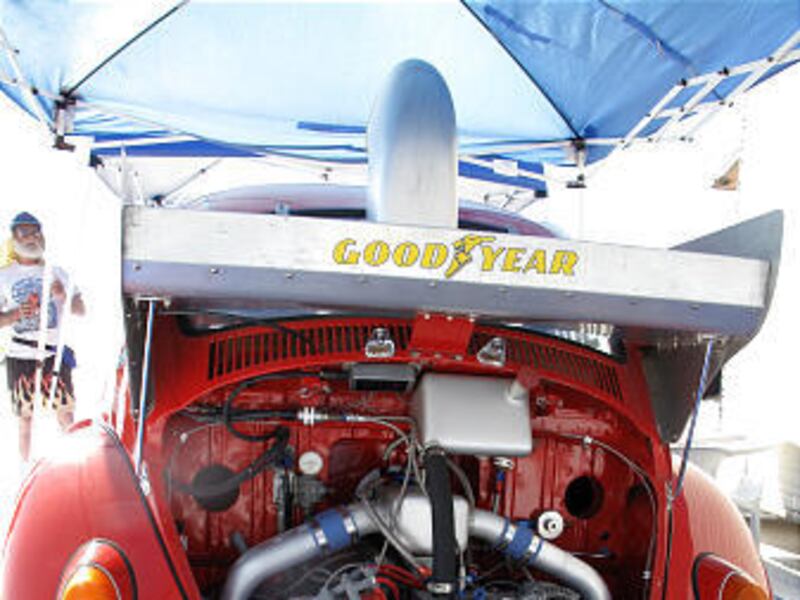
Bob Stahl of Huntington Beach, Calif., first came to the salt 17 years ago with a 1965 Volkswagen sedan. It had a 2 liter engine capable of turning out 19 horsepower. He came to the salt this year with the same car, but with what he believes "is the biggest VW motor ever built — 2,914 cubic inches that now produces 400 horsepower."
His target record is 173 mph. The car has turned 159 mph.
"I'm so close I can smell it," he said, shaking his head. "We had a little hiccup this year, but I'll be back. That's what it takes — perseverance, patience and, of course, money."
Rick Vesco of Brigham City, came to the salt this year with the same car his family built in 1957 and ran for years. In 2007, it was restored. The restoration involved "adding a bunch modern equipment. Little things."
The car turned a 349 mph run last year with a 371 small block engine, but last month small problems kept the car at a top speed of 329.
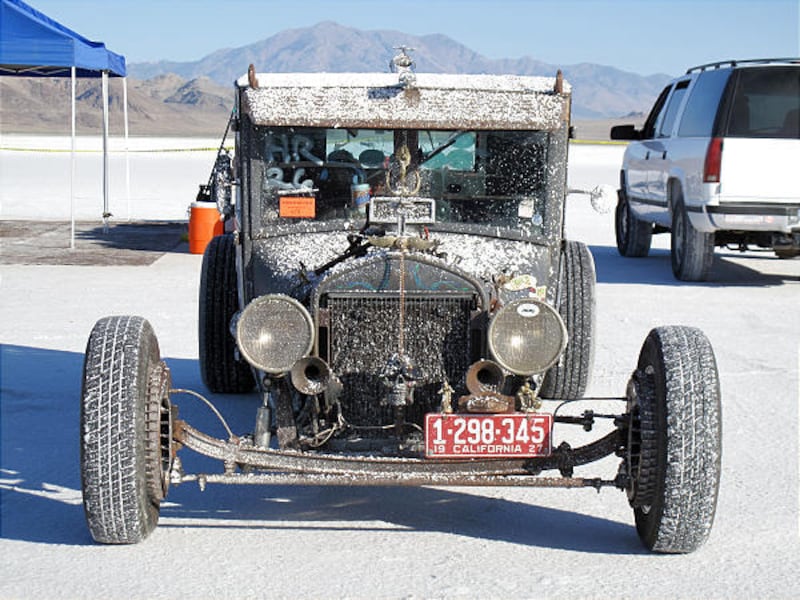
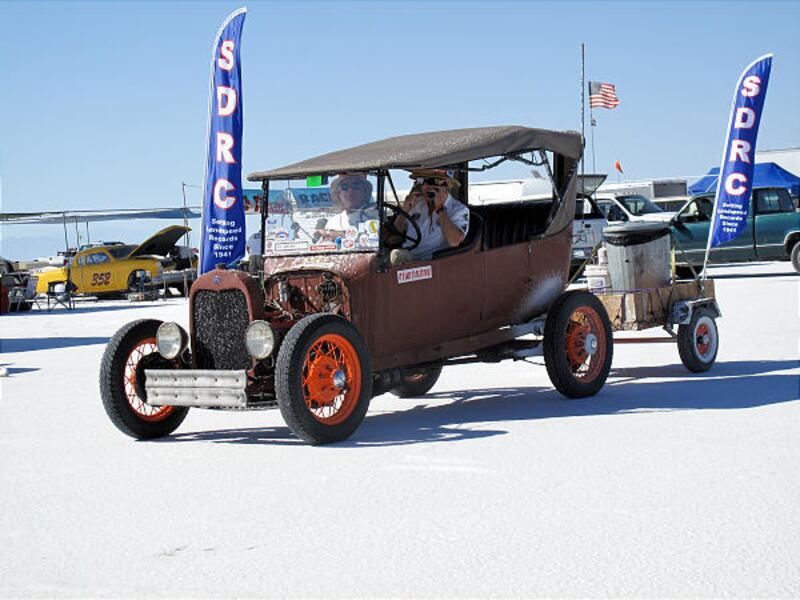
Pete Keyser of Massachusetts recalls sneaking a Hot Rod magazine into class back in the 1950s to read about Bonneville and land speed records. Six years ago he pulled his 1933 Plymouth with an old Ford flathead engine, as he recalled, "To live a dream and now I'm addicted. It's a spiritual experience. Think about it, I'm walking on the same ground as all my heros."
He came back with a larger engine, but found he couldn't compete so he went back to the old flathead, and "I'm having a ball." The record he's after is 152 mph. His top speed thus far has been 141.9 mph.
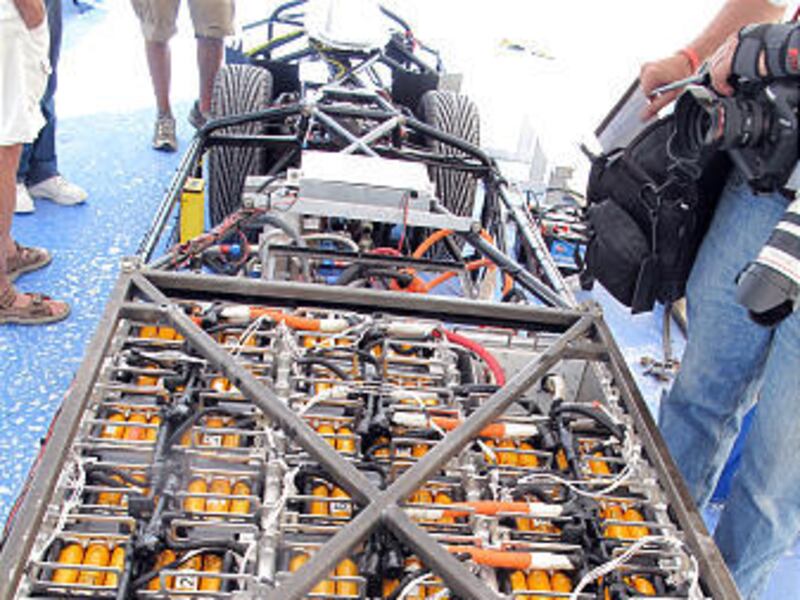
The Ohio State University engineering team chose to switch from hydrogen fuel cells to battery cells this year.
Scheduled to come next week, the engineering team chose to stay on after Speed Week and run its own event to trim travel expenses and test their electrically-charged streamliner. The Buckeye Bullet 2, under hydrogen power, topped 303 mph. The Buckeye Bullet 2.5, under electrical power, turned 317 in its one-car race. The record for the fastest electric car is 315.
"But this is only a test vehicle. It's the same vehicle, same suspension, same motor that we ran for three years under hydrogen power. We pulled out the fuel cell system and put in 1,600 battery cells. These are very powerful cells. The whole package system was designed by students. Students designed, developed and built the car," said Cary Bork, a mechanical grad student from OSU.
The battery cells produce 550 kilowatts that turn out close to 800 horsepower.
Bork said the roots for the electric car started about a decade ago with the Smokin' Buckeye electric Formula car that raced in the 1990s.
"And we're back to electric cars because that's the next big thing — electric technology," he added.
Every car that travels to Utah to run for a land speed record has a story of successes and failures.
The ultimate goal, of course, is a new land speed record. But owners and drivers knows that all the disappointments and failures eventually lead to one things — the satisfaction of a record.