


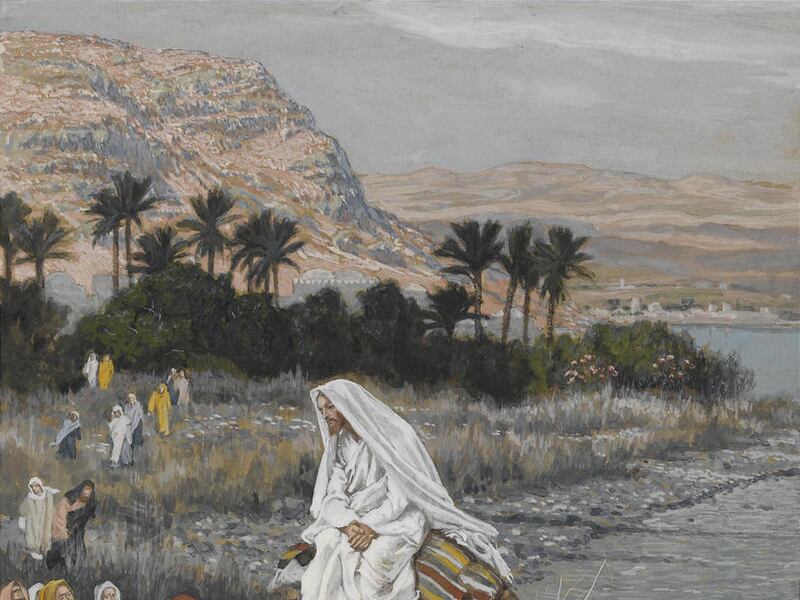
Born in 1836, the French artist James Tissot established himself early on for his depictions of Paris nightlife and women, as well as for his own very free, champagne-drenched lifestyle. In the 1870s, sometime after beginning a profitable 11-year residence in London, he met an Irish divorcee named Kathleen Newton, who became his mistress and the model for many of his paintings.
But "Kate" contracted tuberculosis. And, in November 1882, severely ravaged by the disease and unable to bear her lover's grief, she took an overdose of laudanum. She was only 28. Tissot sat by her coffin, inconsolable, for four days.
Returning to France, he launched a series of paintings that he called "La Femme ?Paris," or "The Woman of Paris." One day in 1885, "a Catholic more by courtesy than by conviction," he visited the Church of Saint-Sulpice. Not for worship, of course, but in order to sketch the women there.
At the point in the Mass when the priest raised the consecrated wafer, however, and to his complete astonishment, a vision burst upon him. Tissot saw Christ, bloodied but aglow, comforting two impoverished men in a ruined building.
The experience transformed his life and dramatically shifted his artistic focus.
Tissot commenced a 10-year project to illustrate "The Life of Our Lord Jesus Christ." He traveled to Egypt, Syria and Palestine in 1886-1887, and again in 1889, to research and sketch an area that had changed relatively little since the founding of Christianity. He was fortunate in his timing, and, because of his work, so are we. The Near East would soon be radically changed by the arrival of the railroad and, in the specific case of Palestine, by the rise of Zionism and the influx of Jews fleeing European anti-Semitism. (Tel Aviv didn't even exist yet; it would be founded in 1909.)
Tissot arrived not only as an artist, but as a pilgrim. Carefully avoiding so much as a glance at Jerusalem, he did not see the holy city until he had reached a specific point on Mount Scopus (near the location, today, of BYU's Jerusalem Center for Near Eastern Studies) that he had selected for his first view. Over the next years, he read the New Testament multiple times and immersed himself in biblical commentary, contemplating the life of Christ and his own relationship to the Lord. Some accounts seem to suggest additional visionary experiences that made him a witness, or, as he regarded it, an actual reporter of portions of the gospel story.
Three hundred and fifty watercolors resulted, chronicling Christ's life from his birth through his resurrection from the dead. Their meticulous accuracy is obvious to anyone who has spent time in the region. Earlier European artists had typically painted landscapes they themselves knew, which bore little resemblance to the real lands of the Bible. In their works, the Holy Family fled Palestine, which looked like Flanders or Tuscany, for Egypt via a route that appeared to lead through the Swiss Alps. Biblical figures often resembled Belgians dressed as Ottoman Turks. Tissot's characters, by contrast, were real Near Eastern Semites. As one writer said of Tissot's portrayal of the Savior, this was a Jesus who actually "wandered about the hot fields of Palestine, sleeping in the open air and living like a peasant"; he did not have the "peaches-and-cream complexion" and the "sleek golden hair" of many 19th-century depictions — portraits that, C.S. Lewis later complained, made Christ look like a "consumptive schoolgirl."
Some critics, struck by their careful attention to detail, have called Tissot's images unemotional. But the large numbers of ordinary people and even clergy who saw them during their first public exhibition in 1894 — everyday people and clerics rarely frequented Parisian art galleries in that period — plainly thought otherwise. Numerous reports survive of viewers weeping, kneeling before the images, of men removing their hats and gazing in reverent silence.
A free exhibit of 124 Tissot watercolors on the life of Christ continues through this Saturday on the lower floor of Brigham Young University's Museum of Art. It offers, for only a few more days, an opportunity not to be missed. And upstairs are some of the remarkable works of the Danish painter Carl Bloch, also devoted to the life of Christ.
Daniel C. Peterson is a professor of Islamic studies and Arabic at BYU, where he also serves as editor in chief of the Middle Eastern Texts Initiative and as director of outreach for the Neal A. Maxwell Institute for Religious Scholarship. He is the founder of MormonScholarsTestify.org.