

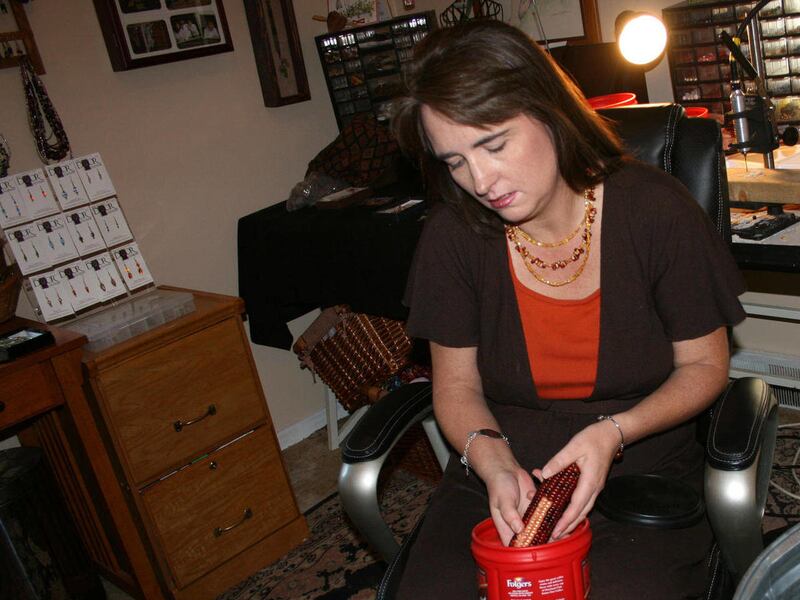
SIOUX FALLS, S.D. — Tara Barney doesn't think food, feed or fuel when she sees row after row of the corn South Dakota harvests each year. She thinks fashion.
Using corn kernels in a multitude of colors as beads, Barney creates necklaces and earrings to sell at stores and museums across the state and online.
"It pretty much embodies South Dakota," she said.
The state harvests more than 400 million bushels of corn each year, and boasts the Corn Palace, a tourist attraction known for colorful exterior murals made of corn and other grains.
Creating the corn jewelry, Barney said, is also a way to convert waste materials into something new or of better quality. Much of the colorful corn the Sioux Falls woman uses for her pieces was originally going to be fed to cattle. Barney contacted the farmer who grows the variety of colors for the Corn Palace in Mitchell and instead of giving his leftover to his livestock, he let her have it.
"It's grown, raised, picked, harvested, made all in South Dakota, and that's kind of a rarity," Barney said.
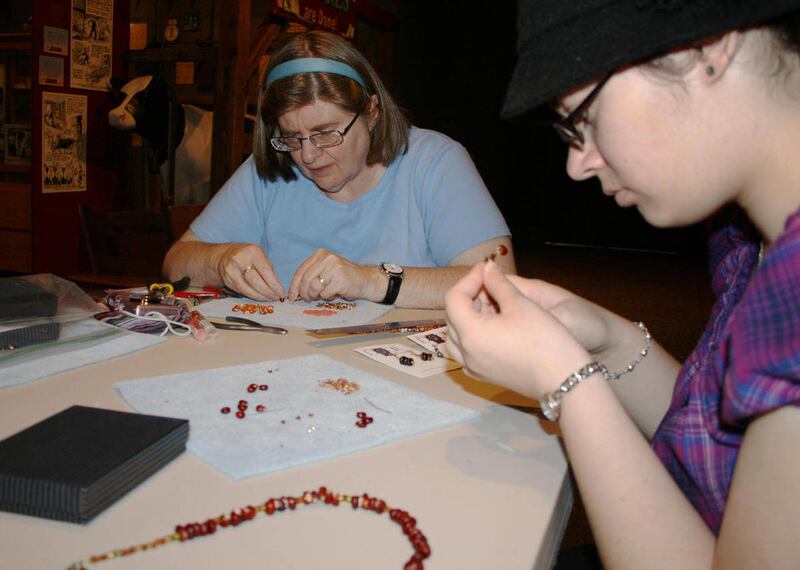
Barney starts by separating the kernels from the corncob. She then clips the sharp edges off the kernels and drills a role in each kernel before stringing them like beads. Many of her pieces combine kernels with contrasting glass or seed beads. Making one $20 necklace can take a lot of time and work, said Barney, who sells the pieces as part of her arts and crafts company, Red Door Creations.
Still, working with the colorful corn has a personal appeal. Barney's family used to grow it in their garden when she was growing up in South Dakota and Iowa.
Barney recently held a class at the South Dakota Agricultural Heritage Museum in Brookings to teach others how to turn one of the state's most abundant crops into a fashion accessory.
Carrie Van Buren, one of the museum curators, asked Barney to offer the class after learning about the jewelry.
"I mean, how much more agricultural can you get in South Dakota?" she said. "Combining agriculture and jewelry was just too much to resist."
For Dunnell, Minn., resident Heidi Scott, creating and selling jewelry made of corn is a statement of sorts. In addition to necklaces and earrings, Scott, who calls herself the Corn Woman, also makes bracelets and headpieces.
"My goal, I think, after Corn Woman was born, to me, was to try and ignite spiritually back into agriculture because it has gone from a spiritual-based practice to agribusiness," she said. "I'd love to be part of the transition to growing things that don't need so much herbicide and pesticides."
____
Online:
____
Kristi Eaton can be reached at twitter.com/kristieaton.