

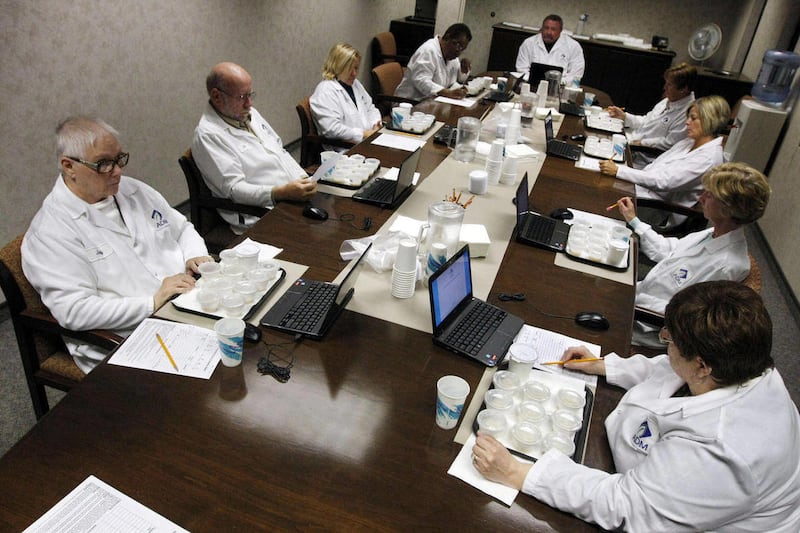
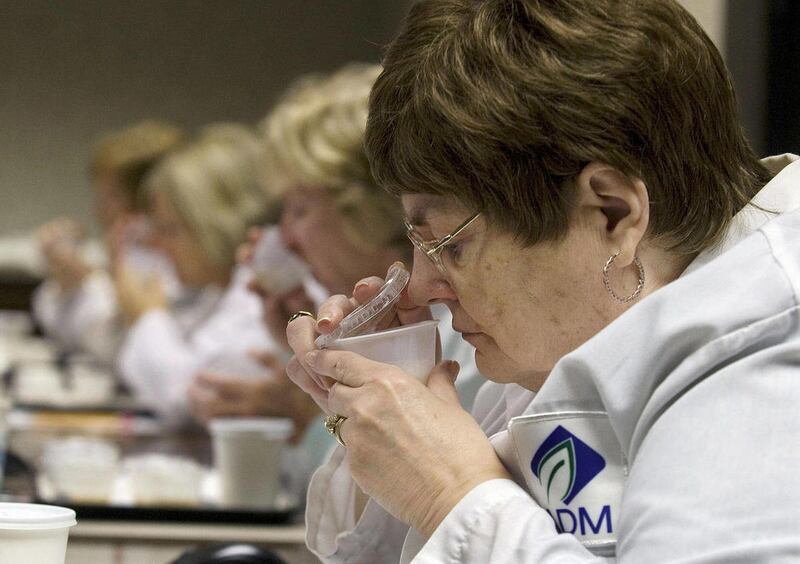
DECATUR, Ill. — The nine members of Archer Daniels Midland Co.'s quality sensory panel detected nothing significantly different in a blind control sample of soy protein isolate they tasted, nor did they have any trouble telling which sample was bad.
Soy protein isolate is an ingredient used in fortified snack bars and beverages.
"Seven-seven barnyard," Ann Kappenman of Mount Zion announced matter-of-factly, an assessment that was echoed to varying degrees around the conference table.
The first number indicates how much the sample being tasted differs from the control sample in smell, and the second number how much it differs in taste. The bigger the number, the bigger the difference.
Kim Hurm, research manager of sensory evaluation, said blind controls and bad samples, or "spikes," are randomly added to the mix as the panel does its work for much the same reason a musician tunes his or her instrument.
"We want to make sure they're detecting a bad sample when one's thrown in," Hurm said. "It's for training purposes - if they didn't get it, they could go back and retaste it - but also to make sure we're protecting our product."
If being a sensory panelist sounds like an interesting part-time job, you're in luck.
ADM is in the process of recruiting new panelists and estimates it needs to hear from at least 100 applicants to find the 20 it needs with the skills needed to do the job.
Good candidates must be able to detect small differences in aroma, flavor, texture and appearance and describe those differences. They're the kind of people who ask their families if they taste old oil flavor in the tortilla chips at a local restaurant, like tasting new foods and/or wines and enjoy trying to guess the scent of a candle before looking at its name.
They must also know how to use a laptop computer and have no food allergies, sensitivities or aversions.
Training in the vast vocabulary the panelists need takes three to six months, so it makes sense to recruit a bunch every two or three years, Hurm said.
Terms used by panelists, depending on what they're tasting, include "dairy," ''toasted," ''caramelized," ''vanilla," ''lemon," ''grain," and "packaging," in addition to "barnyard."
Hires will be added to the quality sensory control panel, which evaluates ingredients ADM produces daily to ensure they closely match a high-quality standard sample, or to a descriptive sensory panel that focuses on how various food products and ingredients differ in flavor, texture and appearance.
In describing the level of flavor in vanilla wafers recently, descriptive panelists used as reference samples juice from applesauce, which rates a 5 on a 15-point scale; orange juice, which rates a 7; and grape juice, which rates a 10.
"You don't worry about the sweetness or tartness or anything, just those specific notes," explained panelist Alex Wall of Decatur.
After tasting something with a stronger flavor than applesauce and orange juice, for example, those two things should taste like water if sipped immediately afterward. "We call it blanking against the scale," Hurm said.
Information from the panel helps ADM determine an ingredient's shelf life and how new ingredients enhance the sensory properties of food.
The descriptive sensory panel has eight members, ranging from between one or two years of service to nine years for Jolene Ison of Decatur.
ADM started its local sensory research program in 2000, with the arrival of Hurm, and has since hired two sensory scientists, four technicians who prepare samples for the panels and people for the two panels themselves, with the descriptive panel starting first and the quality panel about three years ago.
Panelists generally work up to three hours per day, five days a week between 9 a.m. and 3 p.m. Monday through Friday.
Because most applicants are female, the vast majority of current panelists are women.
Information from: Herald & Review, http://www.herald-review.com