

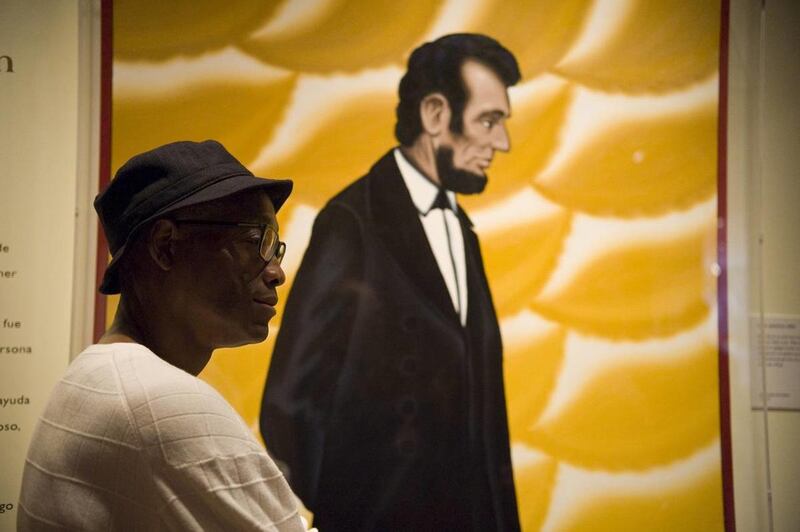
For its title, filmmakers selected a quote from Jones as he asks, "What does this good man have to say to us today? Are we good people? Am I a good man?"
Although theater is the most collaborative of the arts, a director must make a seemingly endless number of decisions as he mounts a new production. To be able to view this creative process would be an illuminating experience for anyone interested in the arts.
In the PBS documentary “Bill T. Jones: A Good Man,” airing Friday at 8 p.m. on KUED, viewers are offered this unique opportunity.
Bill T. Jones is not widely known outside of dance circles, but he is a legendary artistic director, choreographer and dancer. A co-founder of the New York-based Bill T. Jones/Arnie Zane Dance Company, Jones last year received Kennedy Center honors, and his Broadway choreography has earned him two Tony awards. He is also a recipient of a prestigious MacArthur Fellowship “genius” grant and was named “an irreplaceable treasure” by the Dance Heritage Coalition.
Filmmakers were given full access to the two-year development of the most ambitious work of his career, a full-evening dance event inspired by the life and legacy of Abraham Lincoln. The result is this entertaining 90-minute film.
Ravinia Festival, a popular summer concert series on the North Shore of Chicago, commissioned Jones to create an original dance-theater piece in honor of Abraham Lincoln’s bicentennial. His “Fondly Do We Hope and Fervently Do We Pray” premiered at the outdoor festival in 2009 and has since toured the country to much acclaim.
For its title, filmmakers selected a quote from Jones as he asks, “What does this good man have to say to us today? Are we good people? Am I a good man?”
The documentary includes a few brief scenes from the piece, but the development is the main focus here, beginning with the research process. Jones and his collaborators were invited to view Lincoln’s personal belongings at the Abraham Lincoln Presidential Library. The items include a pair of reading glasses and one of his trademark stovetop hats on which a white-gloved curator points out the wear made by Lincoln’s fingertips as he tipped the hat in greeting.
It’s one of many emotional scenes as the director struggles at the magnitude of the project and his individual respect for “the Great Emancipator.” Jones is haunted by stories about his own family history of slavery. In one conversation, Jones explains that as a child Lincoln was the only white man he “was allowed to love unconditionally.”
And it’s a no-holds-barred view. At one point, Jones is frustrated that the work is not progressing as he would like it to, and he storms out of the rehearsal. He returns the next morning and apologizes to the dancers and asks them for their continued patience as he “feels (his) way into making something out of nothing.”
“Bill T. Jones: A Good Man” was directed by Bob Hercules and Gordon Quinn, whose Kartemquin Films produced the highly popular “Hoop Dreams” that was first exhibited at the 1994 Sundance Film Festival, where it won the audience award for best documentary.
PBS' "Bill T. Jones: A Good Man" Preview
Program: American Masters
Episode: Bill T. Jones: A Good Man
The 90-minute film chronicles the intense creative journey of Bill T. Jones as he tackles the most ambitious work of his career and leads the Bill T. Jones/Arnie Zane Dance Company in the creation of "Fondly Do We Hope... Fervently Do We Pray, an original dance-theater piece in honor of Abraham Lincoln's bicentennial commissioned by Ravinia Festival.