

After my column on the nominating process for presidential candidates, I was asked about the nominating process in Utah, which is unique. Here's some history.
Political parties initially picked their nominees by means of conventions. Then, roughly a century ago, some states started replacing conventions with "primary" elections, so named because they preceded the "general" election. Voters in those states registered as members of the party of their choice in order to vote in that party's primary. The idea caught, on and primaries began to replace conventions in state after state.
But not in Utah. Because Utahns valued independence, they resisted the idea that they should be required to declare a party preference. Still, the idea of something more open and participatory than a convention was appealing. Could the differing views be reconciled? The attempt was made. Utah established a primary but kept the convention, the latter to be a screening device to determine both the number and identity of those whose names would be on the primary ballot.
Here's how the system worked:
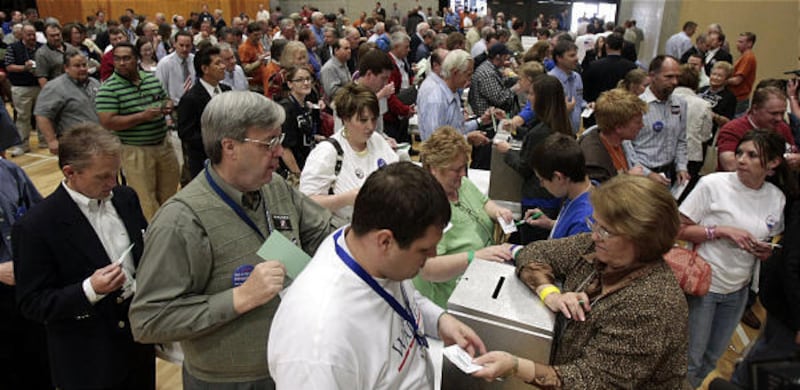
"Mass meetings" — today they are called caucuses — were held to select delegates to the state convention. Because there was no registration by party, a voter was free to attend any mass meeting he or she liked.
At the convention, if there were multiple candidates for a particular office, there would be a vote for the purpose of paring the list to two names. These would go forward to the primary. If there were only two candidates for a particular office, those names went forward without a vote. Whenever a nomination was contested, there would always (and only) be two names on the primary ballot.
That ballot was pre-formatted down the middle, with Republican candidates on one side and Democratic candidates on the other. After marking the ballot, a voter would tear it apart along the perforation and put one half — the one which he or she had marked — in the ballot box and the other half in the waste basket. No one ever knew for which party's candidates any individual had voted.
So, party activists at the convention determined two to be on the primary ballot, and primary voters determined one to be the nominee. It worked as described for decades. Then came some changes.
The convention was empowered to allow a candidate with overwhelming party support to skip the primary, even if he faced convention opposition. The measure of that support was initially set at 80 percent, then lowered to 70 percent and now stands at 60 percent. Then came multiple rounds of voting, where the names of those with less support are dropped off after each round, thus increasing the chances that one of the survivors will eventually reach the magic 60 percent. Even if the list has only two names on it, the convention votes to that end. This injects a bias towards convention choice rather than voter choice into the system.
When a primary does occur, the single, same-for-everyone-perforated ballot concept has disappeared; one must openly chose which party's ballot to take. Republicans require those who want one of theirs to register as Republicans, which makes the primary less attractive to independents.
Taken together, these changes have given us fewer primaries and lower turnouts. Polls show that a majority of Utahns don't like that, but many current office holders, who won under the present system, apparently do. A conflict between public opinion and office holders could set things up for a referendum if the issue becomes hot enough. It will be interesting to see if that will happen.
Robert Bennett, former U.S. Senator from Utah, is a part-time teacher, researcher and lecturer at the University of Utah's Hinckley Institute of Politics.