

GREEN VALLEY, Ariz. — Gayl Bernhardt chucked a hand grenade out of the open window of his Piper Cub airplane, praying it would hit its target before the North Vietnamese had the chance to shoot him down.
At just 500 feet, that was certainly a possibility. The Piper Cub isn't exactly known for its armor plating, and a well-placed spitball could practically have taken it out of the sky.
Bernhardt, then 28, was among the first forward air controllers to arrive in Vietnam in 1963, and he didn't have the luxury of a sophisticated rocket system until several months later. Until then, the Green Valley resident had one line of defense against the People's Army of Vietnam: his strong right arm.
It certainly wasn't the first time Bernhardt needed his right arm to come through in the clutch.
Recently inducted into Northern Colorado University's Baseball Hall of Fame, Bernhardt was one of the better pitchers in the Rocky Mountain Athletic Conference back in the late 1950s. Part of Colorado's "Big Three," Bernhardt helped his team to two straight appearances in the College World Series, in historic Rosenblatt Stadium in Omaha, Neb.
Even though the Colorado State Bears routinely dominated the local scene, they were very much a shoe-string operation. Bernhardt chuckles when making the stark contrast between the big school's luxurious locker rooms and training facilities to what he had access to with Colorado.
"You'd dress at home," Bernhardt said, "Then get in the car and drive to the baseball game."
But Bernhardt made the best of what he had, and performed admirably. His pitching helped lead the Bears to College World Series appearances in both 1957 and 1958, where they were promptly given a harsh awakening by schools with 10 times as many students, such as UCLA, Arizona, and Texas.
Even so, Bernhardt held his ground against the nation's finest collegiate players, and earned a spot in his school's Baseball Hall of Fame.
Bernhardt's road to baseball stardom began like many do, by playing catch with dad in the backyard.
"He's the one who really got me started with baseball," Bernhardt said. "Poor guy would work all day long on the railroad, and come home, go get the gloves, and out to the backyard we'd go and I'd pitch to him for at least a half an hour."
From lying about his son's age in order to get him in a more advanced little league, to jumping over the fence when a pitcher beaned him in a game, Bernhardt's father he did everything he could to make sure his son had the opportunity to live out his baseball dream.
Bernhardt made the most of his baseball career, and enjoyed every second of his time with Colorado.
Few people can claim to have pitched in Rosenblatt Stadium; Bernhardt's been there twice. Even fewer people can say they've pitched against future Major League Baseball players; the last pitch of Bernhardt's career induced a ground ball to second from Ron Fairly, who would go on to spend 21 years in the major leagues and play first base for the championship-winning Dodgers teams of the 1960s.
With regular trips to Omaha in June, and visits to New Mexico and Arizona in the spring, Bernhardt was certainly well traveled. But the mileage he racked up as a collegiate athlete can't compare to his adventures in the Air Force.
Bernhardt started his military career at Lackland Air Force Base in San Antonio, Texas. After spending a month in basic training, the Colorado native was shipped to Malden Air Force Base for pilot training, then sent back to Laredo, Texas for jet training.
On the heels of President John F. Kennedy's "Foreign Assistance Act of 1962," Bernhardt was among the first forward air controllers to be sent to Vietnam in 1963.
Though Bernhardt was in Vietnam before the Gulf of Tonkin Incident, lives were still being lost.
"People will say, 'You were there before things really got started,'" Bernhardt said. "Tell that to eight of our pilots who didn't come back."
Back state-side, things were just as precarious. Bernhardt's wife, Donna, was having complications with her pregnancy, and the consensus culprit was celiac disease. Bernhardt managed to get back home to give his family access to suitable medical care for the auto-immune disease.
He wouldn't be in the states long, but before his next assignment sent him back overseas, Bernhardt was given a front-row seat to one of the most important events of the civil rights era. Stationed in Alabama in 1965, Bernhardt was involved in protecting the hundreds of participants in the Selma to Montgomery marches.
"We were constantly in the air," Bernhardt said, "flying over them in case anything happened to them. It took about four or five days."
After stints in Alabama and later, in Indiana, Bernhardt managed to find his way to Libya in late 1966, where he would spend the next few years just miles from the biggest news stories of the decade.
Stationed at what used to be Wheelus Air Base in northern Libya, Bernhardt monitored the air during the Six-Day War between Israel, Egypt, Syria, and just about every other Middle Eastern country. In fact, the Libyans were so restless, Bernhardt's family were among the first air-lifted out of the country on a big C-130 military transport aircraft. Bernhardt stayed behind, and was in Libya on Sept. 1, 1969, when a military coup placed Muammar Gaddafi in power.
Gaddafi demanded that Wheelus Air Base be shut down, and the United States had vacated the facility by June, 1970. Bernhardt's rotation was up the previous December.
He then served in Korea for 13 months. Following his several years abroad, Bernhardt was assigned to Andrews Air Force Base, just eight miles outside of Washington, D.C. As the commander of the rescue unit, Bernhardt was responsible for escorting presidential arrivals and departures, transporting the President and other political figures — such as former Arizona senator Barry Goldwater, Secretary of Defense James Schlesinger, and General Alexander Haig — as well as supervising the search-and-rescue duties.
Finally, after 20 years of military service, Bernhardt retired to Colorado, where he would take up golf. Operating various golf courses across Colorado and Arizona, Bernhardt also found time to teach the sport.
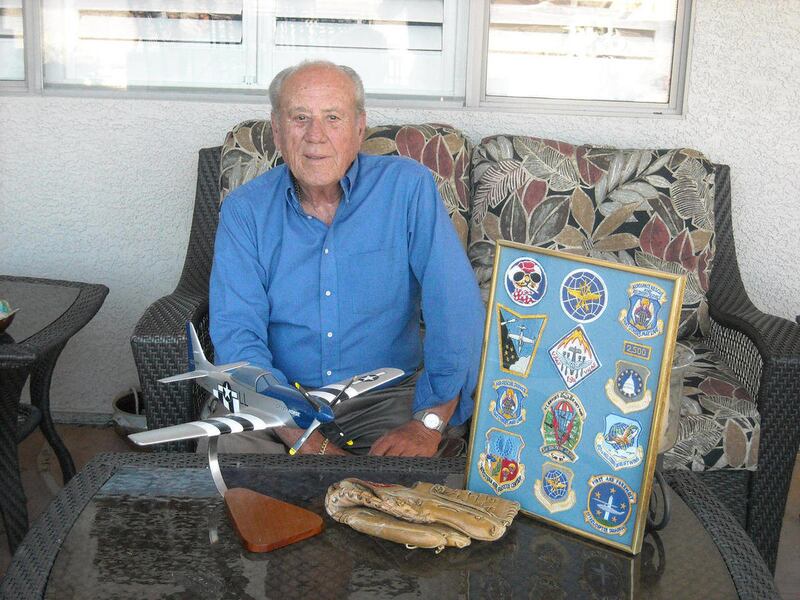
These days, Bernhardt's desk is littered with evidence of a lifetime of experience. Dozens of service patches, photos with Bob Hope, and models of his favorite aircraft line his wall and desk.
Also tucked away in his desk are flight simulator computer games, which surely fail to replicate the experience of searching the Mediterranean Sea for a lost fighter jet, escorting the president to Camp David, or flying around Vietnam tossing hand grenades out of an open window.
Information from: Green Valley News, http://www.gvnews.com