

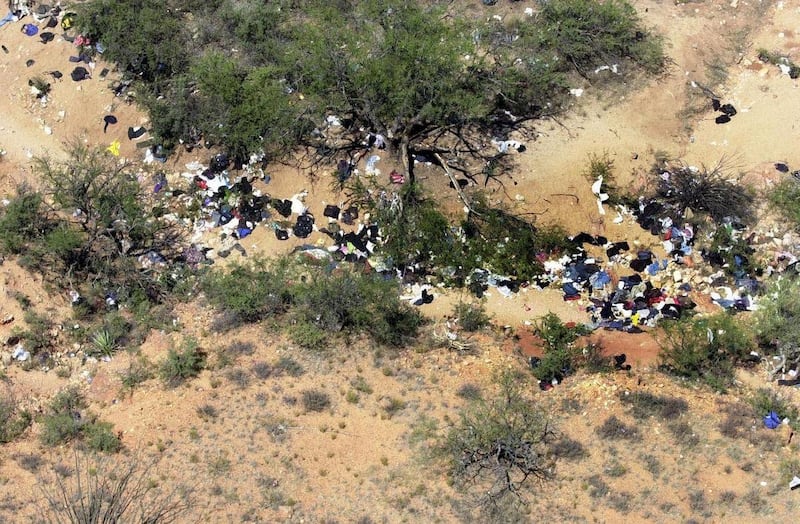
TUCSON, Ariz. — Sometimes weird things bring people together.
In Arizona, trash does just that.
Efforts to clean up the rubbish presumably left behind by illegal immigrants not only physically unites distinct groups — like the Pinal County inmates and dozens of volunteers who spent the morning of April 30 sprucing up Ironwood Forest National Monument — but also create an ideological common ground.
Karl Tucker, a long-time volunteer with Humane Borders, doesn't deny the complexities or divisiveness of the immigration debate. He said there's at least one offshoot of it that almost everyone agrees on, though - the trash is a problem.
"This trash thing people get," Tucker said. "Ain't it awful? Yeah, ain't it awful?"
Tucker helps pick up trash almost every week and said he thinks the problem has been alleviated a lot over the past decade.
Matt Skroch, who works for a land and wildlife conservation organization, agrees.
Skroch, executive director of Arizona Wilderness Coalition's Tucson office, called the scope of the trash removal over the past decade "absolutely amazing."
He credits the Southern Arizona Project, a federally-funded effort administered by the Bureau of Land Management, which was started in 2003 to curb the damages caused by illegal immigration and smuggling on Arizona's borderlands.
The project, which was championed by then Congressman Jim Kolbe and eventually approved by Congress, gave Arizona $695,000 to clean up its borderlands - an area that stretches about 100 miles north of the border. The project funding, which has to be re-allocated each year, has been raised fairly steadily since its onset. By fiscal year 2009, the funding was up to almost $1.14 million.
Its price tag isn't the project's only big number.
In fiscal year 2010, the Southern Arizona Project removed more than 255 tons of trash.
And the BLM's Deborah Stevens said it's not just small things, like water bottles and discarded photographs, that are picked up. In fiscal year 2010, 364 bikes and 77 vehicles were removed from Arizona borderlands. Bikes and cars are often used, and then ditched in the desert, by illegal immigrants and smugglers, she said.
The BLM designates money to county, city and tribal entities that are affected by illegal immigration, Stevens said, and the entities decide how to divvy up the funds.
The BLM also contracts with student conservation groups, who hire temporary workers to help coordinate and work at the trash clean ups.
Although the "visual intrusion" of trash piles gets most of the attention, Skroch said that's not the only negative result of people — often, but not always, illegal immigrants - trekking through the desert.
There's also the issue of habitat fragmentation, which he described as "the slicing and dicing of habitats by roads and illegal trails that crisscross the monument."
The BLM is taking steps to prevent this type of habitat fragmentation from happening - at least on federally protected lands. The agency recently put up about a mile of Normandy-style vehicle-barrier fencing to stop smugglers from driving around the Table Top Wilderness Area.
Another recent addition, partially funded by the BLM and run by the Arizona Department of Environmental Quality, is a trash-themed website, www.azbordertrash.gov. The site, which was started last fall and is still in its early phase, informs people of upcoming cleanup events and will eventually hold data and interactive maps from past cleanups.
As long as migrants trek thorough the desert, trash, too, will be a reality.
In the meantime, people like Tucker of Humane Borders, don't mind the tangible way to help out.
"In a way, it's a blessing for people to be able to feel that they're doing something positive.
Information from: Arizona Daily Star, http://www.azstarnet.com