

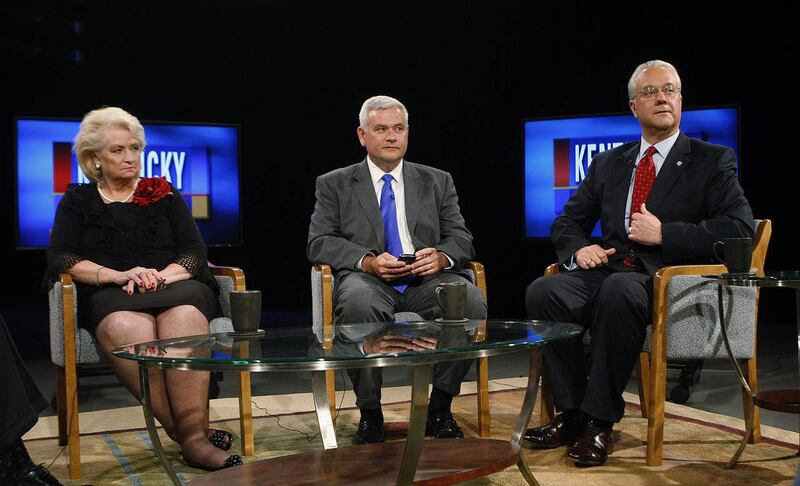
FRANKFORT, Ky. — Back-to-back debates revealed differences among Kentucky's three Republican gubernatorial candidates on Monday over proposals to expand gambling, ban smoking in public places, and restrict sales of some cold and allergy medications to curb meth production.
Trying to win favor with Kentucky conservatives, state Senate President David Williams, Louisville businessman Phil Moffett and Jefferson County Clerk Bobbie Holsclaw also lashed out at President Barack Obama on Monday. Each claimed to be the most electable in this fall's general election against a popular Democratic incumbent.
Obama is considered anti-coal, an unpopular position in a state where mining is a major employer, and the candidates stood in sharp contrast, voicing support on the campaign trail even for mountaintop removal coal mining, a controversial procedure that involves blasting away entire ridgelines to unearth the mineral.
Polls show Williams with a substantial lead in the three-way race, but with turnout predicted at a near record low, the Burkesville lawyer is leaving nothing to chance, having spent more than $1 million so far on the primary campaign. That's 10 times more than Moffett, the tea party candidate and the second leading fundraiser who banked $100,000.
Only about 15 percent of Kentucky's registered voters are expected to cast ballots in the May 17 primary, creating uncertainty in some quarters about polling results.
The candidates can count two groups — tea party activists and stalwart Republicans — to turn out. Both groups tend to be made up of the state's most informed voters, many of whom will have listened to or watched the gubernatorial debates.
In debates Monday on WLAP-AM radio and Kentucky Educational Television, Holsclaw claimed to be the most electable candidate in the general election, in part because the state's largest city, Louisville, is her political base.
"I bring conservative Democrats, independents and tea partyers with me," Holsclaw said.
Moffett and Williams both gave their own reasons for being the GOP's best chance of winning the governor's office. Moffett said his support among tea party Republicans makes him most electable while Williams said he has proven that he can stand up to the liberal agenda in Frankfort and that he can fund a competitive campaign.
"I think I've shown the ability to raise the money," said Williams, the GOP's leading fundraiser.
Midway through the debate, Moffett charged that Williams, who has served in the state legislature for about 20 years, was one of the architects of what he described as the state's failed educational system. Williams, who has been dubbed "the bully from Burkesville" by political foes, was clearly agitated by Moffett's charge.
"You're all hat and no cattle," Williams retorted to Moffett.
In the earlier radio debate, Williams was the only candidate who spoke in favor of a statewide ban, calling secondhand smoke a noxious substance that should be avoided.
"I consider it a matter of workplace safety," he said.
Holsclaw said smoking bans are local issues that should be decided at the county level, preferably through ballot referendums, while Moffett said individual business owners should make the call.
"If you own a business and you want to allow smoking in your business, you ought to be allowed to do so," Moffett said. "I don't think the state should really butt into our personal business."
Holsclaw stood alone in her support for expanding gambling in Kentucky, an issue that has received widespread debate over the past three years.
Democratic Gov. Steve Beshear had pressed for casino-type games in Kentucky to generate money for state government and horse tracks where wagering already is allowed on races. Williams has been a leading gambling opponent in the state legislature, refusing to allow the issue to be voted on in the Senate.
Moffett sided with Williams in opposing expanded gambling, though the tea party favorite suggested he may support an expansion if the legislature first passes his tax report proposal, which includes eliminating state income tax.
"You know, gambling is already in the state of Kentucky," Holsclaw said. "Some of this to me is kind of a silly issue. We have pull-tabs, we have bingos. We have a lot of different ways to gamble. I am not for making Kentucky into a Las Vegas by any means. But I think we should help our horse industry, and I think we should have expanded gaming."
Williams was the only candidate who said he favors requiring prescriptions for medications containing pseudoephedrine. Holsclaw and Moffett said that would cause hardships for cold and allergy sufferers.
In Kentucky politics, public television debates are considered key because they give voters a chance to see and hear the candidates the week before Election Day. The candidates' have been polished after months of campaigning. Williams repeated the refrain that Kentucky is adrift and needs new leadership. Moffett promised to rein in government spending and reduce the state's debt. And Holsclaw lamented the political gridlock in Frankfort, saying she will bring leaders together for the good of the state.
The winner of next week's primary in the fall will face Beshear who is proving to be a political dynamo despite having taken office in the midst of an economic recession that forced more than $1 billion in budget cuts. He has already raised $5 million for his re-election bid.
Beshear spent $9.7 million in his 2007 race.
In a report filed Monday with the Kentucky Registry of Election Finance, the Beshear campaign reported raising another $200,000 just in two weeks in April.
Beshear campaign manager Bill Hyers boasted that Beshear banked nearly three times the amount raised by Williams, the best-funded Republican. Williams reported raising $77,000 for the same two-week period.
In addition to the GOP primary winner, Beshear will face independent candidate Gatewood Galbriath, a Lexington lawyer.