



BEDFORD, Va. — The granite arch is 44 feet, 6 inches tall.
That stands for the date: June 6, 1944.
The word Overlord appears on the arch.
That was the code name the Allies gave for the World War II operation that became the amphibious and aerial invasion of Hitler's Fortress Europe.
Even the concrete on the pedestrian walkway is poured to resemble waves on the French beaches.
Welcome to the National D-Day Memorial that rises at the edge of the Blue Ridge Mountains in western Virginia to honor the legacy of June 6, 1944.
Tiny Bedford, then a community of 3,500, suffered the heaviest D-Day losses per capita in the United States; 21 soldiers from Bedford were killed on the beaches of Normandy, 19 of them within 15 minutes on Omaha Beach. Fourteen other Bedford men were wounded on D-Day.
Those soldiers, forever remembered as the Bedford Boys, served in the Army's Company A, 116th Infantry Regiment, 29th Division. They had been in the National Guard, were activated and were among the first Americans to land on D-Day.
The Bedford Boys, along with others who fought on the five French beaches, are honored today at the 88-acre Virginia memorial.
A total of 160,000 Allied men and women were involved in D-Day along 50 miles of German-held beaches, in addition to 24,000 airborne troops. It was the largest air, land and sea military operation in the history of modern warfare and included 5,000 ships and 13,000 aircraft.
Construction of the memorial began on Veterans Day 1997 in Bedford, now a community of 6,350. The $25 million complex was opened and officially dedicated on June 6, 2001, by President George W. Bush.
It was dedicated to memorialize "the valor, fidelity and sacrifice" of the Allied forces, and to assure that future generations will remember and learn from D-Day. The privately funded memorial gets about 75,000 visitors a year, or 1.3 million since it opened, said April Cheek-Messier, director of education.
Much of the credit for building the memorial in Bedford goes to John R. Slaughter, a D-Day survivor from nearby Roanoke.
He was upset that there was no national D-Day monument. He proposed Bedford, but the idea went nowhere until the 50th anniversary of the invasion, when Slaughter and two other survivors accompanied President Bill Clinton to Omaha Beach.
Bedford donated the land and Slaughter persuaded historian Stephen E. Ambrose to chair the foundation's board of trustees. Director Steven Spielberg's hit movie "Saving Private Ryan" sparked additional interest, and the fundraising campaign was headed by Peanuts cartoonist Charles M. Schulz, a World War II veteran. He personally donated $1 million.
The Bedford memorial is divided into plazas that tell the story of the invasion. It is a somber, emotional and educational tribute. There are memorials to the landing troops, sailors and aviators.
Visitors can enter the memorial a number of ways, but there is a preferred chronological route. It starts at the English garden, representing where the D-Day invasion plan was drafted and polished in England.
A life-size statue of U.S. Army Gen. Dwight D. Eisenhower stands in a rotunda. The head of the Allied invasion force is flanked by bronze busts of his chief aides.
The garden is patterned after the Supreme Headquarters Allied Expeditionary Force uniform patch. Its sword shape is aimed at Elmon T. Gray Plaza, which is designed to symbolize crossing the English Channel and the beach landings.
Bronze plaques list the names of those who died on D-Day on the sides of the central plaza. There are 4,413 names: 2,499 Americans and an additional 1,914 Allies.
The most impressive section of the D-Day memorial is the stylized invasion tableau with striking bronze sculptures on the wide-open, beachlike central plaza.
It features a single empty granite Higgins landing craft with an open front gate at the edge of a pool of water running up to a beach.
Three bronze statues show soldiers in the water and on the beach: One represents valor; a medic represents fidelity; and one lying dead on the sand represents sacrifice.
Jets of air from the bottom of the pool mimic German gunfire. Two metal hedgehogs, German-created obstacles, defend the beach.
At the rear of the beach, a concrete wall suggests the Germans' heavily fortified Atlantic Wall. Bronze soldiers are climbing the fortification in another sculpture.
The sculptures by Kansas-based artist Jim Brothers are titled Through the Surf, Death on Shore, Across the Beach and Scaling the Wall.
Above the wall is the top plaza with the giant Victory Arch.
The main arched monument is flanked by the flags of the 12 Allied nations involved in the D-Day invasion. A reflecting pool is nearby.
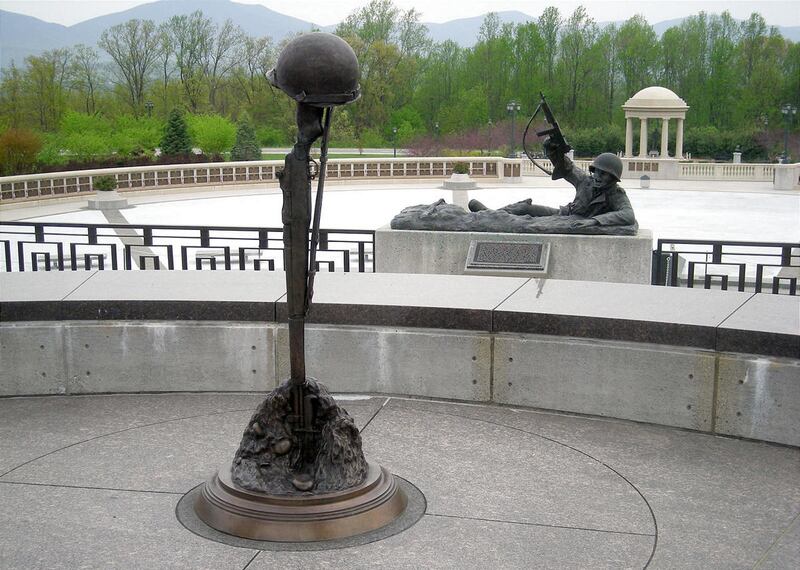
Final Tribute is the sculpture that honors the Allied troops who died. It includes an inverted rifle and helmet.
Above the monument is the Stettinius Parade, named after former U.S. Secretary of State Edward Stettinius Jr., who played a key role in the creation of the United Nations. It symbolizes the liberation's expansion from the Normandy beaches to freeing Paris and defeating Hitler. The Purple Heart Monument stands nearby honoring all who earned that award.
Officials have said the Bedford memorial is having major financial problems.
Attendance dropped sharply in 2010 because of bad winter weather, the poor economy and since-rescinded Monday closings, officials said.
The nonprofit group that owns and operates the memorial also found itself at the center of a political furor last year. The National D-Day Memorial Foundation added a bronze bust of Russian leader Josef Stalin to note his role in the D-Day invasion, a move that triggered heavy criticism.
The National Park Service is preparing a report that will assess whether the memorial could become part of the federal park system to ensure its continued operation. The study will probably take two years.
Memorial officials in 2009 sought federal financial help for its long-term sustainability, but officials are looking at all options, said Cheek-Messier.
Distributed by McClatchy-Tribune Information Services.
National D-Day
Memorial
Tours: Memorial hours are 10 a.m. to 5 p.m. daily. Officials say visitors can see the memorial in one hour but should plan on spending about two hours to fully take in the sights. The best time to visit is from April through October.
All guided walking tours are an additional $3 for adults and $2 for students. Walking tours are offered at 10:30 and 11:30 a.m. and 12:30, 1:30, 2:30 and 3:30 p.m.
Tours begin in the military tent on the edge of the grounds. It is filled with World War II artifacts, weaponry and memorabilia.
Tickets for guided and self-guided tours must be purchased at the adjoining Bedford Area Welcome Center, 816 Burks Hill Road, Bedford. Admission is $7 for adults and $5 for students 6 to 18.
Other features: You can dial into an audio tour on your cellphone. There is no charge except your minutes.
Special activities are provided for children 4 to 12 years old. Shuttle carts are available to transport the disabled for an additional fee.
More information: contact the National D-Day Memorial Foundation at P.O. Box 77, Bedford, VA 24523; 800-351-DDAY or 540-586-3329; www.dday.org. The memorial is near state Route 122 and the U.S. 460 Bypass on Bedford's southwest side.
Bedford tourist information: Call 877-447-3257 or check www.visitbedford.com.