

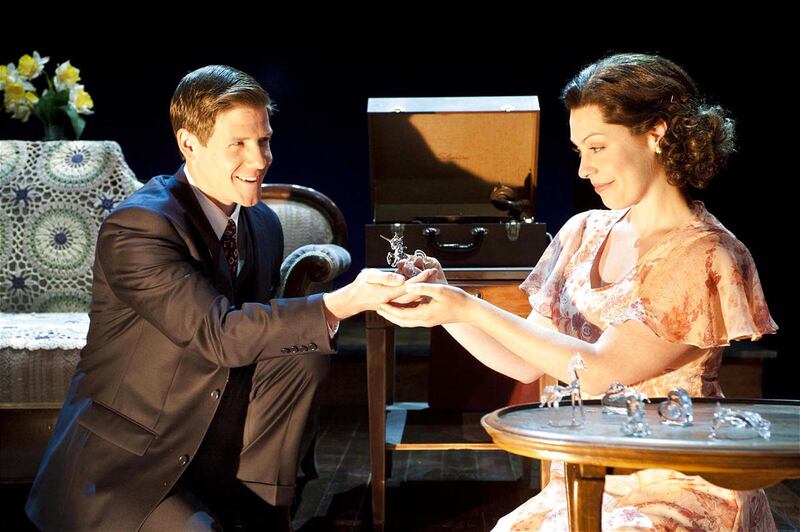

We all live in denial about ourselves and our family members. That is just one of several relevant messages for today's audiences in the Utah Shakespeare Festival's production of Tennessee Williams' "The Glass Menagerie".
This year marks the 100th anniversary of Williams' birth. He is considered possibly the greatest American playwright and perhaps the most accomplished in the English-speaking theater world.
What is both intriguing and heartbreaking about this play is it's an autobiographical view of a family trapped in poverty and teetering toward madness.
The play takes place in St. Louis in 1937. It opens with Tom Wingfield, the young storyteller. He talks to the audience of who he is now and how he chose a different life a few years back. Then he takes us inside his former life. Tom works a thankless, low-paying job in a shoe warehouse to support his mother, Amanda, and sister, Laura. His father left the family years before. They live in a rundown apartment building.
After dinner, Amanda, once again, tells the tales of her youth as a much-sought-after Southern belle. Her nonstop talking, narcissistic narrative is her escape. Her daughter, Laura, disabled both physically and emotionally, has no prospects for a gentleman caller and spends her time daydreaming with her glass figurines. Amanda becomes even more distraught when Laura secretly drops out of business college.
Tom, a would-be writer, is so frustrated by his domineering mother and saddened by his sister's life that he escapes to, as he puts it "the movies" but it is likely to bars. His arguments with his mother escalate and Tom accidentally breaks some of his sister's prized possessions. To make amends, he promises his mother he will bring an acquaintance from work to dinner to meet Laura. She is so painfully shy she makes herself sick with worry, especially when she realizes she had a crush on this gentlemen caller, Jim, in high school.
Tom confides in Jim that he plans to leave his family and join the Merchant Marine and see the world. He admits to Jim that he used money intended for the electric bill to enlist. When the lights go out, Amanda uses candles and Jim and Laura finally settle into comfortable conversation. Is there hope?
Ben Jacoby plays Tom very believably. You feel his frustration and yet want to stop him from making things worse. As Amanda, Demetra Pittman is pitch perfect at times and others not. I kept wondering whether another look — hairstyle and clothing — would have made a difference for her and me. I wanted more of the genteel side. Sara J. Griffin brings lovely moments as Laura but her pacing in some scenes seems too slow. She and Jeb Burris, as Jim O'Connor, share a dance that will bring both a smile and tears.
This was my not my favorite production in this 50th anniversary season as I am still struggling with choices from actors and designers, but I hope you see it because the play is an American classic; overall, it is well done and I like to believe we go out of our way to find good theater.
Festival founder Fred Adams told me that they first produced this play in 1989 as the beautiful, indoor Randall L. Jones Theatre opened. But few came to see it. He believes audiences should have the opportunity to watch performances of and listen to the words of, as he calls them, "Shakespeares of other lands and times" … in this case, our own.