

According to an early story, a despairing mother whose little boy had died once came to the Buddha, begging him to restore her son to life. The Buddha told her to go about the town collecting mustard seeds. But she was to do so only from houses in which nobody had ever died.
Hopeful, she set about her task. But she found only disappointment, because each house had seen a death. Finally, she returned to the Buddha without a single mustard seed. Now she understood that death was universal and inescapable. And, though still sorrowful, she had come to accept it.
The simple, unavoidable fact is that we all will die. And all those whom we love, and every thing that we love, will also die. All earthly relationships end in death, if not before.
When you hear the funeral bells ring, the English poet John Donne said, "send not to know for whom the bell tolls: It tolls for thee." And, he might have added, for thy family and friends.
Shakespeare's Hamlet recognized death's inevitability: "If it be now," he said, "'tis not to come; if it be not to come, it will be now; if it be not now, yet it will come: the readiness is all."
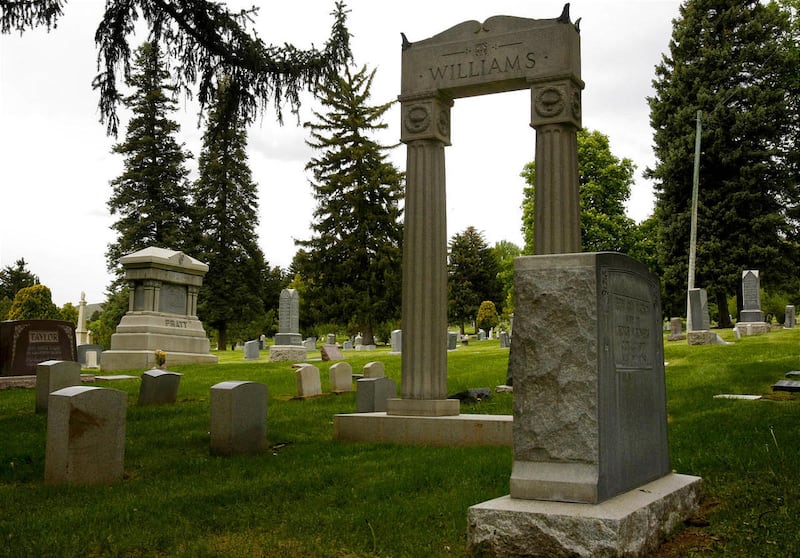
For this reason, an entire genre of art exists called "Memento mori." The Latin phrase means "Remember your mortality" or "Remember that you will die." Some religious traditions have even encouraged meditation in cemeteries as a way of remembering that death cannot be avoided.
On the other hand, many of us energetically (and fairly successfully) try to avoid reflecting on our mortality. "I'm not afraid to die," Woody Allen said. "I just don't want to be there when it happens."
Some, of course, will respond that this life is so wonderfully good that it is enough, and that we should simply enjoy the moment without worrying about a mythical afterlife.
And, indeed, life can be and often is, for many lucky people, very good.
"If there were a God," one supremely complacent atheist reflected during an online discussion about a decade ago, "I think (s)he'd enjoy hanging out with me — perhaps sipping on a fine Merlot under the night sky while devising a grand unified theory."
But, for many, life isn't wonderful. And, for virtually all, it's punctuated (and often ended) by moments of terrible pain and acute sorrow. If there is no redemptive life after death, viruses, child murderers, gross physical deformities and random accidents — not to mention history's Hitlers and Stalins — have had the last word in billions of lives, and will continue to have it.
The great John Henry Cardinal Newman made this point poignantly with the words of a dying factory girl from a once-popular story:
"I think if this should be the end of all, and if all I have been born for is just to work my heart and life away, and to sicken in this dree place, with those millstones in my ears for ever, until I could scream out for them to stop and let me have a little piece of quiet, and with the fluff filling my lungs, until I thirst to death for one long deep breath of the clear air, and my mother gone, and I never able to tell her again how I loved her, and of all my troubles, — I think, if this life is the end, and there is no God to wipe away all tears from all eyes, I could go mad!"
Historically, most of the human race has lived like the dying factory girl, not "sipping a fine Merlot under the night sky." Beyond a relatively small number of privileged places, her story typifies much human experience even today.
None of this proves that there is life beyond the grave. Shakespeare's MacBeth thought life was "a tale told by an idiot, full of sound and fuy, signifying nothing." But such reflections illustrate very starkly why the claims of religion matter.
Prophets ancient and modern declare that MacBeth was wrong.
Be still, my soul: the hour is hast'ning on
When we shall be forever with the Lord.
When disappointment, grief, and fear are gone,
Sorrow forgot, love's purest joys restored.
Be still, my soul: when change and tears are past
All safe and blessed we shall meet at last.
Daniel C. Peterson is a professor of Islamic studies and Arabic at BYU, where he also serves as editor in chief of the Middle Eastern Texts Initiative and as director of outreach for the Neal A. Maxwell Institute for Religious Scholarship. He is the founder of MormonScholarsTestify.org.