

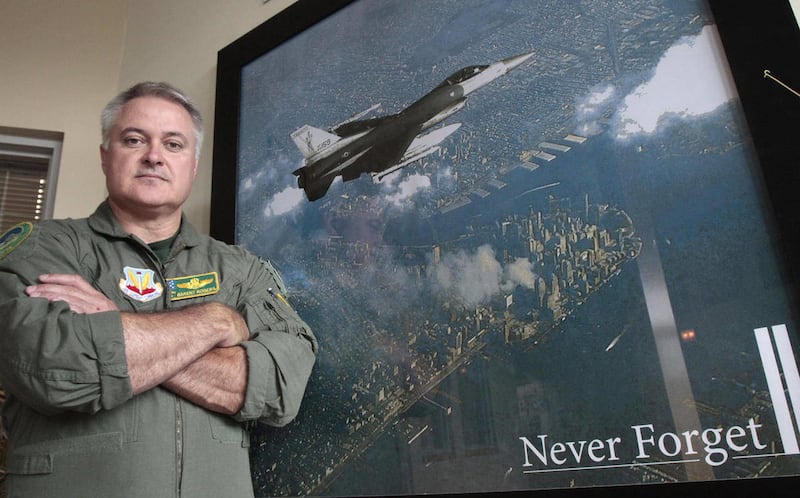
MONTPELIER, Vt. — The photo of a Vermont Air National Guard F-16, the decal of a Revolutionary War-era Green Mountain Boy holding a musket clearly visible on the tail, flying over the burning ruins of the World Trade Center was taken with a simple camera, yet carried great meaning for many.
For the Vermont Air National Guard, Vermonters and countless others across the country, the September 2001 image of the plane, live air-to-air missiles on its wings, offered instant comfort to many still reeling from the shock of the terrorist attacks that killed nearly 3,000 people in New York, at the Pentagon and in Pennsylvania.
During 2001 and 2002 the photo was one of the most downloaded images from military websites and it appeared on front pages of newspapers across the world, said Lt. Col. Lloyd Goodrow, the Vermont National Guard public affairs officer who had to get special permission from the Department of Defense to release the image at a time when the details of military operations in response to the attacks were still secret.
"That picture became very, very famous," Goodrow said. "It says 'We're here, we've got your back, don't mess with us.' It was also an incredible symbol of reassurance."
The pilot of the plane in the photo, Vermont Air National Guard Lt. Col. Barent Rogers, a major on 9/11, said Friday he didn't see the photo, taken on the afternoon of Sept. 12, until it was shown to him on the front pages of newspapers later in September.
"It was a terrible moment in American history, but a proud response for the Vermont Air National Guard," said Rogers, himself a victim of an Al-Qaida terrorist attack.
In 1996, while serving in the active duty Air Force, Rogers said he was thrown out of bed and injured when a truck bomb destroyed the Khobar Towers housing complex in the Saudi Arabian city of Dhahran, killing 23 American service members.
"I experienced firsthand a terrorist organization trying to kill you," he said.
He was on a training flight on the morning of Sept. 11, 2001, when he received the unusual order to return to base shortly after takeoff. At first, ground controllers wouldn't say why. Then, he was told the country was under attack.
Even before receiving orders to fly, Vermont Air Guard personnel had begun arming their planes, knowing the order was coming. When the order did come early that afternoon, Rogers and another pilot were in the air over New York City within minutes.
That first day he flew seven hours, refueling his plane in the air every hour or so. They spent the time over New York shooing away from city landmarks civilian aircraft that weren't supposed to be in the air.
It was the next afternoon, on his second mission over New York, that Rogers' wingman, now Lt. Col. Terry Moultroup, took the picture with a disposable camera. Each pilot was taking pictures.
When they got back to the Vermont Air Guard base in South Burlington they gave their cameras to intelligence officers.
Goodrow said he saw the photo within a few days and then sought permission to release it. Goodrow first released the photo to The Associated Press. Concord, N.H.,-based photographer Jim Cole took the image and prepared it for distribution. He said he instantly knew how powerful the image was.
"We were at a time when things were eerie in the sky and here's this Vermont Air National Guard plane helping," Cole said. "It has all the elements it needs. It shows what's going on, it's composed well. It does what a photo is supposed to do."