

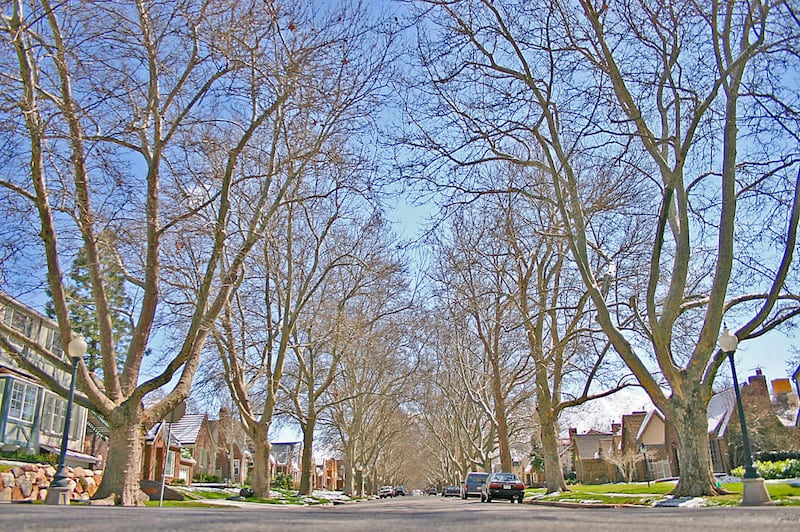
When the Mormon pioneers came to the Salt Lake Valley, Brigham Young ordered black locust trees planted around the many streams in the valley. Black locust trees were preferred because they are insect- and rot-resistant. The family who deeded Yalecrest's Miller Park to Salt Lake City also planted many of the trees in the park. Tree planting was an important part of preparing Utah to be an inviting and resource-rich area.
Recently, hundreds of old trees were cut in Miller Park around Red Butte Creek. The tree cutting was due to a riparian restoration project whose goal was to remove so-called invasive trees in the park and return the area's foliage to pre-pioneer times. Trees that were considered to be invasive and cut down were the black locust, the Siberian elm and the tree of heaven. After the 2010 Red Butte Creek oil spill, many birds and raptors abandoned the area. They were just starting to return. The park's fans will have to wait for several more years to see if the large-scale cutting of trees will encourage most birds to return.
The oil spill prompted compensation from Chevron Oil Company. The money had to be spent by this year. Unfortunately, in the rush to spend the money, most of the residents adjacent to the park were left out of the discussion on the changes that were planned. These neighbors were almost all against cutting the large trees that provided one of the best urban forests in the state. Many of the residents were also upset about the loss of privacy: they can now see across the park to the other side.
Much of the park's urban-oasis character was changed by the drastic cutting of large trees. The city is planting many small trees and bushes to replace the old-growth trees in a "restoration" effort. But the replacement trees are just 1 or 2 feet tall and won't be able to replace the older trees for decades.
It seems hypocritical for Salt Lake City to cut hundreds of old-growth trees and at the same time hire an urban forester. The Salt Lake City Council also recently passed an ordinance to protect old trees from being cut down when developing property but ignored protests against the tree cutting in Miller Park.
Trees can have a significant beneficial impact by reducing air pollution (according to a recent Forest Service study) and by cooling adjacent areas. Trees, especially old-growth trees, provide a shady urban oasis and an important cooling offset to Salt Lake City's high-density neighborhoods.
The mayor of Salt Lake City should not claim to be environmentally friendly at the same time that he cuts hundreds of old trees. Hopefully, the protection of old-growth trees will be more important in the future in Salt Lake City. In the meantime, parkgoers will have to be satisfied with the munchkin trees of Miller Park.
Miller Park is still a beautiful park. It is still an inviting area. I encourage Salt Lake City residents to take a walk in Miller Park when it reopens (by the end of the year).
George Chapman is vice chair of Friends of Miller Park. He can be reached at 801-867-7071.