

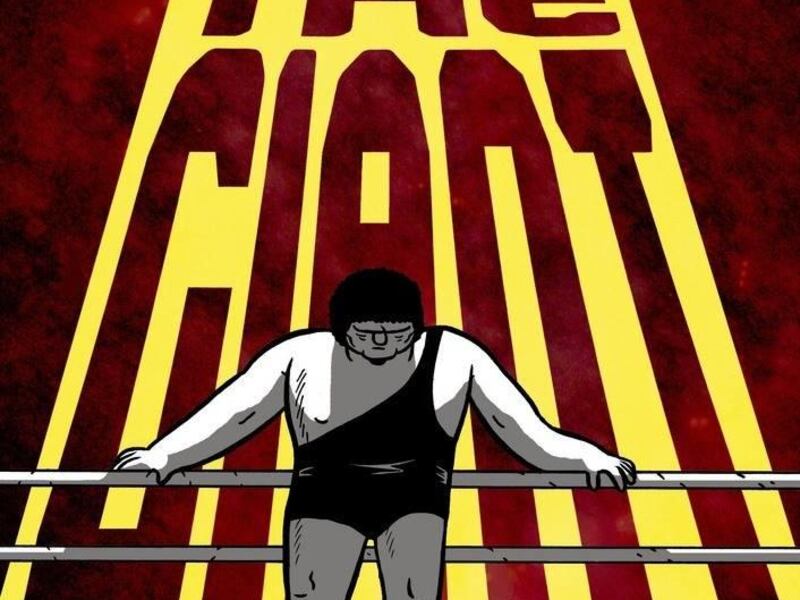
"ANDRE THE GIANT: Life and Legend," by Box Brown, First Second, $17.99, 240 pages (nf)
Graphic novels can sometimes tell a story more clearly and powerfully than words alone. Box Brown’s “Andre the Giant: Life and Legend” does this by creating potent vignettes. The stories of Andre Roussimoff’s life are edited and commented elegantly like poetry. Paired with clear, minimal drawings (a la Marjane Satrapi’s “Persepolis”), the effect is both captivating and entertaining.
Growing up in France, Andre never really fit in — literally. He had acromegaly, a condition in which a person has too much growth hormone, and at 7-foot-4, he eventually weighed 500 pounds. With his size and skill, he became a star professional wrestler.
This is where the book gets interesting. Brown exposes the mechanics and managing view of professional wrestling, the parallel world in which Andre existed.
While fans in arenas cheered Andre on, he appears to have had rare meaningful connections. He frequented bars and talk shows, but he was mostly isolated.
One of the book's more touching scenes is a discussion on the set of “The Princess Bride” between Andre and Mandel Bruce "Mandy" Patinkin, who played Inigo Montoya.
Patinkin asks, “Andre, have you enjoyed your time making the film?”
“Oh, yes … very much.”
“Even when we're just sitting here? Even these long hours?”
“No one looks at me here.”
Some dramatic and engrossing moments are the play-by-play matches of Andre against Hulk Holgan and others. Brown lifts the curtain to explain what is really going on — what the words mean, the thoughts and plans of the wrestlers, the long-term impacts of their punches and speeches. There are roles, such as the "heel" or villain and the hero.
Events that at first appear to be out of Andre’s character end up exposing the soul beneath the wrestling persona. Small stories of honesty, reverence and kindness shine through a life of much suffering. He loved his ranch in North Carolina but wept over his loneliness.
Andre had a tough life. He was treated like a freak and unable to blend into a crowd or feel normal. For example, working as a wrestler required long flights. Andre couldn’t fit in airplanes’ bathrooms, so he’d have to avoid drinking before a flight and hope he made it — even on international flights between the U.S. and Japan.
A short segment about Andre's estranged daughter reminds readers of the family he longed for and might have had. It is a sad, late episode in his short life — he died in 1993 at age 46.
Brown humanizes wrestling but also shows the business side of the organization. Like any other show, it runs on entertainment — believable enough to please the audience while using any gimmicks, speeches or setups necessary.
The book contains some offensive language, alcohol consumption and two crude gestures.
Brigham Wilson works for the Air Force in Washington, D.C. Email him at brighamtree@gmail.com.