

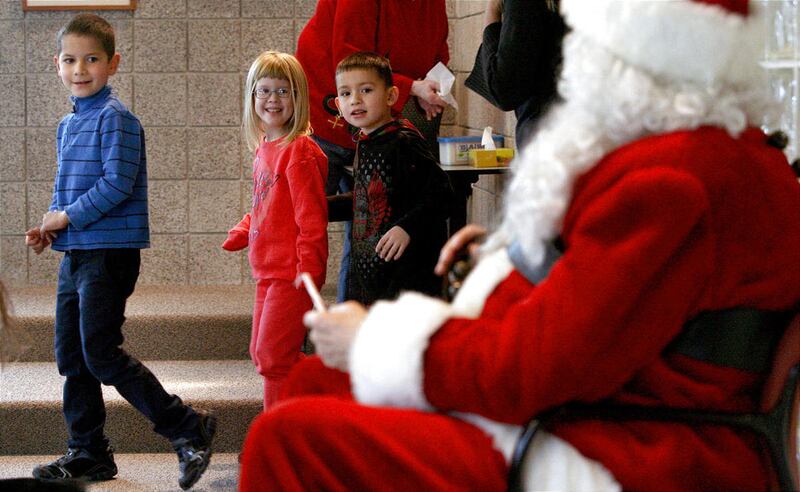
I love being a father to six beautiful children, all of whom are excited for Santa Claus to come on Christmas Eve. While my older children, ages 14 and 12, speak to me about Santa Claus with a wink and a smile and my 10-year-old is far too curious about the Amazon Prime boxes that have been arriving at our home over the last couple of weeks, our little family has adhered to an iron-clad rule with respect to Santa Claus: “If you don’t believe, you don’t receive.”
Experienced parents know that the excitement that builds up among children this time of year often erupts into spasms of activity, with kids literally bouncing off the walls and into each other, causing all kinds of problems. As the noise levels escalate and the tears start to flow, while the interminable minutes crawl by, I have found that I can restore a measure of order by singing, “You better watch out! You better not cry! You better not pout! I’m telling you why. Santa Claus is coming to town.” Since most of the bloody noses, hurt feelings and broken ornaments occur when my wife and I are NOT in the room, it’s helpful to remind the kids that Santa Claus is no sucker; “he knows if you’ve been bad or good, so be good for goodness sake.”
But if you believe a recently released paper titled “Who’s the Boss” by University of Ontario Institute of Technology professor Laura Pinto, by reinforcing the idea of Santa Claus and the narrative that private behavior is never really private, we are setting up our children for “dangerous, uncritical acceptance of power structures” that will lead to the ultimate acceptance of a surveillance state. I’ve learned, having been a parent for almost 15 years, nearly everything we parents do is wrong and children are so scarred coming out of adolescence that all of them need professional therapy. At least that’s what I’ve come to understand. But I’m calling bull on this one.
To be fair to Pinto, she does not directly disparage Santa Claus. Instead, she raises existential concerns about the relatively new phenomenon of the “Elf of the Shelf,” a stuffed elf doll that helps Santa keep the naughty and nice list current. According to Pinto, “If you grow up thinking it’s cool for elves to watch me and report back to Santa, well, then it’s cool for the NSA to watch me and report back to the government.” That’s quite the leap for Pinto to make based solely on “anecdotal” and unspecified “evidence.” Based on my own anecdotal evidence, Pinto was probably on the naughty list as a kid.
Maybe I’m old-fashioned, but I’m not ready to give up on Santa Claus. I’m focused on teaching my children that their private behavior matters, that doing what is right at all times and in all places is the best policy. I’m trying to equip my children with integrity, a character trait that I believe is critical to building a happy life. I think the idea of Santa Claus helps.
Leaving aside the spiritual implications and the pain poor decisions can inflict on lives, we need to reinforce with our children that what they might think is private behavior might not be private at all. Too many kids these days are learning this lesson the hard way. The ubiquitous smartphone, equipped with cameras and a connection to the Internet, can make private behavior very public, very quickly, and to devastating effect. The safest course is to be good for goodness sake.
Dan Liljenquist is a former state senator and former U.S. Senate candidate.