


SALT LAKE CITY — One of the most popular celebrity couples in Utah is back at Temple Square this spring, ready to raise their young and thrill the people below.
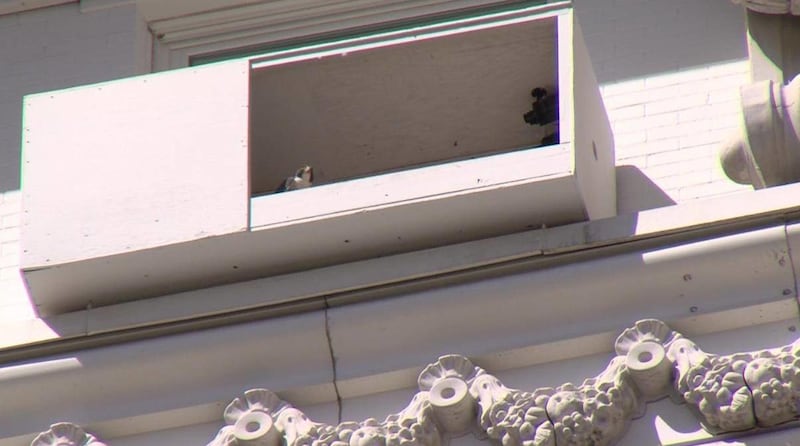
For three decades, peregrine falcons — the fastest birds in the world — have nested and fledged their chicks on a perch high atop the Joseph Smith Memorial Building on Temple Square on the corner of South Temple and Main.
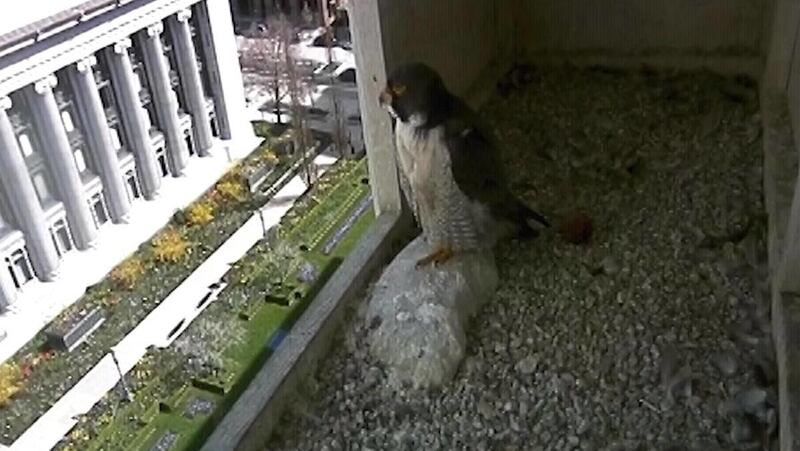
The highfliers welcomed their first egg of the season Tuesday in a nesting box that was built for them several years ago near the top northeast corner of the building. The box is equipped with two HD webcams so people can follow the peregrines' progress online.
Around 11 a.m. Tuesday, both the male (known as a tercel) and the female (just called a falcon) were perched high above the urban jungle where they will start teaching their young to fly in about 10 weeks.
"It's amazing to see them right down here in the city," said Jon McQueary of Kaysville, who was visiting Temple Square to soak in the beautiful spring day.
The peregrine falcon pair is busy hunting and feeding to keep the female healthy as she prepares to lay a couple more eggs. She will lay eggs every other day, typically for a total of three or four eggs.
"They're good-sized," McQueary said. "They're impressive birds — beautiful."
For humans below, like McQueary, it was an inspiring sight, especially if you did not arrive expecting to see the regal raptors. Peregrines can hit 200 mph as they dive for pigeons and other food.
"Amazing. I didn't even know they were still in the area," McQueary said.
Since 1994, peregrines have nested near the top of the Joseph Smith Memorial Building (it was the Hotel Utah until 1994), with a six-year absence from 1997 to 2003. Twenty-five of 35 fledglings received flight lessons from their parents and successfully went out into the world on their own.
That's not the easiest proposition when you consider the urban landscape in which they learn to fly.
"Those birds have a hard time flying in the big city," said Bob Walters, the watchable wildlife coordinator with the Utah Division of Wildlife Resources. "Everything is hard. Glass is very confusing to them."
If all goes well in the nest, anywhere from one to four birds will start learning to fly near the end of June, or early July. Last year, however, only one egg was hatched, and the chick did not fledge.
As they learn to fly, volunteers with the Salt Lake City Peregrine Falcon Watchpost Team will keep a watchful eye on the fledglings in case they crash into windows, or land on hard surfaces as they earn their wings.
Before that training began last year, they had two males down, Walters said. They found the father, with a wounded shoulder, needing rehab. It now appears to Walters that the new male won over the female.
"He's taken the territory and wooed, probably not with too much trouble, wooed this adult female," he said. "Things seem to be working out."
People can keep a close eye on their progress and look for new eggs in the coming days on the webcam mounted in the nesting box.
People who come down to Temple Square to look for the birds should bring binoculars and some patience, as well. Sometimes people will spot the birds quickly. Other times, they may have to spend some time to catch even a glimpse of them.
The birds can be viewed online at: wildlife.utah.gov/learn-more/peregrine-cam.html
Email: jboal@deseretnews.com