

From 1957 through 2004, the official seal of Los Angeles County, California, centered on a standing image of Pomona, the Roman goddess of fruit trees, gardens and orchards.
The Pomona Valley, east of downtown Los Angeles, was long a major citrus-growing area and is home to both the annual county fair and the distinguished agriculture program at California Polytechnic University.
To the goddess’s left, in one of the seal’s six subsections, was an image of the Hollywood Bowl and, above it, two small stars (representing the motion picture and television industries) along with a tiny cross — so very tiny, in fact, that probably few people ever noticed it. The cross symbolized the Spanish friars, the area’s earliest European settlers, and the missions they founded.
In 2004, however, the county board of supervisors, faced with claims by the American Civil Liberties Union that the cross' appearance on the seal violated the “Establishment Clause” of the United States Constitution and the separation of church and state, removed it. Curiously, the ACLU didn’t complain about the pagan goddess Pomona, the central and most prominent feature of the seal. Still, the supervisors took the opportunity to remove her as well.
The revised seal now features a standing Native American woman flanked by an image of the Mission San Gabriel Arcángel, which was founded in 1771. Notably, though, the mission was first depicted without a cross. However, in January 2014, the county supervisors voted 3-2 to add a cross to the building’s image, citing the need for historical accuracy. A month later, the ACLU filed a federal lawsuit alleging that putting the cross back on the county seal violated the constitutions of both California and the United States.
However, if the goal is to eliminate Christian symbols and references from official materials, an enormous amount of work remains to be done. After all, the literal translation of “City of Los Angeles” is “City of the Angels.” And the colonists sent out from the San Gabriel Mission in 1781 named their new settlement “El Pueblo de Nuestra Señora la Reina de los Ángeles del Río de Porciúncula” (“The Town of Our Lady the Queen of the Angels on the River Porciúncula”).
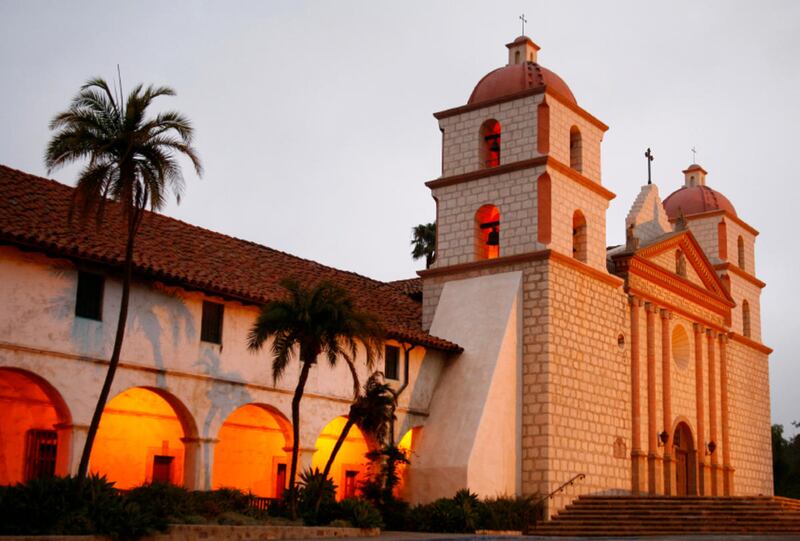
It will be very difficult to erase the Christian heritage of California and the broader American Southwest. The state is studded with cities, mountains and valleys named after saints such as Santa Maria, the mother of Jesus; her husband, San Jose; and her parents, San Joaquin and Santa Ana. San Francisco commemorates the founder of the Franciscan order; San Diego and San Bernardino recall members of that order, and both Santa Clara and Santa Clarita memorialize Francis’ most famous female disciple.
San Fernando was named to honor a canonized 13th-century king of Castille. San Luis Obispo honors St. Louis of Anjou, a 13th-century bishop of Toulouse, France. The word “Obispo” (“bishop”) distinguishes him from the 13th-century Louis IX, the only sainted king of France; the mission of San Luis Rey stands in modern-day Oceanside, California, and, of course, the city of St. Louis, Missouri, bears his name.
Santa Monica recalls the mother of St. Augustine, after whom an important city in Florida was christened. San Clemente honors a first-century bishop of Rome, regarded by Catholics as one of the first popes. Santa Barbara remembers a Christian martyr. San Onofre preserves the name of the fourth-century Egyptian hermit St. Onuphrius. We could go on for quite some time, with names such as San Ramon, San Gorgonio, San Marino, San Dimas, Santa Margarita, San Rafael, San Simeon and the like.
Moreover, California’s capital city, Sacramento, takes its name from the Sacramento River. But that river, in its turn, was named for the “Santísimo Sacramento,” the “Most Blessed Sacrament” — referring to the Roman Catholic liturgy of the Eucharist, or Communion.
From California’s super-progressive university town of Santa Cruz (“Holy Cross”) to New Mexico’s Santa Fe (“Holy Faith”) and Las Cruces (“The City of the Crosses”) and Sangre de Cristo (“Blood of Christ”) Mountains — and, for that matter, from Utah’s Lehi, Nephi and Manti to St. Charles in Missouri, and Bethlehem, Pennsylvania — American history and American landscapes are saturated with religion.
But there’s still hope: In 1996, the question arose of renaming Canada’s Northwest Territories. For a while — we’re not making this up — one of the most popular suggestions was “Bob.” In the end, though, the province’s name remained unaltered. So, happily, “Bob” remains available as a replacement for, say, “San Francisco.”
Daniel Peterson founded BYU's Middle Eastern Texts Initiative, chairs The Interpreter Foundation and blogs on Patheos. William Hamblin is the author of several books on premodern history. They speak only for themselves.