

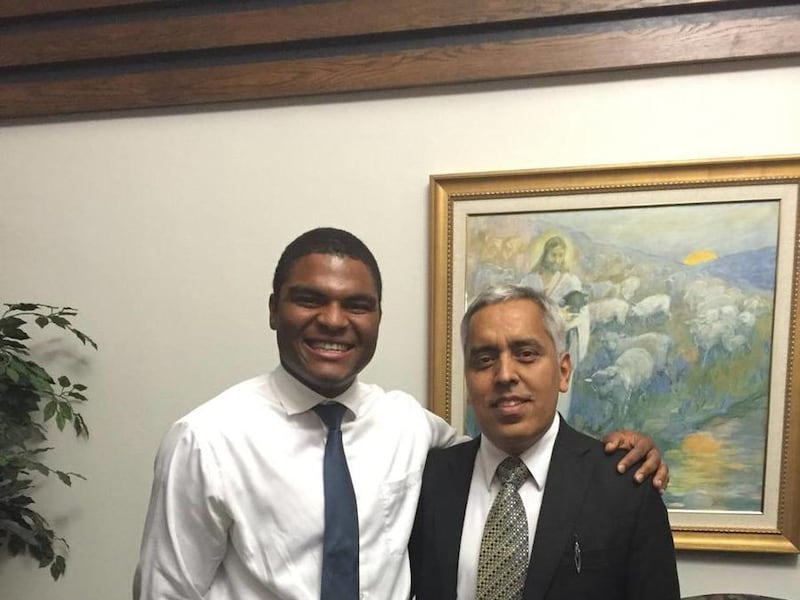
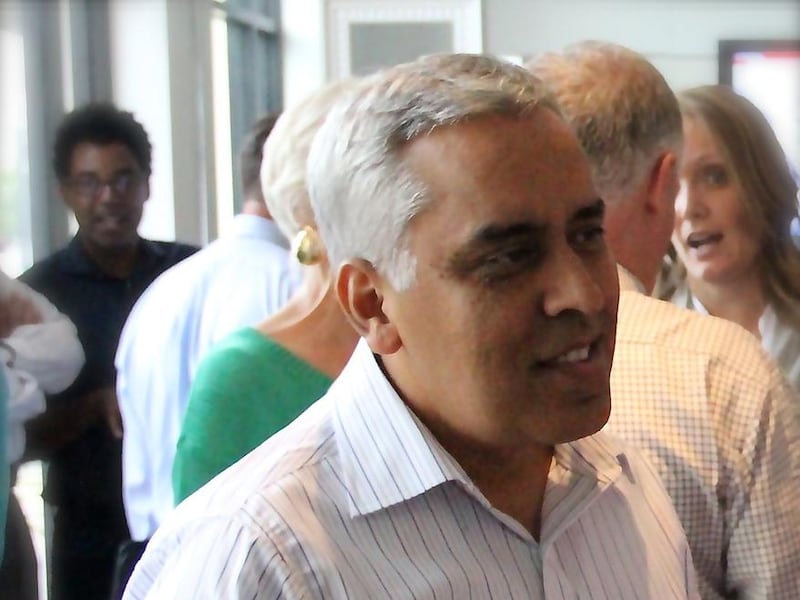
KLEIN, Texas — Bishnu Adhikari, a Nepal in-country director for Choice Humanitarian, spoke to a gathering of close to 800 people about his humanitarian work after the April earthquake in Nepal during a recent fireside at The Church of Jesus Christ of Latter-day Saints in Klein, Texas.
Adhikari, a 2010 Choice Humanitarian of the Year featured in the film "Meet the Mormons," spoke of his humble beginnings and his drive to help the people of Nepal.
Adhikari was 30 years old when he received his master’s degree in engineering at a school in Russia and returned to visit his small rural village in Nepal. Adhikari became emotional when he saw his 60-year-old mother still having to carry water from a distant well.
“It broke my heart to see my mother still carrying water in a basket on her back,” he said. “I thought it was ironic that even though I had been gone for five years and received an education, my village had not changed at all.”
He joined the LDS Church in Russia soon after receiving his degree. He recognized that because of the gospel, he had been given “an opportunity to grow in humanity.” When he saw his mother and other women carrying water long distances, he knew what to do.
“I decided that this would be my first project,” he said.
Adhikari spent the next four months developing a pipe project that brought water to the villagers. It was so well designed that it even withstood the recent Nepalese earthquake.
Despite his rise in visibility thanks to the movie and awards, he humbly speaks only of his great love of work and striving to improve the quality of life of those around him.
“You can’t help but feel his heart,” said Cypress Texas Stake President Al Haines, former chief administrator for the city of Houston and a member of Choice Humanitarian’s board of directors.
It wasn’t that long ago that Adhikari, frustrated with himself, asked, "Am I utilizing myself for good? Am I using my education to help others?"
He decided to read his patriarchal blessing for direction.
“The Lord knows how to make his promises work,” Adhikari said.
Adhikari also warned against pride. One of the characteristics that drew him to the missionaries in Russia was their humility. Because of the missionaries and the gospel, he knew he wanted to — and could — change.
“One thing I learned in the church is don’t look at and compare yourself with others," he said. "It is between you and Heavenly Father. If we are discouraged or dismayed because of someone else’s gain or fortune, we need to repent.”
Adhikari joined Choice Humanitarian in 2007 as an in-country director for Nepal after working on development projects for the World Bank, Asian Development Bank and USAID. Since joining, he has brought Choice Humanitarian's sustainable-development model to hundreds of villages in Nepal alone. Adhikari’s and Choice Humanitarian’s overall mission is to end extreme poverty around the world, and to date they have entered and had huge impacts in seven countries.
Despite his education, however, Adhikari had to adjust some of his expectations.
“I had been trained in civil engineering, and that meant working with large areas and heavy equipment,” he said. “But when I went back to Nepal, there was no bulldozer — only pickaxes and shovels. I had to learn to work with what was available.”
After the devastating magnitude 7.8 earthquake in Nepal in April, Adhikari assisted with providing shelter using tents and other local materials. While his and Choice Humanitarian's focus is on sustainability, he knew that immediate relief was necessary. But even in the midst of that country’s trauma, the model of ownership and using local leadership became invaluable in meeting the villagers’ immediate needs.
Adhikari encouraged neighbors to help one another and witnessed as they worked side by side, Nepal’s government contributed aid, and local leaders helped identify specific villagers and their immediate needs, including shelter. Adhikari believes strongly in working with the local people, understanding their culture and teaching self-sufficiency.
“It is important to go to the people,” Adhikari said. “The people learn how, and they replicate it in other villages.”
Adhikari has since created Nepal rebuild designs for schools and housing, utilizing Choice Humanitarian's model of self-sufficiency while respecting Nepalese culture.
“Nepal will rise again,” he said. “It will rise again because of the people’s desire.”
Ramona Siddoway is a freelance writer who has published articles in Belgium, Angola and the United States. She lives with her husband in Houston. Her website is at ramonasiddoway.com.