

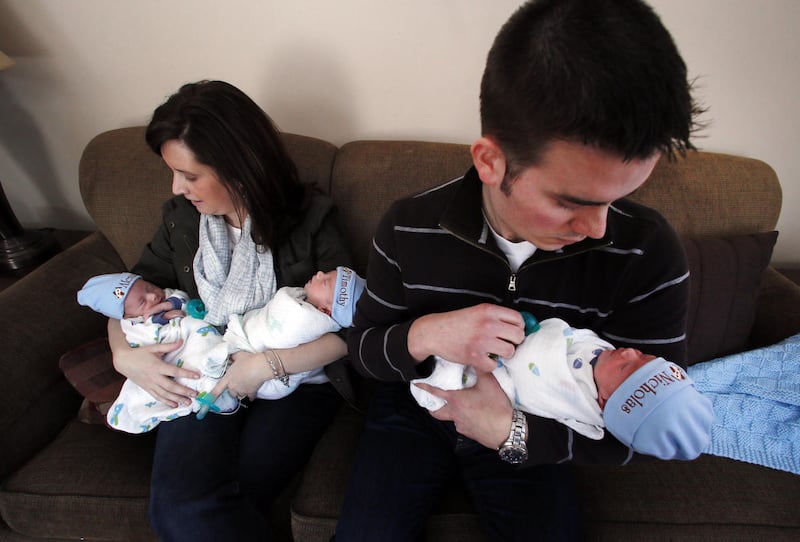

More than 140,000 babies born in the United States in 2014 arrived with at least one companion — a twin, triplets or more. And though they collectively made up only 3.5 percent of births, that's the highest share in American history, up from a steady 2 percent for most of the last century, according to a new Pew Research Center report.
Pew said the birth rate for multiple births started to tick up around 1980. The center based its analysis on just-released vital statistics data from the Centers for Disease Control and Prevention.
"This growing market for double strollers might reflect a shift in Americans’ lifestyles," wrote Pew senior researcher Gretchen Livingston. "First, as women delay childbearing into their 30s and beyond, their likelihood of having multiples – even in the absence of medical intervention – naturally rises. Second, the increasing use of fertility treatments, such as hormone therapy or in vitro fertilization (IVF), further bolsters the likelihood of multiple births."
Livingston noted that "the link between a new mother’s age and the share of multiples born is striking. Among teens, fewer than 2 percent of all babies born are multiples, but this share rises steadily for each subsequent age group. Fully 5 percent of babies born to moms in their late 30s are multiples, a figure that rises to 6 percent for babies born to moms in their early 40s. And for women 45 and older, fully one-in-five babies are multiples."
The report notes that black mothers produce the highest rate of multiple births at just over 4 percent. White moms are more likely to produce twins than are Hispanic or Asian mothers.
Medline Plus noted the uptick in multiple births and offered some advice recently to those who are not expecting a singleton: "Years ago, most twins came as a surprise. Now, most women know about a multiple pregnancy early. Women with multiple pregnancies should see their health care providers more often than women who are expecting one baby. Multiple pregnancy babies have a much higher risk of being born prematurely and having a low birth weight. There is also more of a risk of disabilities. Some women have to go on bed rest to delay labor. Finally, they may deliver by C-section, especially if there are three babies or more."
Email: lois@deseretnews.com, Twitter: Loisco