



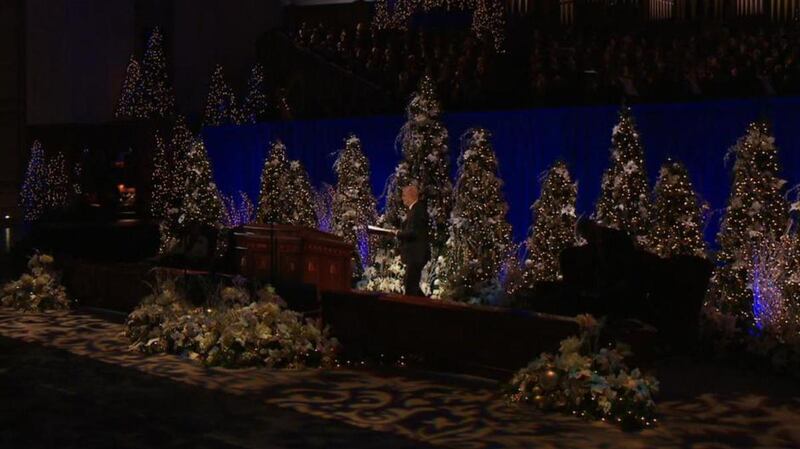


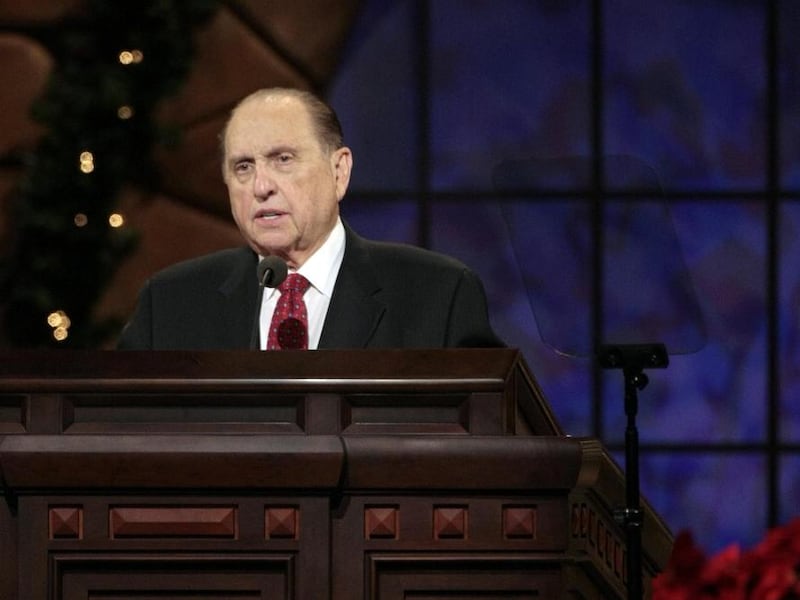



In the annual First Presidency Christmas devotional for The Church of Jesus Christ of Latter-day Saints, church leaders share stories of gratitude and love to evoke the Christmas spirit.
In the most recent devotional, President Dieter F. Uchtdorf of the First Presidency told the story of a man in Africa who had never been able to walk. One day, he attended a church-sponsored event where he had the opportunity to use a wheelchair. He was joyful as he freely moved about. When church members told him the wheelchair was his to keep, the man could not contain his happiness and began to weep.
"This man understood gratitude," President Uchtdorf said.
Here are six additional stories church leaders have shared in past Christmas devotionals.
******
President Thomas S. Monson conveyed the spirit of Christmas in his message from the devotional in 2009 by sharing a story about travelers stranded at a tiny gate in the Atlanta airport. It was December in 1970, and an ice storm had delayed travel for people trying to get home for Christmas. The frustration and anxiety of travelers grew as midnight arrived and the situation had not improved.
A conversation between a young soldier and a desk agent intensified as the soldier expressed his desire to get home and see his family since his unit was being deployed to Vietnam immediately after the holiday. If he did not make it home for Christmas, the young man did not know when he would see his family again. The agent told him that he would not be able to go anywhere for the next 24 hours.
As the flight boarded, a man who had been sitting nearby during the conversation stood up and said, “I have a confirmed ticket. I’d like to give my seat to this young man.”
The soldier began to cry as he shook the man’s hand. The man responded by simply saying: “Good luck. Have a fine Christmas. Good luck.”
“No more than a few among the thousands stranded there at the Atlanta airport witnessed the drama at Gate 67,” President Monson said. “But for those who did, the sullenness, the frustration, the hostility — all dissolved in a glow. That act of love and kindness between strangers had brought the spirit of Christmas into their hearts.”
******
President Uchtdorf recalled one particular Christmas when he was 4 years old during his message at the 2011 Christmas devotional. He described admiring the decorated Christmas tree in his home as well as the candles surrounding it. He held up one of the candles to a nearby window and made a major discovery — window curtains are flammable. He went on to explain that the fire "spread quickly, threatening the walls and ceiling" of his home.
President Uchtdorf exclaimed, “I knew, with all the certainty of a 4-year-old boy, that I had ruined Christmas!”
From this incident, President Uchtdorf explained that he learned two things: not to play with fire, and that despite his concern, he had not actually ruined Christmas.
“I’m certain my mother and father were shocked and dismayed that I had done such a foolish thing,” President Uchtdorf said. “But in the end, it didn’t diminish the love we had in our family, nor did it destroy the wonder of the Christmas season.”
President Uchtdorf proceeded to say that his fear that he had ruined Christmas stemmed from not understanding the true meaning of Christmas.
“We have in our minds a picture of how everything should be — the perfect tree, the perfect lights, the perfect gifts and the perfect family events,” President Uchtdorf said. “But if Christmas can point our hearts toward our Savior, we can rejoice even in the imperfections of the season.”
******
Sister Bonnie L. Oscarson, general president of the church's Young Women organization, shared a story about her ancestor Jed Stringham, a grocery-store owner who exemplified Christlike love on Christmas Day in 1901.
She began this story given in the 2014 devotional by telling of a family of 10 that had had a challenging year "with one of the children suffering poor health, which drained the resources of the family." As Christmas Eve was winding down, the eight children were excited for Christmas, but their mother told them Santa would not be coming that year. It had been a trying year for the family, and the parents did not have the money to get gifts for their children, Sister Oscarson explained.
The children remained hopeful. When Christmas morning arrived and there were no gifts, the children tried to hide their disappointment, but their mother could feel their sadness. With a wavering voice, she told her children that they did in fact have a lot to be grateful for. Gradually, the children cheered up, and the family began to celebrate Christmas.
Later on, one child noticed a dime on the table. He was convinced Santa had left it there for him to buy candy, so he went into town. All the businesses were closed, but Stringham happened to live right by his store. The boy knocked on the store owner's door and explained to him that Santa had given him a dime to buy some candy.
When asked if he would open his store, the man gave a response that was simple, but meaningful: “You bet I will. Come.”
The store owner gave the boy what was clearly more than a dime’s worth of candy, Sister Oscarson said, and there was plenty for each child to enjoy. As the children sat together eating that candy on Christmas Day, their mother said, “God bless Brother Stringham.”
“Sometimes, small things mean the most,” Sister Oscarson concluded.
******
In his message given in the 2012 devotional, President Henry B. Eyring of the First Presidency reflected on Christmas Day in 1970, when he was the father of three young boys. He explained that he had to go on a business trip just two days after Christmas, leaving his wife to entertain the children during the holidays. Consequently, he spent extra time selecting gifts for his boys, “knowing that their happiness might well depend on having good Christmas gifts to play with,” President Eyring said.
He gave his oldest son, who was 7 years old, a barometer. The gift came in several parts and had complex instructions. President Eyring and his son worked side by side for hours putting the pieces together.
As they were assembling the barometer, President Eyring realized there was a problem with the device, but he didn’t convey his concern to his son. He did, however, write a letter of complaint to the company, stating his frustration with the malfunctioning barometer. He wrote: “Please tell me how to make it work. It’s not your credibility but mine that will suffer unless you help.”
President Eyring said he never sent the letter and that he also never got the gift to work. He also said that to this day, what his son most remembers about that gift is the love they shared as they helped each other and worked together.
“We learned from that what you know from your experiences: Success in giving joy at Christmas usually involves help from others,” President Eyring said. “It is rarely found in solitary effort. Joining with others spreads the joy and makes it more lasting.”
******
President Monson brought up an experience he had as an 11-year-old Primary boy during his message in the 2012 devotional. After church one Sunday, his Primary president, Melissa, told him that she couldn’t get the older boys in Primary to be reverent. Melissa asked him if he would help her with this problem. This conversation ended all issues of reverence in that Primary.
“She had gone to the source of the problem — me,” President Monson said. “The solution was love.”
Many years later, President Monson visited his beloved Primary president, then more than 90 years old, in a nursing home. He felt prompted to visit her and express his love and gratitude for all she had done for him. When he arrived, Melissa stared at him blankly, but he sat by her side in the lunchroom and engaged in a one-sided conversation. He talked of her service to children as a Primary worker. As he did this, one nursing home resident told him that Melissa didn’t recognize anyone — not even her own family members.
“She hasn’t said a word in all the time she’s been here,” he added.
As lunch ended and President Monson stood up to leave, he held Melissa’s hand and said: “God bless you, Melissa. Merry Christmas.”
To his surprise, Melissa responded, saying, “I know you. You’re Tommy Monson, my Primary boy. How I love you.”
President Monson concluded his message of love, saying: “There is no better time than now, this very Christmas season, for all of us to rededicate ourselves to the principles taught by Jesus the Christ. It is the time to love the Lord, our God, with all our heart — and our neighbors as ourselves.”
******
In his message in the 2009 devotional, President Uchtdorf mentioned a time after World War II when his family lived in Zwickau, East Germany. It was there they joined the LDS Church.
Members of the church met in a small meetinghouse adorned with a stained-glass window depicting the First Vision. President Uchtdorf spoke fondly of this, stating, “I often looked up at this window and felt a special spirit. How I loved our quaint meetinghouse!”
He discovered years later that the chapel was demolished and that in its place stood a tall apartment building.
“Had they only seen the place the way I did as a young child, they might have made a different decision,” President Uchtdorf said.
He added, "Sometimes the most precious and sacred things are right in front of us — in plain sight, so to speak — but we cannot or will not see them. … I promise that if we unclutter our lives a little bit and in sincerity and humility seek the pure and gentle Christ with our hearts, we will see Him, we will find Him — on Christmas and throughout the year."
Email: lpeterson@deseretnews.com