

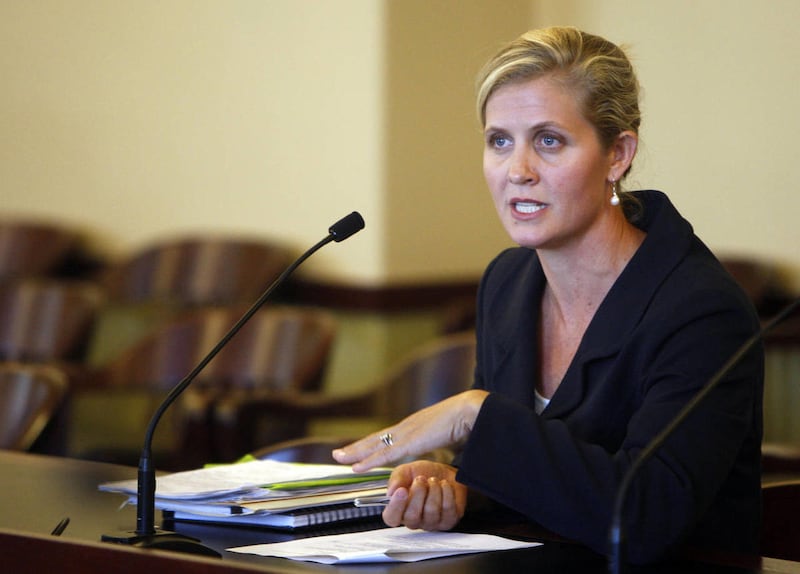

SALT LAKE CITY — Amanda Smith, who has spent the past six years at the helm of the state's environmental agency shepherding oversight of protections for Utah's land, air and water, is stepping down to pursue opportunities in the private sector.
Smith's departure was announced Thursday by the governor's office, with Utah Gov. Gary Herbert noting the contributions she's made through addressing contentious environmental issues via collaboration.
“Amanda’s leadership on environmental issues, perhaps most notably air quality, has changed the conversation in this state,” Herbert said. “She has been a valuable member of my cabinet and a tremendous public servant who realizes we face unique challenges in Utah and we are determined to find Utah solutions."
In particular, Herbert cited the Utah Department of Environmental Quality's work on air quality initiatives in the Uinta Basin that under Smith's direction will ultimately lead to improvements for the region.
"We are not simply waiting for the federal government to declare the area to be in nonattainment of standards. We are making significant improvements now," he said.
Smith's departure is effective May 22 and is a decision she said was not made lightly.
“It’s a difficult decision because I have enjoyed working with such a high-caliber staff at DEQ,” she said. “But I leave at a time when many great things set the stage for a smooth transition.”
During Smith's tenure at the agency, there has been a significant overhaul of procedures dealing with permits and appeals, as well as the reorganization of regulatory boards.
Some of the most controversial but convoluted issues have dogged her time at the Utah Department of Environmental Quality, including the state's potential acceptance of radioactive depleted uranium, implementation of the state's plan to curb fine particulate air pollution, and grappling with response and remediation involving the Red Butte oil spill.
Most recently, Smith oversaw the state's largest monetary settlement involving a company accused of violating pollution limits set by its permit. North Salt Lake's Stericycle was fined $2.3 million in a negotiated settlement that ultimately was accompanied by the medical waste incineration facility's decision to relocate to a remote section of Tooele County.
Smith was named to her post in May 2009 by then-Gov. Jon Huntsman Jr., after serving as his legislative affairs director.
She is a graduate of the University of Utah and has a law degree from Gonzaga University.
Her work at the agency was praised by even some of its most ardent critics.
“While we haven't agreed with every decision the DEQ had made, we've always known that Amanda is motivated by a genuine desire to protect public health and the environment, and we've appreciated her intelligence, frankness and willingness to consult with advocates," said Matt Pacenza, director of HEAL Utah.
Ingrid Griffee, with Utah Moms for Clean Air, praised Smith's willingness to weigh the voice of clean air advocates.
"It is our hope and expectation that in choosing a successor, the governor will find someone who will hold this mission as their No. 1 priority, who will consider the concerns of citizens to be as important as the concerns of industry, and who will continue the strong working relationships with advocates which Ms. Smith has developed over her tenure at DEQ," Griffee said.
Rep. Patrice Arent, D-Millcreek and chairwoman of the Utah Legislature's Clean Air Caucus, issued a statement praising Smith.
“We have enjoyed having the opportunity to work with Amanda and appreciate her many years of dedicated service to the state, and the time she spent providing information on complex environmental issues," Arent said. "We look forward to the new director’s willingness to join forces with legislators and advocates to create and implement plans that genuinely improve our environment."
Email: amyjoi@deseretnews.com
Twitter: amyjoi16