

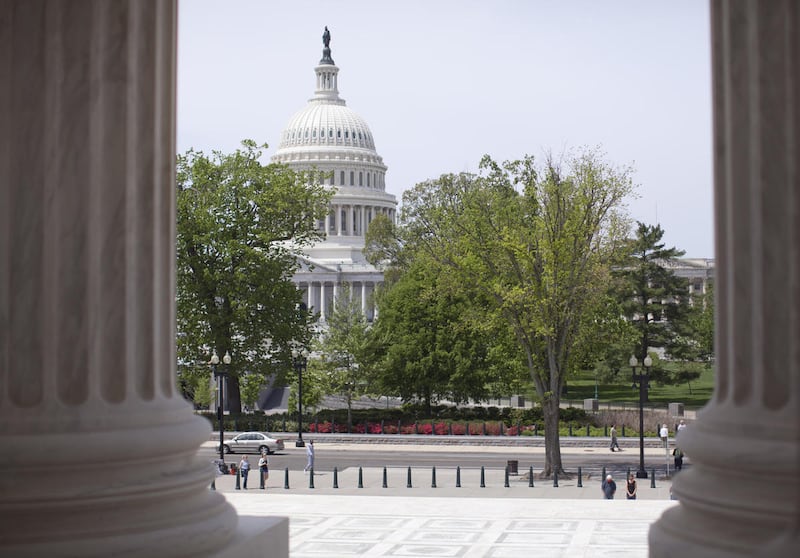

SALT LAKE CITY - The legal, jurisdictional and political twists and turns in same-sex marriage saga have been numerous. The question squarely before the Supreme Court this Tuesday is, "Does the 14th Amendment require a state to license a marriage between two people of the same sex?"
That’s the central question, but not the only one. And therein lies a thread of possibility: Might the Supreme Court do something unexpected to diffuse this emotionally charged controversy?
When the high court accepted review of the 6th Circuit Court of Appeals' November 2014 decision affirming traditional marriage, it narrowed the scope of debate to two questions.
The first question is cited above. It will receive 90 minutes of debate, 45 minutes by the advocates of judicially imposed same-sex marriage (including the federal government), and 45 minutes for the state of Michigan, to defend its definition of marriage as the union of one man and one woman.
But the Supreme Court also recognized a second question presented: "Does the 14th Amendment require a state to recognize a marriage between two people of the same sex when their marriage was lawfully licensed and performed out-of-state?" It will receive an additional 60 minutes of debate, again split between the parties, with Tennessee representing states on this issue of “recognition.”
In the lead-up to Tuesday, however, it remarkable how few commentators have discussed this second question. Of the 76 “friend of the court” briefs supporting same-sex marriage, the five briefs supporting neither party, and the 66 briefs against same-sex marriage imposed by the federal judiciary, only one brief is devoted entirely to this question of recognition.
It’s not that there aren’t politically attractive reasons to find a tenable compromise. Indeed, in the pages of the Deseret News, Lew Baker of Salt Lake City wrote on February 15 that: "No one seems to see the obvious compromise that might just give everyone enough to be content with the result.
“When the Supreme Court definitively rules on the issue, it can reaffirm the rights of all states to define marriage within their borders but, at the same time, affirm that is then the obligation of every state to recognize any marriage performed in any other state where such marriage is legal."
Last week, columnist Richard Davis strongly implied that instead of answering both questions in the affirmative or the negative, it might well pick a third option: "Here, the justices would be determining that there is no constitutional right to same-sex marriage.
“However, at the same time, they would be requiring states to honor the full faith and credit clause of the Constitution. This clause, located in Article IV, mandates that each give ‘full faith and credit’ to the ‘public acts, records, and judicial proceedings of every other state.’ That includes marriages."
If same-sex marriage advocates were to win on the first question, state marriage laws would be declared unconstitutional and the recognition question would be moot.
By contrast, if defenders of the democratic processes for marriage laws prevailed on the first question, it’s hard to imagine how the 14th Amendment could then require them to recognize other states’ differing marriage statues.
There might be a separate principle, under the “full faith and credit” clause cited by Davis, that would justify that result. But the justices did not ask about that part of the Constitution. Further, the “full faith and credit” clause had traditionally enforced judicial decisions across state boundaries, not the granting of marriage licenses, write the authors of the “choice of law” amicus brief.
As evidence for the unlikeliness of this route, consider that two years ago — when presented this matter — the Supreme Court declined to strike down portions of a federal law shielding states from the requirement that they treat same-sex marriages from other states as valid.
Might there be any other grounds for compromise? The best clues come from the briefs that support neither side.
One, written by Citizens United for the Individual Freedom to Define Marriage, says that marriage is by nature a religious act. They urge the high court to reconcile the Establishment Clause and the rights of gay couples by requiring states to create the legal status of civil unions.
A separate and powerfully argued brief by the Eagle Forum Education and Legal Defense Fund argues that federal courts inferior to the Supreme Court simply lack the jurisdiction to address domestic relations, including marriage.
A third brief, by the General Conference for Seventh Day Adventists and the Becket Fund for Religious Liberty, highlights the unavoidable victim in this high-profile clash between the First Amendment right to the free exercise of religion and a possible new right to same-gender marriage.
It argues that, however the court rules, it must “recognize the importance and vitality of religious liberty protections for conscientious objectors.”
Drew Clark can be reached via email: drew@drewclark.com, or on Twitter @drewclark, or at www.utahbreakfast.com