

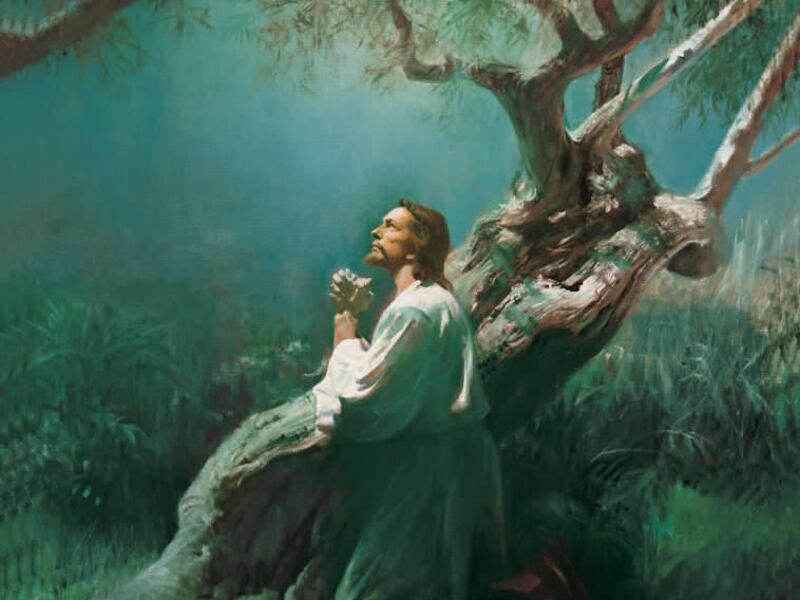
Jesus was probably crucified on a Friday. The evening before, Thursday, having celebrated Passover with his disciples, he’d gone to the Garden of Gethsemane to pray and await arrest.
According to the evangelist-physician Luke, whose gospel claims to rest upon eyewitness interviews, his agony became so intense that “his sweat was as it were great drops of blood falling down to the ground” (see Luke 22:44; compare 1:1-4). “Father,” the Savior prayed, “if thou be willing, remove this cup from me: nevertheless not my will, but thine, be done” (Luke 22:42).
We would be lost without his Atonement and Resurrection; they came only because Jesus subordinated his will to the Father’s.
Consider, too, a much earlier account of difficult, willed submission: Abraham had long prayed for a son, and finally, after decades, through divine grace, Sarah bore Isaac. Then, horribly, the Lord told Abraham (himself a near-victim of human sacrifice) to make an offering of Isaac, and the patriarch bent his undoubtedly anguished will to God’s. Happily, though, the Lord accepted the willingness without the act and bestowed a remarkable blessing upon Abraham, who was known thereafter as “the friend of God” (James 2:23):
“By myself have I sworn, saith the Lord, for because thou hast done this thing, and hast not withheld thy son, thine only son: That in blessing I will bless thee, and in multiplying I will multiply thy seed as the stars of the heaven, and as the sand which is upon the sea shore. … And in thy seed shall all the nations of the earth be blessed; because thou hast obeyed my voice” (Genesis 22:16-18).
“Ye receive no witness until after the trial of your faith,” wrote Moroni (Ether 12:6).
The apostle Peter, horrified at Jesus’ predictions of his impending crucifixion, provides a stark contrast:
“Then Peter took him, and began to rebuke him, saying, Be it far from thee, Lord: this shall not be unto thee” (Matthew 16:22).
Peter meant well. He loved Jesus. But he didn’t understand. His counsel was misguided, and he received a stinging rebuke from the Savior: “Get thee behind me, Satan: thou art an offence unto me: for thou savourest not the things that be of God, but those that be of men” (Matthew 16:23).
Some have suggested that Judas, a political Zealot, may have betrayed Jesus in order to compel the Savior, whose miraculous power he’d observed, to take revolutionary action against Roman occupation. If so, he too misunderstood God’s plan.
“Trust in the Lord with all thine heart,” says Proverbs 3:5-7, “and lean not unto thine own understanding. In all thy ways acknowledge him, and he shall direct thy paths. Be not wise in thine own eyes.”
“Seek not to counsel the Lord,” said Jacob (4:10), “but to take counsel from his hand.”
“Believe in God,” advised King Benjamin. “Believe that he is, and that he created all things, both in heaven and in earth; believe that he has all wisdom, and all power, both in heaven and in earth; believe that man doth not comprehend all the things which the Lord can comprehend. And again, believe that ye must repent of your sins and forsake them, and humble yourselves before God. … I would that ye should remember, and always retain in remembrance, the greatness of God, and your own nothingness” (Mosiah 4:9-11).
Faith isn’t slavish subservience. It’s trust. Abraham knew the Lord and trusted him. Isaac wasn’t a mere boy when he accompanied his father to Mt. Moriah; he was a young man who, at least at some point, went knowingly and submissively. He knew and trusted his father — and the Lord.
And, of course, Jesus knew, loved and trusted his Father.
We need to develop our own trust in God, and, on that basis, to follow him. “I know that he loveth his children,” said obedient Nephi, “nevertheless, I do not know the meaning of all things” (1 Nephi 11:17).
Faithful members of The Church of Jesus Christ of Latter-day Saints also trust and follow God’s chosen servants — not blindly, but out of experienced confidence that their counsel is true and good. As the Savior taught his apostles, “He that receiveth you receiveth me, and he that receiveth me receiveth him that sent me” (Matthew 10:40).
Note: In a recent article titled “Sustaining the Brethren” — published, appropriately, at conference season—Duane Boyce thoughtfully considers the Lord’s admonition that we sustain our leaders by our faith, prayers and actions.
Daniel Peterson teaches Arabic studies, founded BYU’s Middle Eastern Texts Initiative, directs MormonScholarsTestify.org, chairs mormoninterpreter.com, blogs daily at patheos.com/blogs/danpeterson, and speaks only for himself.