

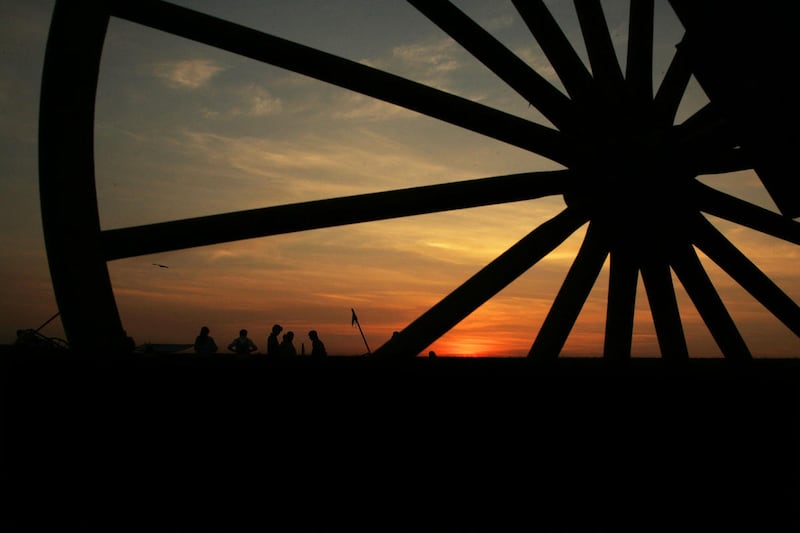
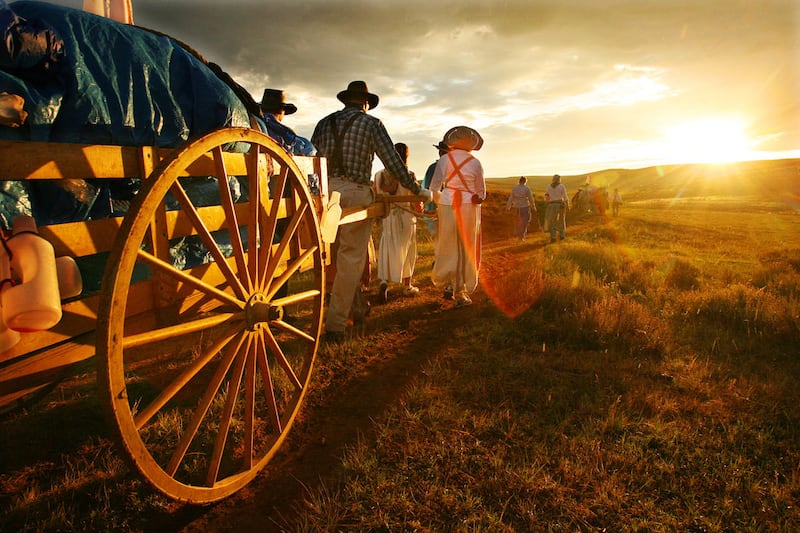
The consummate author of the Western experience, Wallace Stegner, penned "The Gathering of Zion: The Story of the Mormon Trail." He was quite enamored by the “suffering, endurance, discipline, faith, brotherly and sisterly charity” he discerned from the diaries, letters and reminiscences of the early Mormon pioneers. In his introduction for the book, which was published by the University of Nebraska in 1981, he also notes their “human cussedness, vengefulness, masochism, backbiting, violence, ignorance, selfishness, and gullibility.”
Yet he cannot find enough superlatives at the conclusion of his prologue where he writes, “That I do not accept the faith that possessed them does not mean I doubt their frequent devotion and heroism in its service. Especially their women. Their women were incredible.”
Stegner’s words are a powerful reminder of the often quiet yet critical role women played in the Mormon westward crossing. I would even venture to say that the trail experience and, in this instance, the settling of Utah would have been impossible without the contributions of women of The Church of Jesus Christ of Latter-day Saints.
A few of the experiences of these early Mormon women pioneers give us a taste of their pluck — their spirited and determined courage — and their gritty tenacity. And perhaps the best place to start is understanding what inspired these women to their task.
Irene Pomeroy converted to the LDS Church in New Salem, Massachusetts, and with her husband traveled to Nauvoo, Illinois. Persecution drove the Saints out, and the new and pregnant bride had no recourse but to leave “the prettiest place I ever saw for a large place,” Stegner recounts.
However, as Irene explained, “Everyone has to be tried and make a sacrifice like faithful Abraham when he offered his son Isaac.”
Little did she know that her sacrifice would not be required on the trail, and Irene was optimistic when they started west for “we had as good a wagon as any of them.”
She made the long, rugged plains crossing and arrived in the Salt Lake Valley more committed than before, affirming in a letter to her family in Massachusetts, “I would die in one minute for this gospel if necessary or required of the Lord,” Stegner noted.
However, in 1858 when the U.S. government sent Johnston’s Army to the Utah territory and Salt Lake City was evacuated, during the retreat Irene severely burned her arm. The damage was so extensive that soon thereafter it was amputated. Never properly healed, she struggled on, but within three years died of complications.
James and Amy Loader joined the LDS Church with their family in Oxfordshire, England, and emigrated to the United States in 1855, subsequently joining the Martin Handcart Company. Accounts of their stories have been published in "Tell My Story, Too," by Jolene S. Allphin, and "The Price We Paid," by Andrew D. Olson.
James died on the trail in September 1856, leaving his wife, Amy, and at least six children to carry on alone. Over time, food rations were cut to four ounces of flour per person per day, and the weather grew bitterly cold. One frigid night, Amy feared her daughters were slowly freezing to death, and when she could not get them up and moving, she decided to use what little strength she had and started dancing around their meager tent. The girls laughed in delight until she slipped and fell, prompting them to spring to her aid. Their mother laughed and admitted she fell intentionally, worried “her girls was (sic) going to give out and get discouraged and (it) would never do to give up,” according to the accounts of their experience. And they did not, though conditions worsened.
Amy’s daughter Patience described in her diary one day when a storm forced them to “halt” and “take shelter under our carts. After the storm passed we traveled on until we came to the last crossing of the Platte River. … The water was deep and very cold and we … drifted out of the regular crossing and we came near being drowned, the water coming up to our arm pits ….
"After we got out of the water we had to travel in our wet clothes until we got to camp and our clothing was frozen on us. … We had to make the best of our poor circumstances and put our trust in God our Father that we may take no harm from our wet clothes. It was too late to go for wood and water, and wood was too far away that night. The ground was frozen (so) hard we was unable to drive any tent pins in. As the tent was wet when we took it down in the morning it was somewhat frozen, so we stretched it open the best we could and got in under it. … Every day we realized that the hand of God was over us. … We knew that we had not strength of our own to perform such hardships if our Heavenly Father had not help us" (see "Diary of Patience Loader Archer").
Mary Goble Pay, grandmother of Marjorie Pay Hinckley, who was the wife of President Gordon B. Hinckley, was 13 when she traveled in the Hunt Wagon Company. She wrote, “We traveled from fifteen to twenty-five miles a day … til we got to the Platte River. … There were great lumps of ice floating down the river. It was bitter cold. The next morning there were fourteen dead. We went back to camp and had our prayers and … sang ‘Come, Come Ye Saints, No Toil Nor Labor Fear.’ I wondered what made my mother cry that night. … The next morning my little sister was born. … We named her Edith. She lived six weeks and died. She was buried at the last crossing of the Sweetwater,” as recorded in "Journal of the Trail," edited by Stewart E. Glazier and Robert S. Clark.
Hats off to the early Mormon pioneers who settled Utah, and as Stegner wrote, “Especially their women. Their women were incredible.”
Kristine Frederickson writes on issue-oriented topics that affect members of the LDS Church worldwide in her column “LDS World." She teaches part time at BYU. Her views do not necessarily represent those of BYU.
Email: kfrederickson@desnews.com