







SALT LAKE CITY — She wasn't old enough to vote. She should have been preparing for her freshman year in college.
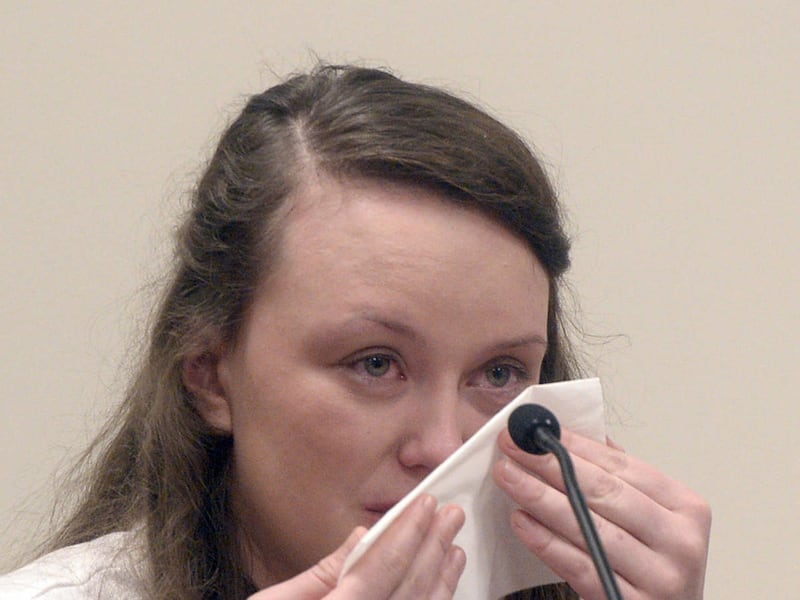
Instead, Meagan Grunwald, who was 17 when she drove the getaway vehicle for her boyfriend after he shot and killed a Utah County sheriff's sergeant and later shot and critically injured another deputy, could be sentenced Wednesday to life in prison without the possibility of parole.
Fourth District Judge Darold McDade only has one other option he can consider for her: 25 years to life in prison.
But while legal experts agree that a life-without-parole sentence for juveniles convicted of aggravated murder in adult court is constitutional, some Utah attorneys — speaking in general about the issue of sentencing and not the Grunwald case specifically — are divided over whether it's appropriate.
"There's absolutely no information that a juvenile is better served with life in prison," said Pam Vickrey, executive director of Utah Juvenile Defender Attorneys.
The tougher question may be how to balance rehabilitation and second chances with justice and retribution.
Salt Lake County District Attorney Sim Gill is an advocate of rehabilitating a person in most cases, but he still wants to have the life-without-parole option for those who commit the most serious crime as juveniles.
"I recognize there are certain categories of offenses and the nature of a crime and the violence of crime is such that, I'll say it very bluntly, the desire is to incapacitate. I just don't want this person circulating out there," he said. "How long and what is the appropriate time? I think we should use science and research to support that decision making rather than just an emotional response."
Life without parole
Under Utah law, a judge has the option to sentence a juvenile who is convicted of aggravated murder in adult court to either life in prison with a possibility of parole or life without any possibility of parole.
In 2005, the U.S. Supreme Court made the death penalty unconstitutional for those who are under 18 when they commit their crimes. A second ruling in 2010 said juveniles cannot be sentenced to life without the possibility of parole for crimes that did not involve a killing.
The Supreme Court took it a step further in 2012 and declared in a 5-4 decision that a mandatory sentence of life without parole for juveniles convicted in adult court of murder is cruel and unusual punishment. But because Utah judges have the option of sentencing a juvenile to either life with or without parole, it is not unconstitutional.
In February, the Utah Supreme Court upheld life-without-parole sentences for juveniles convicted of aggravated murder as constitutional. The disturbing case involved Robert Cameron Houston, who was 17 years old in 2006 when he raped and then fatally stabbed Raechale Elton, a 22-year-old youth counselor who had given him a ride from a Clearfield group home for troubled teens to a nearby independent living center during a fierce snowstorm. Houston was charged with capital murder. Prosecutors noted the heinous nature of the crime, saying that Houston not only tried to break Elton's neck but he slit her throat and tried to rip out her trachea because she would not stop screaming.
The Utah court's decision was issued this year as a number of other states are deciding whether to take away that sentencing option.
In May, Nevada became the 13th state to declare life without parole illegal for teens who commit murder before they turn 18.
A national coalition is pushing to abolish life without parole sentences for youth.
"The United States is the only country that imposes life without parole on children. The sentence is forbidden under international law," the Campaign for the Fair Sentencing of Youth says. "The U.S. Supreme Court, drawing in part on child development science and international human rights norms, has ruled that children are constitutionally different from adults and should not be subject to the harshest penalties."
“Nevada has taken a great step forward in recognizing that children should be treated differently than adults,” said James Dold, advocacy director for the campaign. “It is indicative of the growing rejection of harsh sentences for children that the legislature voted unanimously for such sweeping reforms."
Pendulum swing
Utah's tough stance on juvenile crime can be traced back to the early 1990s and the passage of the Serious Youth Offender Act. In the fall of 1993, Gov. Mike Leavitt called a special session of the Legislature, in part to deal with the growing problem of violent crimes committed by teens. Many point to the downtown Salt Lake shooting death of Aaron Chapman by 17-year-old Asi Mohi, a West High football star, outside the Triad Center in September of 1993 as the final straw.
The Serious Youth Offender Act allows prosecutors to directly charge as adults juveniles 16 years and older accused of committing any of 10 listed violent crimes. But even then, some, like Bill Nelsen, one of Salt Lake County's youth corrections administrators, were opposed to the idea.
"Philosophically, I felt and still feel juveniles ought to be dealt with in our system,'' Nelsen said in 1996. "We have the expertise and programs to deal with them.''
The juvenile system is designed to deal with young criminals, he said. The adult system is not.
"At least they have a chance (at rehabilitation) in the juvenile system,'' Nelsen said.
Some today still believe the act goes too far.
"The whole reason for the Serious Youth Offender Act was the pendulum was too lenient in society's eyes," said defense attorney Chris Bown. "It's time for the pendulum to come back to the middle where it needs to be where we recognize that punishment is required, but also that these criminals are juveniles and need to be treated with that in mind as opposed to how we'd treat a 55-year-old person who committed murder."
Punishment, rehabilitation
Bown currently represents Chris Bagshaw, a boy who was just 14 when police say he beat 15-year-old Anne Kasprzak to death in 2012 and dumped her body into the Jordan River.
During a week-long hearing in March to determine whether Bagshaw should be certified to stand trial as an adult, 3rd District Juvenile Judge Dane Nolan had several difficult issues to consider. One issue was that Bagshaw was 17 during the hearing, and would be set free once he turned 21 if he remained in the juvenile system. But if he were to be convicted in the adult system, he could be sentenced to an average of 25 to 30 years and potentially life.
Bagshaw turned 18 on June 10, making him eligible to be transferred from the juvenile detention facility to the adult Salt Lake County Jail.
During his certification hearing, his attorneys argued that the teen would receive treatment in the juvenile system during some of his critical developmental years that he wouldn't receive in the Utah State Prison's "archaic" system of services, as they called it. Prison would only teach him how to become a more hardened criminal with anti-social behavior, they said.
"I believe it will do more harm than good because of the element they will be among and because they'll become institutionalized. They'll basically grow up in a setting where there are different rules, unspoken rules and then the rules of the actual prison. Does it do damage to them? Absolutely," said Bown, who emphasized that he was not talking about his client's case specifically because it has not yet gone to trial. "I just don't know how a juvenile who's sent to prison doesn't come out damaged and unable to functions in society because he's missed that whole time period when he's supposed to learn how to function in society."
Vickrey says research has shown that a person's brain is not done developing until about the age of 26.
"I think what the research shows is that kids, even with the most serious of offenses, are really better served in the juvenile justice system," she said. "A lot of people look at the juvenile justice system and say it's about rehabilitation and being nice and stuff. But the reality is the juvenile justice system is also very, very good at providing for community safety and accountability."
Gil agreed that research shows the adolescent brain is continuing to develop until people reach their mid 20s. He also concedes that the two court systems are different.
"The adult system is not constructed nor does it have the resources to address the needs of juveniles who have been charged as adults," he said, but added that victims' families deserve justice and appropriate punishment.
Some crimes, he said, are so egregious that after a certain age, a juvenile needs to be held accountable as adult. That's why Gil believes a sentence of life without parole for a juvenile should remain an option for the most serious of crimes.
"Under the right circumstances … I could see (a life without parole sentence), although it should be rare like the death penalty. It needs to be a rare application when it comes down to juvenile offenders. But in certain categories of crime and the violent nature of them, that might be appropriate," he said.
"When it comes to a violent, violent crime, we want to still be able to reach them, but we're also responding to the desire to incapacitate, to keep this person out of circulation."
But what seems to be missing, all sides seem to agree, are options for 16- and 17-year-olds charged with serious crimes that allow them to get the treatment provided by the juvenile justice system, but won't necessarily release them from custody in just a couple of years.
Gil said he would like judges to be given more flexibility to be able to hold certain juveniles responsible as adults, but still be able to provide them services offered only in juvenile court.
"Start to tailor sentences that are both proportionate and age appropriate," he said.
Utah cases
Cases of heinous crimes committed by juveniles who are certified as adults are not common, but there are more cases in Utah than most people may realize.
• In addition to the Grunwald and Bagshaw murder cases, prosecutors in Salt Lake County are currently considering whether to certify a 15-year-old boy who police say shot and killed a 22-year-old man near a bus stop in West Valley City in June.
• Aza Vidinhar was 15 when he stabbed his two brothers, ages 4 and 10, to death in their West Point home. His attorneys had worked out a deal to keep him in juvenile detention until he turned 21 as long as he behaved himself. He would have then been sent to prison. But a few months after that deal was reached, he attacked another inmate and was sent to the Utah State Prison earlier than planned.
• In 2007, Carlos Hernandez was 15 when he was sent to prison for raping and strangling 15-year-old Keely Amber Hall to death in a St. George park. Hernandez was 14 at the time.
• Brookes Colby Shumway was convicted when he was 16 of stabbing his friend 39 times during a sleepover in 2000.
• Sean Winget was sentenced to prison in 1993 at age 16 for strangling 10-year-old Tara Stark.
• Johnny Angelo Perez was sent to prison in 1977 at age 15 for stabbing an Ogden motel clerk to death.
Four inmates are currently serving prison time who were convicted and sentenced to life in prison before their 18th birthdays:
• John Pender Miller pleaded guilty in 1981 to sexual abusing and murdering a 2-year-old Clinton girl. Miller was 15 at the time of the crime in 1980.
• Nick Alan Clatterbuck was 15 in 1984 when he killed his foster parents, fatally shooting his foster father and stabbing his foster mother. While in prison, he was named the Outstanding Student of the Year at high school graduation ceremonies.
• Robert Allen Austin was 16 when he was convicted of murder during a robbery attempt of a Weber County couple.
• Douglas Anderson was 15 in 1992 when he kidnapped, sexually assaulted and killed 5-year-old Bobbi Jo Hart and stuffed her body in a garbage can behind his house.
Douglas Anderson
Anderson was certified as an adult, convicted of aggravated murder and sentenced to life in prison at age 16. In 1993, the Utah Board of Pardons and Parole told him he would spend the rest of his life behind bars. No parole hearing is currently scheduled for him, although he is allowed to ask the board every 10 years to reconsider its decision.
"It was pretty scary," Anderson, now 38, remembers of his arrival at the Utah State Prison.
The 16-year-old was placed in maximum security — mainly for his own protection — alongside some of Utah's most notorious adult killers. The other inmates greeted him by banging on their cell doors and yelling things like, "A new fish!" he recalled.
Since then, Anderson earned his GED and enrolled in the prison's culinary program. He is now working in the prison's furniture making shop. Even though parole is something that isn't even a consideration at this point, Anderson said he wants to do whatever is necessary to make himself a productive member of society should he ever be released instead of spending his time "moping around."
Anderson sat down with the Deseret News at the Utah State Prison recently and recalled how he was having trouble both at home and at school prior to his crimes. Anderson said he and his brother would have emotional talks with their mom to try and convince her not to do drugs. He even had thoughts of becoming a narcotics officer one day because of his concerns for his mother.
"But instead of a hero, I became a villan," he said.
When Anderson was first incarcerated, he said he still had all of the anger and depression issues pent-up inside that contributed to his extreme behavior. He preferred staying in his cell and didn't like talking to others at the prison.
Today, Anderson claims he has come a long way in overcoming his anger issues. He has learned to keep his head down, avoid those who might lead him into trouble at the prison, and just sticks with a group of friends he knows he can trust. Prison officials say Anderson hasn't had a disciplinary write-up since 2009.
While programs offered by the prison have helped him deal with his anger issues and depression, Anderson said the biggest influence on him has come from older inmates whom he befriended.
Anderson believes he would have benefitted from some of the programs offered in the juvenile system.
"When in youth detention, there are counselors who talk to you more," he said, adding that he believes his transition to adult prison would have been smoother if he had had more one-on-one counseling.
"Here, it's different," he said.
While Anderson has found some counselors and corrections officers helpful in the adult facility, he says others are there to collect a paycheck and don't go out of their way to talk to the inmates or help them like the administrators in juvenile detention do.
Teen offenders, he believes, would benefit from being placed in the juvenile justice system first.
"You can mold a teen's mind a lot easier than a grown-up's mind because they're already set in their ways," he said. "All some kids need is someone to show they care."
Yet Anderson also agreed that spending just five or six years in a juvenile system for serious crimes "might not be enough either."
Anderson, who has now spent 22 years in prison, believes juveniles should receive more than one examination before a determination is made to put them into the adult system. He proposes that once inmates turn 21 they undergo another evaluation before a judge decides whether to send that person to adult prison.
He also believes corrections officials should explore the idea of a "halfway ground" facility for offenders who were older than 21 but aren't suitable for adult prison.
And once a person is sentenced to prison, they should have the chance to rehabilitate, he said.
"All should at least have time to prove they're not a horrible person," the inmate said.
He realizes that ultimately, whatever a person gets from their time in prison is completely up to them.
Does he think he could still be a productive member of society should the board ever decide he can be released?
"I think I can," he said.
Email: preavy@deseretnews.com, Twitter: DNewsCrimeTeam