


So far, the local college football season is right on schedule: Two games down, two quarterbacks down, and one more is limping.
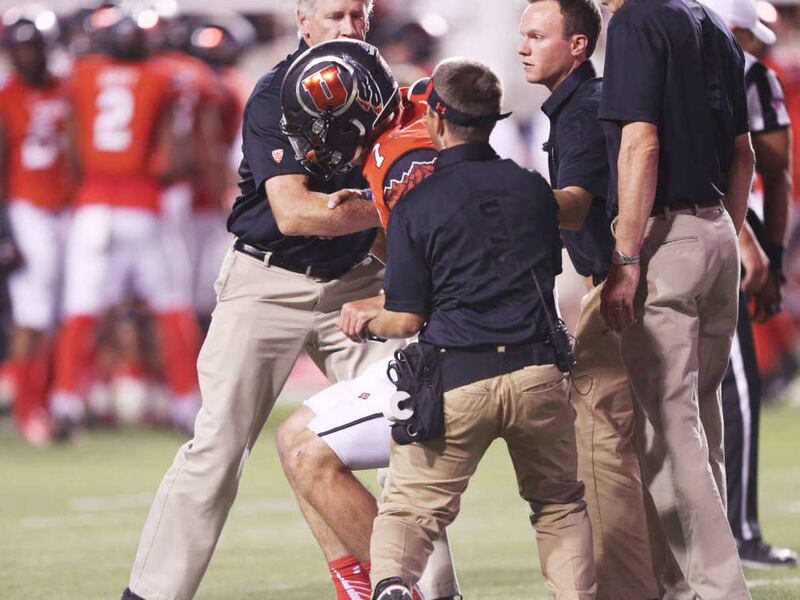
Last Friday night, Ute quarterback Travis Wilson left the game against Utah State in the second quarter with a shoulder injury that might cost him a start.
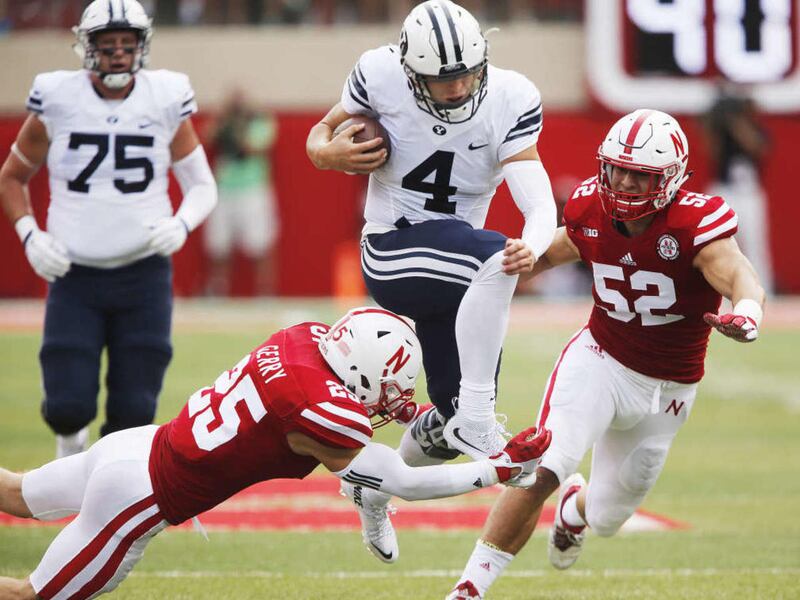
A week earlier, in BYU's season opener against Nebraska, star-crossed Taysom Hill sustained a season-ending foot injury.
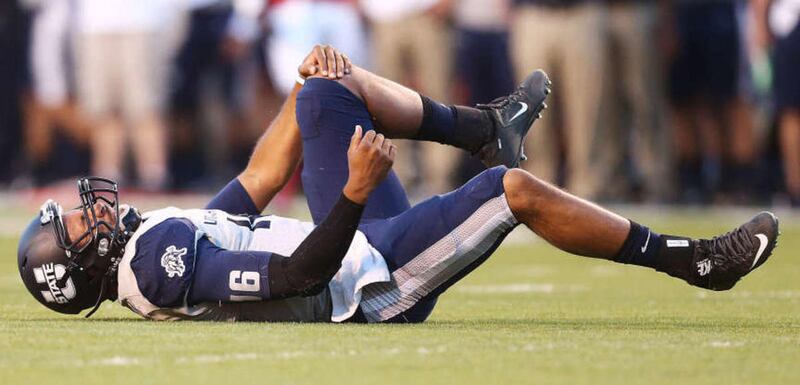
On the same night and same field Wilson was injured, the other team’s quarterback, Utah State’s Chuckie Keeton, took a late, low hit to the knee in the first quarter that left him limping the rest of the game.
This is business as usual for Utah’s three FBS schools, if not all FBS schools. According to the latest tally, the starting quarterbacks at South Carolina, Notre Dame, Kansas State, Virginia Tech, Syracuse, BYU and Utah are injured. Four of them are out for the season and two others will miss a month or more.
According to research posted by the NCAA, quarterback is not the most injurious position. Linebackers get that honor (13.5 percent of all football injuries), followed by running backs and receivers (11 percent each). Quarterbacks account for only 5.8 percent of the injuries. On the other hand, there is only one quarterback on the field, as opposed to multiple receivers and linebackers.
Finding a good quarterback is difficult. So is keeping one in the lineup. Consider what has happened at BYU, Utah, Utah State, where starting quarterbacks have rarely been able to finish a season since 2008.
Hill should wear a Red Cross on his helmet. He suffered season-ending injuries in 2012 (knee), 2014 (ankle) and 2015 (foot). He did manage to play the entire 2013 season. By season’s end, he will have missed 27 of 52 starts.
Before Hill came along, Riley Nelson missed almost half of the 2012 season and parts of the 2011 and 2010 seasons due to various injuries.
It’s been largely the same story at the other two in-state schools. Keeton has been the Aggies’ version of Hill, a promising, injury-prone quarterback. In 2013, he tore ligaments in his left knee in the sixth game and missed the rest of the season. In 2014, he injured the same knee in the third game and missed the rest of the season.
Since Brian Johnson’s senior season in 2008, the Utes’ starting quarterback has missed 27 starts, most of them because of injuries. Jordan Wynn missed three games in 2010, nine games in 2011 and 10 games in 2012, forcing the Utes to start a JC transfer and a freshman. Wilson started the first nine games of 2013, but an injury sidelined him the rest of the season, forcing the Utes to start a walk-on.
“It’s tough to play with one quarterback anymore,” says Ute coach Kyle Whittingham. “It’s simple: With spread offenses, the quarterback is subject to more hits. I don’t think there’s a lot more to it than that. Quarterbacks used to sit in the pocket and get knocked to the ground only occasionally. Now they’re on the ground every fourth or fifth play.”
Johnson, who sustained a season-ending injury as a sophomore and missed starts as a junior because of injuries, reduced his rushing attempts late in his college career and didn’t miss any playing time as a senior year in 2008. That was the last time a Ute quarterback went the distance.
Some quarterbacks just seem to have a knack for injuries and others seem to have a knack for staying healthy. BYU’s Max Hall and Utah State’s Diondre Borel were ironmen. Hall started all 39 games during his three seasons as a starter from 2007 to 2009; Borel started all 36 games during his three seasons as a starter from 2008 to 2010. Such streaks are almost unheard of anymore.
Hall and Borel were aberrations. Before Hall came along, BYU quarterbacks John Beck, Matt Berry, Kevin Feterik and others missed starts because of injuries, and they played before the spread offense became fashionable.
Hall had only 189 rushing attempts, which might have contributed to his health. On the other hand, Borel had 499 rushes and never got hurt. So go figure …
Hill has had a whopping 397 rushing attempts in just 25 games, and Nelson had 305 rushing attempts in 40 games, which certainly exposed them to more injury risk. By comparison, prespread era quarterbacks stuck to the pocket. Jim McMahon had only 265 running attempts in 47 games, and even a great running quarterback like Steve Young had a relatively modest 269 running attempts in 34 games. (All stats for running attempts include sacks and quarterbacks being flushed out of the pocket on plays that were not designed as runs.)
A few years ago, when 49ers quarterback Colin Kaepernick was running all over NFL defenses, Joe Flacco, the Baltimore Ravens quarterback, told reporters, “Quarterbacks like (Kaepernick) are eventually going to have to become mostly pocket passers to survive in this league.”
Michael Vick and Robert Griffin III learned this the hard way. Meanwhile, the spread offense has not taken over the NFL game, as some predicted, largely because defenses adapted quickly and because quarterbacks are too valuable to risk.
But the spread remains the rage in the college game. Coaches try to protect their quarterbacks, but there is only so much they can do.
“We try to teach quarterbacks how to avoid the hits and to be judicious with their decisions,” says Whittingham. “But these are competitive kids and they want to compete.”
Doug Robinson's columns run on Tuesdays and Wednesdays. Email: drob@deseretnews.com