

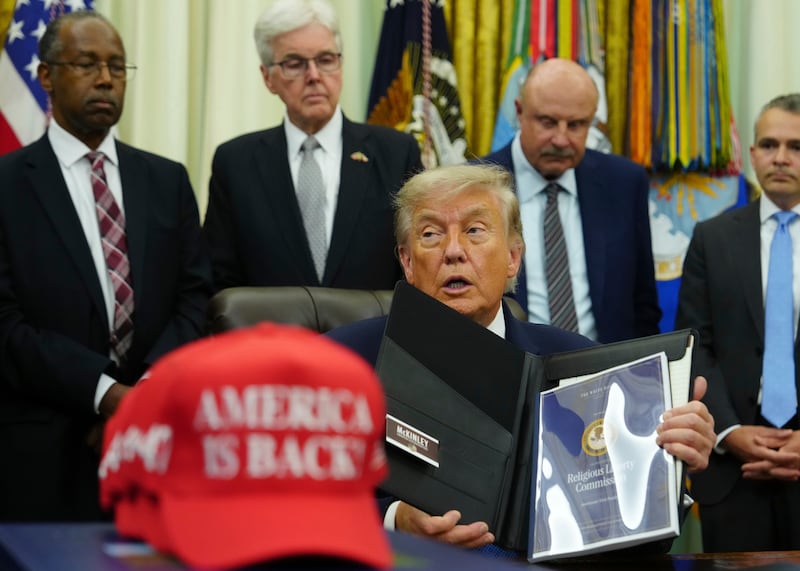

After hearing testimony from more than 100 witnesses over the past year, members of President Donald Trump’s Religious Liberty Commission concluded that government officials and employers have often used “fear tactics” to convince religious Americans they do not have the right to publicly express their faith.
The commission includes well-known figures like Dr. Phil and neurosurgeon and former presidential candidate Ben Carson. It was established last year by Trump to “enforce the historic and robust protections” given to Americans.
Dan Patrick, Lt. governor of Texas and chairman of the commission, told the president, when presenting their report, that the commonly known phrase “separation of church and state” was used on nearly every witness to discourage or suppress their lawful religious expression in public life.
“The separation of church and state is not in the Constitution,” Patrick said. “That phrase should have no power over people of all faiths ever again in America.”
Witness accounts included children bullied for their religious beliefs, a Navy SEAL losing his pension for refusing the COVID-19 vaccine, a teacher threatened to be fired if she didn’t remove a cross from her desk, or a student being targeted at one of the nation’s most prestigious universities because they were Jewish.
The draft report authored by the commission contained 12 recommendations to the president, ranging from establishing religious liberty violation reporting hotlines, to better guidance from the Department of Justice, to repealing the Johnson Amendment, the U.S. tax code that limits the political activity of tax-exempt nonprofit organizations, including churches.
The recommendations are those of the commission, and are not necessarily embraced by religious organizations.
Understanding church and state
The report’s first recommendation is that the DOJ issue guidance on clarifying “the proper understanding of the Establishment Clause and separation of church and state.”
The Establishment Clause is the first of the two religion clauses in the First Amendment. The second clause immediately following it is the Free Exercise Clause:
“Congress shall make no law respecting an establishment of religion, or prohibiting the free exercise thereof.”
The U.S. Constitution makes no mention of separating church and state. That wording comes from a letter Thomas Jefferson penned in 1802 to the Danbury Baptists, in which he wrote about “a wall of separation between church and state.”
“It was one sentence in one letter out of hundreds of letters that Thomas Jefferson wrote,” Patrick told Fox News’ Charlie Hurt, “and the people who use that, Charlie, they either don’t know the Constitution ... or they do know it, and they’re pushing their own agenda to frighten people and quiet them.”
Eric Baxter, vice president and senior counsel at The Becket Fund for Religious Liberty, said the modern view of strict separation took hold in constitutional jurisprudence in the 1960s and ’70s.
“Americans inherently are drawn to God,” he told the Deseret News. “So it’s natural when we have major successes or community challenges, when we suffer tragedies, it’s natural to turn to God, to turn to religion, to have those expressions in public settings.”
“And for many years,” he said, “the court was basically sending the message that that was inappropriate and a violation of the Constitution if it ever took place on public land, or in public settings, or in public government meetings, and so forth.”
U.S. Supreme Court rulings in the 20th century included rulings prohibiting state and federal governments from passing laws that aid all religions or one religion over another, and another banning school systems from facilitating official prayers — both rulings cited the Establishment Clause as being violated.
Baxter, who has litigated religious liberty cases for more than a decade, including at the nation’s highest court, said the Supreme Court has gradually moved away from a broad “wall of separation” interpretation of the Establishment Clause, instead looking to the nation’s history and the founders’ understanding of what constitutes an establishment of religion.
“When the founders barred establishments, they were barring a specific thing: they were barring you from having an established church, from letting government officials dictate doctrine or select clergy, from taxing people to favor a particular church, and punishing people for not going to church,” he said. “So, there are specific things that they understood to be an establishment, and the Supreme Court is starting to say, ‘look, if it’s not one of those themes, it’s not a violation of the Constitution.’”
The court is increasingly recognizing that public religious displays are often historical or cultural acknowledgments, rather than unconstitutional government endorsements of religion, he said.
“You can walk into pretty much any public building in America that’s more than 50 years old, and there will often be religious symbols, religious statues,” Baxter explained, “and as long as no one is discriminated against because of the religion, that’s not a problem.”
How religion affects a nation
During the commission’s report presentation in the Oval Office last week, Patrick and Carson praised Trump for his actions on religious freedom.
Patrick portrayed the issue as partisan, with threats generally coming from one side of the political spectrum.
Baxter said Becket has faced litigation with virtually every president since the institute was founded, and that each administration has had pros and cons regarding religious freedom.
He believes the issue remains heavily bipartisan and that the vast majority of Americans support religious liberties, even in circumstances that may be surprising.
“Elected officials would benefit from understanding that, because really many, many of their constituents, no matter whether from the most left or the most right-leaning districts, have religious needs and need religious liberty protections,” Baxter said.
His concern is that some do see religion as something to be managed rather than supported — an example he brought up is when military leaders see their soldiers’ religious accommodations as an inconvenience they have to allow.
“They should be embracing the fact that they have soldiers, you know, airmen and women, sailors who are coming in and wanting to embrace their religion, whether they’re Muslim, Sikh, Jewish, Christian, whatever it be, but those service members are way more likely to be 100% committed to their duty, to be hard working, to really be willing to stick through the hard things, because their religion is part of what inspires them to do that.”
He continued, “Whereas if you just kind of treat the religion like something that you have to modify, you have to accommodate, and you’re not really doing everything that you need to help them exercise their religion, that’s going to build resentment and make them feel torn between their loyalty to God and their loyalty to the country.”
“The religion clauses are referred to as our first freedoms, not just because they’re listed first in the Bill of Rights, but because they are also the cornerstone or the bedrock of all of our other freedoms,” Baxter said. “Because they help ensure that there are morally good people who are willing to uphold the laws of our country and do all those things that are necessary for democracy to thrive.”