

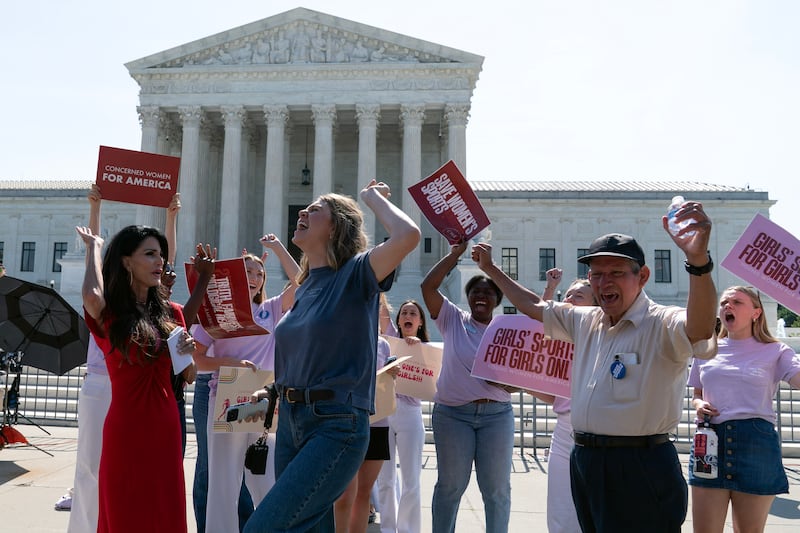

The U.S. Supreme Court on Tuesday gave states constitutional authority to enforce laws barring transgender athletes from participating in girls and women’s school sports.
In a 6-3 ruling, the justices ultimately said that laws like those adopted by more than two dozen states are lawful.
The conservative majority held that federal civil rights law, Title IX, allows schools to maintain separate girls and boys sports teams based on biological sex and that states do not violate the Equal Protection Clause of the 14th Amendment by limiting sports to biological sex.
The justices rejected the argument that the laws discriminate against transgender people, saying they classify athletes based on biological sex rather than gender identity and therefore are constitutional.
“Sports are generally zero sum,” Justice Brett Kavanaugh said in the majority opinion. “Every biological male who makes the team takes a roster spot from a female athlete. Every biological male who earns playing time reduces the playing time of a female athlete. Every biological male who starts takes a starting position from a female athlete. Every biological male who wins a race takes the gold medal away from a female athlete.”
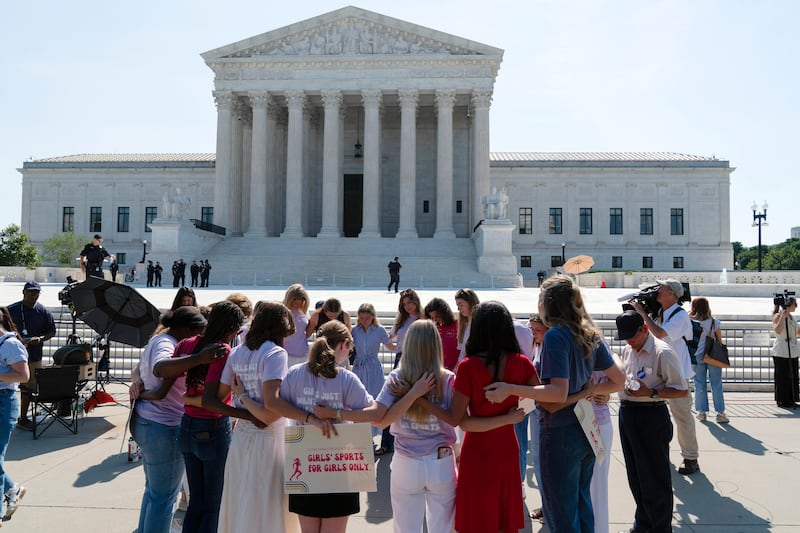
Regarding Title IX, which prohibits sex discrimination in education, he said “the States argue — and we agree — that the interests in safety and competitive fairness are important for purposes of equal protection analysis. And the States’ sex-based classification — limiting women’s and girls’ sports to biological females — is substantially related to those interests.”
President Donald Trump praised the ruling, calling it a “BIG WIN” on Truth Social:
“The United States Supreme Court just RULED AGAINST MEN PLAYING IN WOMEN’S SPORTS. Wow! That takes that ridiculous situation off the table!!!”
Utah enacted its law in 2022, prohibiting biological males from playing in or against female sports teams. Utah Attorney General Derek Brown called the Supreme Court ruling a “victory” for girls and women.
“The court confirmed what Utah has maintained since 2022: states have the constitutional authority to set fair rules for girls’ and women’s school sports, and Title IX does not compel otherwise,” he said in a statement. “Our office will continue to defend HB11 with this ruling now squarely behind us.”
Though not all Utah political leaders agreed with the ruling.
Utah House Democrats said, “The U.S. Supreme Court got it wrong.”
“This ruling, and all laws banning transgender girls from playing in school sports, are not about protecting girls’ athletics. They are rooted in fear and discrimination against transgender people,” their statement said. “Strengthening women’s sports starts with expanding access and opportunity, not using athletics and gender identity as a tool to divide or exclude vulnerable young people.”
Case background
In 2025, just weeks after the Supreme Court upheld states’ rights to have laws against administering gender-related medical treatments on minors — like puberty blockers and sex change operations — the court agreed to take up the issue of transgender athletes in female sports in its 2026 calendar.
The case marks the Supreme Court’s first opportunity to address the issue of transgender athletes in girls and women’s sports, a debate that has dominated state legislatures and national politics in recent years.
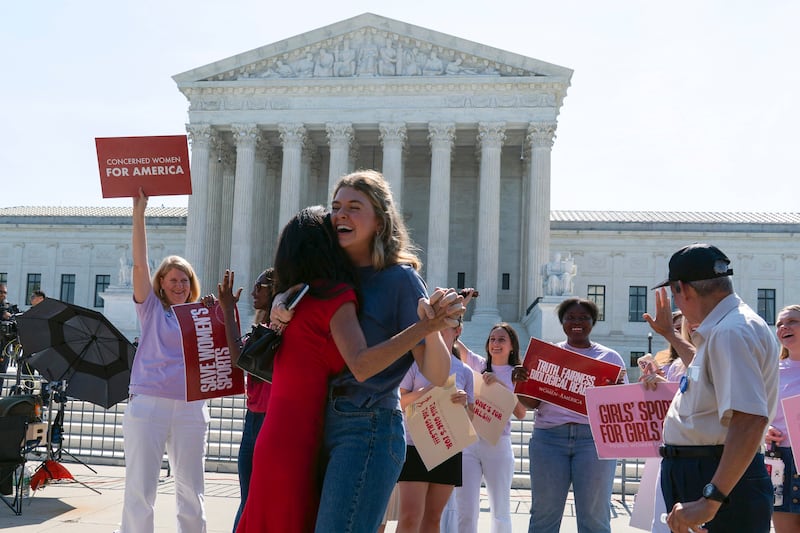
In the beginning of his second term in the White House, Trump signed a presidential action stating that “it is the policy of the United States to rescind all funds from educational programs that deprive women and girls of fair athletic opportunities, which results in the endangerment, humiliation, and silencing of women and girls and deprives them of privacy. It shall also be the policy of the United States to oppose male competitive participation in women’s sports more broadly, as a matter of safety, fairness, dignity, and truth.”
More than a dozen states have laws restricting transgender athletes, people born male but who identify as female, from participating in female sports.
The court heard oral arguments last January in two combined cases arising from Idaho and West Virginia.
In both of these states, those laws were challenged in court:
Little v. Hecox
In 2020, Idaho enacted the Fairness in Women’s Sports Act, which ultimately barred transgender girls and women from playing in public school sports — elementary to college. Lindsay Hecox, a student athlete at Boise State University and a high school student named as Jane Doe filed a lawsuit arguing that their constitutional rights, specifically the Equal Protection Clause of the 14th Amendment, were being threatened.
West Virginia v. B.P.J.
West Virginia requested the high court to weigh in after the 4th U.S. Circuit Court of Appeals issued an injunction blocking the Save Women’s Sports Act, a state law enacted in 2021 that says athletes in any public secondary school or state institution of higher education can only participate on sports teams that align with their biological sex.
Like the Idaho case, a transgender student, Becky Pepper-Jackson, filed a lawsuit with the American Civil Liberties Union and Lambda Legal, arguing that Title IX, and the Equal Protection Clause of the 14th Amendment prohibit the state from blocking transgender athletes from participating in female sports.
The West Virginia case focused more heavily on Title IX, a federal civil rights law that prohibits sex-based discrimination in education programs and activities that receive federal funding.
Supporters of allowing transgender girls to compete in girls’ sports argue that Title IX’s protections against sex discrimination extend to gender identity, but those against allowing participation argue that the law was intended to protect opportunities for biological females and that allowing transgender girls to compete undermines those protections.
During oral arguments before the court earlier this year, the court appeared to indicate how it would ultimately rule.