

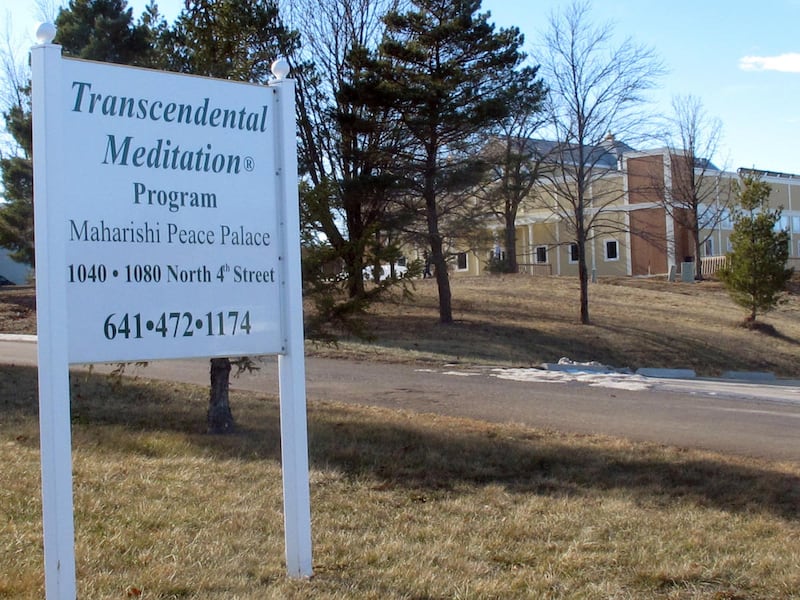
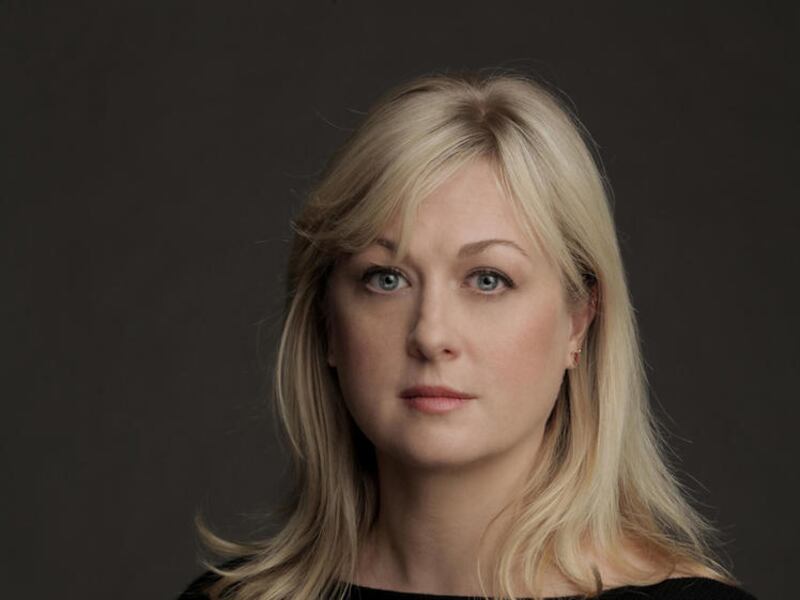

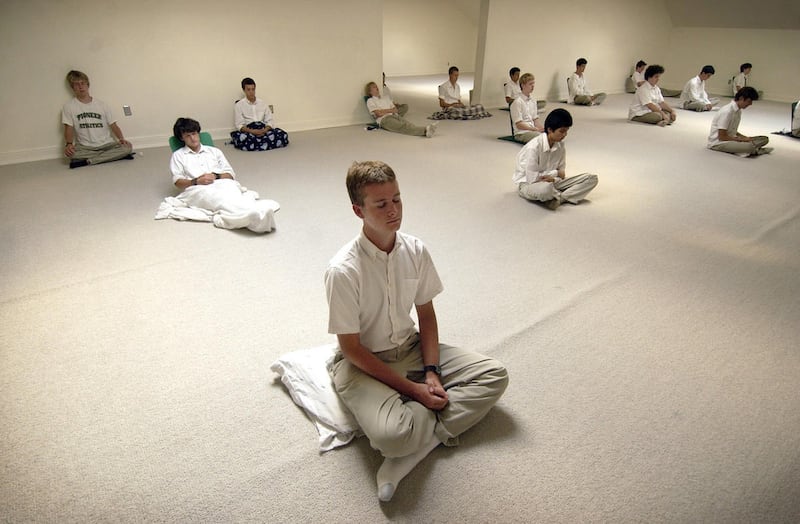

Claire Hoffman first meditated when she was 3 years old. By age 5, her mom had moved her and her brother to Fairfield, Iowa, to be part of a transcendental meditation community.
For the next 12 years, Hoffman's family life revolved around the teachings of Maharishi, Utopia Park's guru. She memorized his wisdom in a special school and her mom spent three to four hours away from home each day in deep meditation.
Hoffman's childhood seems foreign at first, but parts of it are tragically familiar. She was raised by a single mom. Her dad was an alcoholic. She struggled to carry her early beliefs into adulthood.
"I was stuck between two worlds, and that feeling kind of continued on forever," she said.
Hoffman describes her unique upbringing in "Greetings from Utopia Park: Surviving a Transcendent Childhood," which was released in June. Her tale is influenced by her academic engagement with religion (she has a master of divinity degree from the University of Chicago) and the cynicism of being a journalist.
However, at its heart, Hoffman's story is about how some pieces of childhood faith never leave you, even when you're angry or confused. She returned to transcendental meditation after her daughter was born and considers the practice to be an essential part of her spiritual life.
"The big arc of the story is about excavating value from a belief system that you might not buy into anymore and understanding that there are great things to be taken from it," she said.
Hoffman spoke with the Deseret News this week about making peace with strange spiritual beginnings and practicing a faith that few people understand. The interview was edited for length and clarity.
Deseret News: Would you describe practitioners of transcendental meditation as a religious community?
Claire Hoffman: Many of the people who practice transcendental meditation today don’t even know who Maharishi is. There’s no set of beliefs that goes with that (meditation) technique.
When you learn to meditate, people will often say that you don’t have to believe anything to make it work. It’s not a beliefs-based practice.
High-profile meditators like Oprah, Ellen, David Lynch, Howard Stern, Gisele and pretty much every celebrity at this point probably know little to nothing about Maharishi.
But I would call where I grew up a belief community. Maharishi was our guru, and he had a whole vision of the way life should be lived. We believed that he was enlightened and, stemming from that belief, everyone signed up for all the knowledge that was spewing forth from him.
DN: What do you think outsiders often misunderstand about communities like Utopia Park?
CH: Growing up in this town that was really divided (between followers of Maharishi and others), there was a lot that was different and a lot that was the same from life somewhere else.
There was an outside perception of us being these sort of fairy people who moved from a coast to the Midwest to only eat vegetables and spend their whole day meditating. But the truth is, my mom was a single mom who was struggling and my dad took off and was an alcoholic.
Human suffering is common ground, and stereotypes keep you separated from each other.
DN: You left Fairfield, Iowa, as a teenager and built a life separate from transcendental meditation. What inspired you to start practicing again?
CH: I left when I was 17, and I was pretty jaded and pretty cynical. I had a real sense of the hypocrisy of the organization and some anger about that.
In the decade that followed, a lot of (those feelings) solidified. As a reporter, I learned more and more that I found upsetting and disillusioning.
After I had my first daughter, which was 6 years ago, I felt a strange sense of sadness, maybe a lack of integration. I had really fond memories of my childhood and that sense of magic and purpose that I had as part of that community.
I didn’t feel like I had a way to pass that on to her, because I really didn’t believe in anything at all.
As a new parent, you see this baby and it’s pretty magical. You feel an incredible and immediate sense of not wanting to screw them up, which I carry with me daily. You don't want to take away that magic or sense of innocence. You want to supplement it.
A lot of people I grew up with recognized hypocrisy in their childhood belief system and wanted to throw the whole thing out. But I didn't want to just be angry and cynical about it.
I went back (to Fairfield) when my daughter was 1 and took a month-long advanced technique course. It was a powerful experience. I felt more connected to my mother and my past. I took some of the value and integrated it into my life.
Since then, my daughter and husband have learned to meditate. But we don’t have pictures of Maharishi in our house. It’s not the same as when I grew up.
DN: How did you explain your desire to return to transcendental meditation to skeptical friends and loved ones?
CH: The advanced technique of Maharishi’s meditation is something called yogic flying. It’s this idea that you’re going to practice a form of meditation that allows you to levitate.
There’s nothing you could be more cynical and skeptical about.
As a journalist, I worked at places like the L.A. Times, New York Times and Rolling Stone. Those are not places that embrace that kind of guru thinking, and I loved that about them. I really enjoyed being with people who questioned everything.
But when I decided to go back, the people I told would start digging into me. It was sort of like they found this soft spot in me that they could stick a finger in.
But it’s easy to stand in a fixed position and say, "You know, all this religious or spiritual stuff is bull honky and it’s made up and it’s stories that we tell each other. It’s delusional. It’s not logical." I would have these debates with my husband, and I still do.
It was an expansive experience to let go of cynicism and let go of some of the logical parts of my brain and to access more transcendent parts of me. It made me see that life is more complicated and strange.
DN: What inspired you to pursue an advanced degree in religion?
CH: Religion as an academic subject became attractive to me in college. I took an anthropology course on born again Christianity.
It was like a light switch going off. I could see these patterns and commonalities between belief systems. I could see so much of what happened in Fairfield in these other religions and it was really exciting.
There’s something about the way we conceive of the divine and cosmic, and the way it gets interpreted into daily life — I can't get enough of it.
DN: Why do you think so many people are attracted to meditation?
CH: One obvious explanation for a rise in popularity of meditation is the wired nature of the world. We wake up and look at a cellphone. We’re getting news alerts throughout the day, and we’re constantly connected. That makes it really hard to have a sense of quiet and a sense of space, which meditation can give you.
Meditation gives me my sense of self. It helps separate me from my thoughts.
Growing up in a tumultuous family situation, meditation was really valuable. It gave me a privacy and protectedness from a chaotic childhood.
DN: What advice do you have for people who are still figuring out their religious or spiritual journey?
CH: When I was in high school, a friend of mine wrote — as so many high school girls have — in my yearbook, “Claire, never ever change.”
I read it and, even at the time, I was like “Ugh! All I want to do is change.”
I think people hit certain ages and they think they’re supposed to be finished changing. But that mindset can really arrest your development.
I think if you have a yearning for deeper feelings and experiences and ideas, you have to follow that. It can be so joyous and rewarding. And if you don’t, you can end up living in a very flat world.
Email: kdallas@deseretnews.com, Twitter: @kelsey_dallas