

Living in the early 21st century, we have means of accessing scripture unimaginable to people only a few decades ago. Modern digital technologies allow us to carry a vast library of scripture and related books on our personal “white stone” — like phones and computers (see Doctrine and Covenants 130:10-11).
Indeed, we can not only access our own scriptures — in multiple languages, with links to dictionaries, commentaries and studies — but can also access the sacred texts of almost all the great religions of the world.
The digital revolution of the late 20th century that transformed scriptural accessibility was preceded, some 500 years earlier, by the printing revolution, which created the possibility of relatively inexpensive copies of scriptures and other books. Even so, through the mid-19th century, most people were able to read scripture only in “family” Bibles rather than personal copies. Today one can buy a copy of the Bible for less than an hour’s work at minimum wage and access a digital copy essentially for free.
Before the print revolution in the 15th century, copies of the Bible — or any other scripture — were very rare and expensive because they had to be copied by hand by well-trained scribes, often using special methods and ritual practices. This would generally require several months of work and thus cost thousands or even tens of thousands of dollars, in modern terms.
Thus, at the time of Jesus, only very wealthy individuals would be able to afford personal copies of scripture or any other books. The richest individual might have a personal library numbering in the hundreds. The greatest library in the ancient world, the Museum of Alexandria, housed only several hundred thousand books.
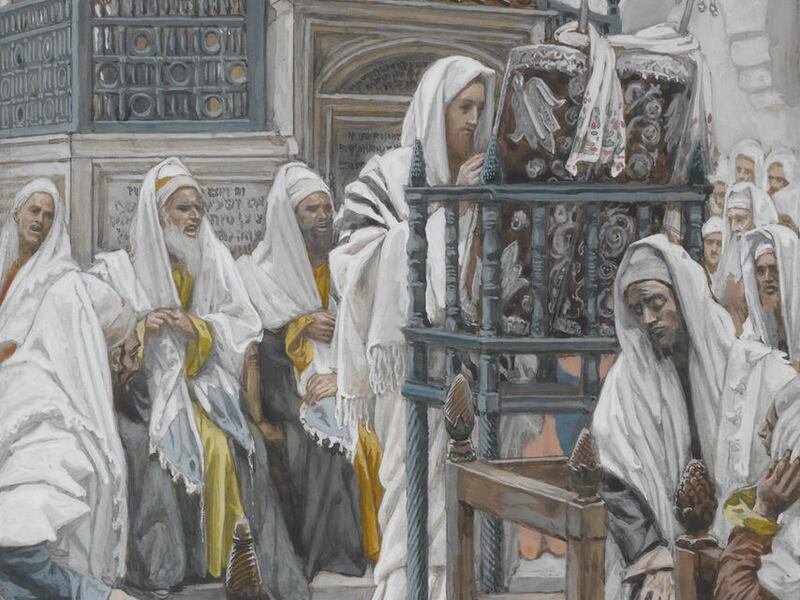
The expense of books meant that the average person in antiquity did not own a personal copy of scripture. Ordinary Jews and Christians at the time of Jesus encountered the scriptures through public reading. Throughout the Old Testament, scripture was read publicly to the people (Exodus 24:7; Deuteronomy 17:19, 31:11; Joshua 8:34; 2 Kings 23:2; Nehemiah 8:3, 9:3; Jeremiah 36:6-10). Only priests and aristocrats are described as reading scripture.
Public reading of scripture was likewise the norm during the time of Jesus. Reading scripture occurred each Sabbath in synagogues (Acts 13:15, 27, 15:21; 1 Timothy 4:13). The only example of Jesus reading directly from a book of scripture is in Luke 4. He visits the synagogue of Nazareth on the Sabbath and is asked to read from Isaiah (Luke 4:16). Then he is handed the book (“scroll”) to read — he does not appear to have his own copy (Luke 4:17). The only possible exception to this is the royal treasurer of queen Candace of Kush (modern northern Sudan), a wealthy aristocrat, who is said to have had a copy of Isaiah — though not necessarily of the entire Hebrew Bible (Acts 8:27-30).
Just like the reading of the Hebrew Bible in Jewish synagogues, Christian books and letters were intended to be read publicly (Colossians 4:16; 1 Thessalonians 5:27). The book of Revelation declares “Blessed is he that readeth, and they that hear the words of this prophecy.” Which is to say, a single individual was to read the book to a group of Christians, who listened to what was read. Such public reading of scripture still occurs in most Jewish, Christian and Muslim denominations.
If Jesus, Paul and the other apostles did not have copies of the Bible for personal scripture study, how did they manage to quote from it so extensively? They were generally quoting from memory. A copy of the Hebrew Bible was generally stored in each synagogue. Young Jews could attend classes, where they learned to read the Bible.
The Hebrew Bible was read over and over through the years; study in education focused intensely on memorizing scripture, which is described as writing on the tablet of the heart.
As Jeremiah put it: “I (the Lord) will put my law in their inward parts, and write it in their hearts” (Jeremiah 31:33; see also Proverbs 3:3, 7:3; Jeremiah 17:1; 2 Corinthians 3:2). A hard heart, thus, is that upon which the word of God cannot be written.
Throughout the New Testament, Jesus repeatedly expects his listeners to know the content of scripture both by hearing and reading, repeatedly asking his listeners, “have you not heard/read?” In the end, the Pharisees are condemned because they “have not his word abiding in (them)” even though they “search the scriptures” (John 5:38-39).
Daniel Peterson founded BYU's Middle Eastern Texts Initiative, chairs The Interpreter Foundation and blogs on Patheos. William Hamblin is the author of several books on premodern history. They speak only for themselves.