

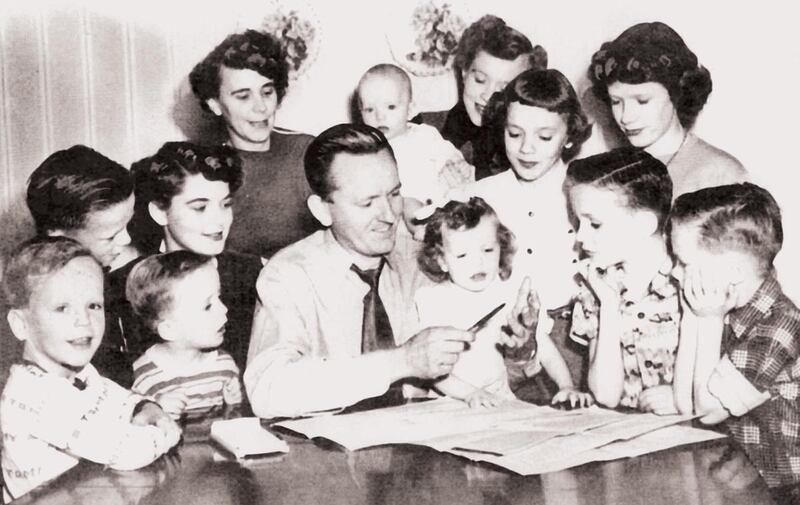
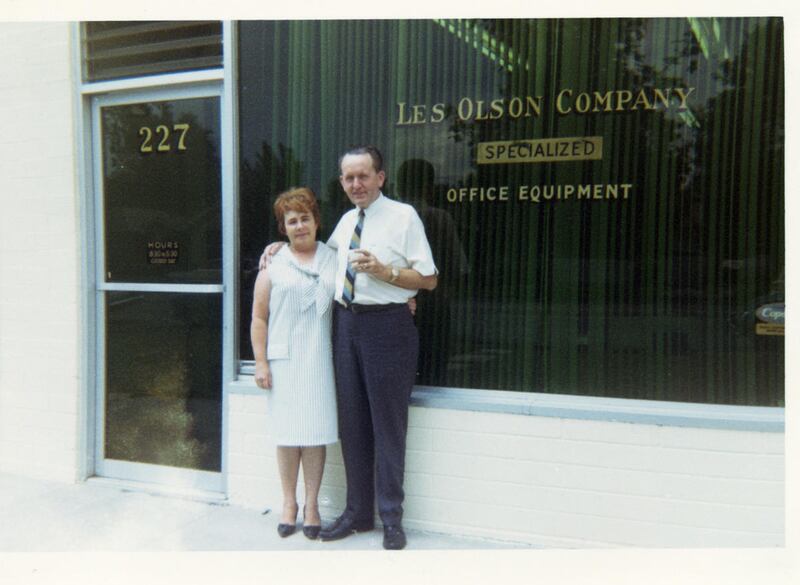



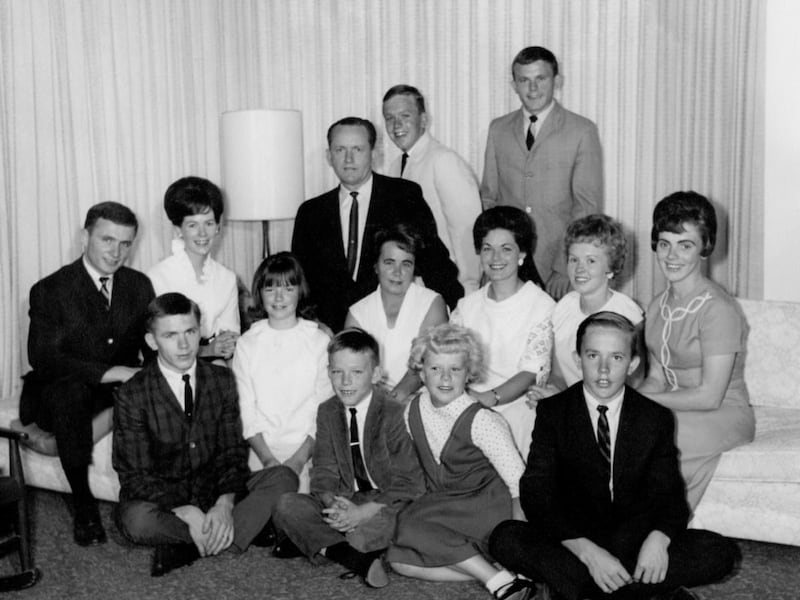

SALT LAKE CITY — On an otherwise routine, nothing-out-of-the-ordinary weekday afternoon in the spring of 1956, 42-year-old Les Olson pulled into his driveway, turned off his car, loosened his tie, walked in the front door, cleared his throat, and informed his family he had an announcement to make.
He’d just quit his job …
… and he didn’t have another one.
Instead, he planned to start his own company selling business machines.
But no way could he do this alone, he told his 12 kids. He asked them to go to their rooms and get their piggy banks.
A few minutes later, the kids were back, dumping their life savings on the kitchen table. All total, they had $63. That’s $578 in today’s dollars.
Les’s wife Reva wrote down every investment in a notebook, while Les, sensing history while he was making it, spoke of building a family business that would last. The next day, he used the family stash to buy a train ticket to the East, where the plan was to secure a line of dictating machines.
The Les Olson Company was born.
• • •
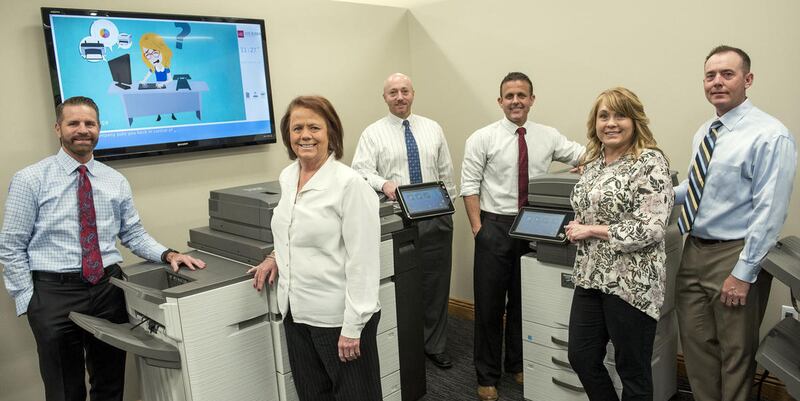
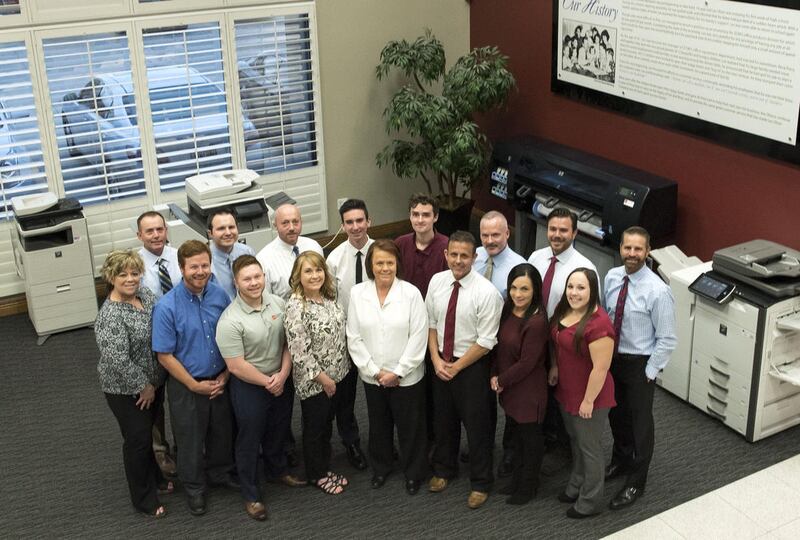
Sixty years later, Les Olson Company stores stretch from Logan to Las Vegas, selling and servicing copiers, scanners, printers, servers, computers, document management, firewalls — pretty much anything you can think of an office might need (other than, ironically, dictating machines). Thanks to good management, good timing (it helped to start doing business when a new product called a photocopier came on the scene), and, among other things, ahead-of-its-time customer service and a catchy, toe-tapping advertising jingle — “Les … Ole-son … Come-puh-nee” — the business Les started has had a nice little run.
But the kids. What about the kids? How have the decades treated them?
Even better, it would seem. Through life’s ups and downs, trials and triumphs, land mines and smooth sailing, the Olson brothers and sisters have stuck together like flypaper. There’s close and then there’s Olson close. Sixty years later they remain as tight as the day Les came home and raided their piggy banks.
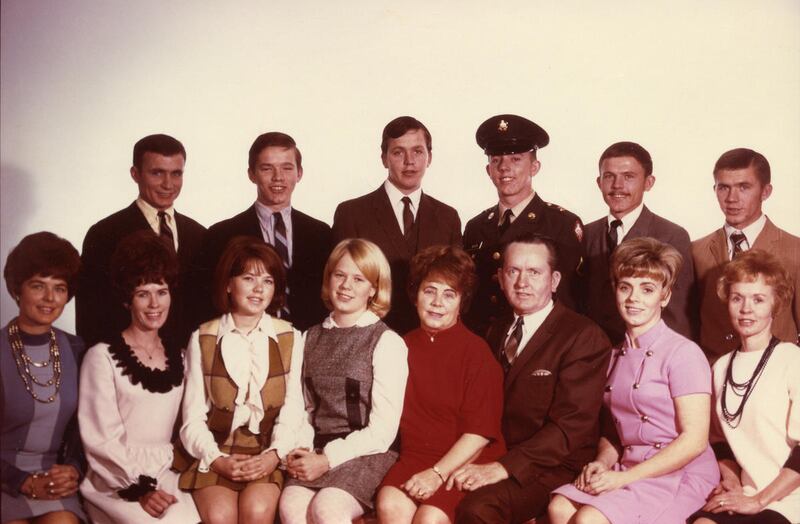
They’re senior citizens now, baby boomers eligible for Medicare, ranging in age from 82 to 63. There’s Nancy, JoAnne, Annette, Ray, Steve, Larry, Tom, Jim, Susan, Scott and Debbie, the baby. Only Barbara, the third oldest, is gone; she died from heart failure in 1983 when she was just 46.
For 19 years, from 1934 through 1953, an Olson kid was born, on average, every 19 months. Reva and Les started with four girls, then had five boys, followed by a girl, a boy and a girl, for an even half-dozen of each.
They grew up together in a crowded, noisy, lively homestead in East Millcreek, where they went through 12 quarts of Arden Dairy milk a day, ate supper next to each other every night, without fail, on a large round bench, and never had any trouble finding enough bodies for a softball game in the street.
They made do, and when they couldn’t make do they did without. When a shoe got a hole in the sole, that’s what cardboard was for. “Don’t lift your foot and nobody will know,” Les, who polished the kids’ shoes, used to say when he sent them off to school. He always cooked breakfast, because Reva was up half the night dealing with babies. He had just two rules: don’t fight amongst yourselves and don’t sass your mother. Break either one and you had to deal with a “good talking-to” from Les, a fate worse than a whipping.
Everybody’s business was everybody’s business. When Nancy was named “Most Beautiful Schoolgirl” in a contest sponsored by Lux Soap, it was due in no small part to her brothers and sisters scouring the neighborhood for Lux Soap wrappers to send in with their votes; when Ray went off to the Air Force at 18, he got more letters than anyone at boot camp; when Steve and Larry won state wrestling championships at Olympus High School, their personal cheering sections took up half the bleachers.
“Mom and Dad taught us to be so close, we were a team,” remembers Annette, daughter No. 4. “There’s not one brother or sister that wouldn’t give me the shirt off their back, then or now.”
On that fateful day when their dad started his own business, the surprise would have been if he had not involved them.
“We always had family councils after dinner, where someone would talk about what was going on in their life,” recalls Steve, son No. 2. “The day my dad quit his job, he said it was his turn to talk. When he told us what was happening, I remember my 12-year-old heart wondering, what about me, what about my food, what about my clothes? I suspect others were a little frightened too. Mom was standing behind him, like she always did, and she caught the emotion and said, ‘Children, don’t worry about a thing. I have perfect faith in the Lord and perfect faith in your father and it’s going to be OK.’ As soon as she said that, it was like 12 collective sighs went around the table. Oh, if mom says it’s going to be all right.”
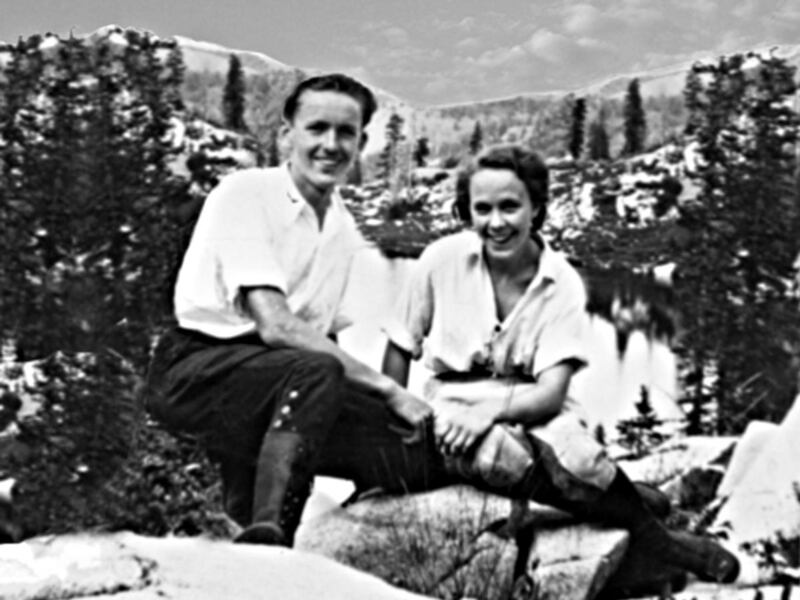
For Les Olson, it was merely another chapter in a life full of selling himself that began when he was a 14-year-old freshman at West High School and was pulled out of the welcoming assembly and told that his father, a laborer for Union Pacific Railroad, had just suffered a fatal heart attack. Gustave Marcellus Olson was on top of a train in mid-swing with a hammer when he died.
Les ran home from school and never ran back. He got a job as an errand boy at the ZCMI department store in downtown Salt Lake City for $50 a month to help his mother and two sisters keep the Great Depression, which was just beginning, at bay.
He’d worked at ZCMI for 28 years and risen to a position as divisional manager over office products by 1956, when he was passed over for a raise, or missed out on a bonus, or was facing a pay cut. Olson family history isn’t entirely clear on the subject.
Either way, he was outta there.
The company he started was long on vision, short on funds and off the charts on energy. After working so long for somebody else, working for himself was a dream. If a business owner had a pulse, Les tried to sell him office gear. He cold-called the state.
He made it a point to take his boys with him, which was in its own way a college course.
Larry, son No. 3, was in eighth grade when he accompanied his dad to the Glen Canyon Dam, then under construction in southeastern Utah, and helped carry machines and supplies across the suspension bridge to the work site to make sure they got the sale.
That was memorable, but even more memorable for Larry was the conversation he had with his dad that night over dinner, when Les gave Larry a $1 bill in exchange for 11 shoeshines.
“He wrote 10 numbers on a napkin,” says Larry. “He said each number represented a shoeshine. He gave me the dollar, but he said the first shoeshine was free because he got a cash discount. The point: negotiate with cash and save money.”
Steve remembers the time he and his dad went into a men’s room after a sales call. He watched Les take a paper towel and clean the sink after he used it. Then he watched him clean the one next to it.
“He looked at me and said, ‘What?’” remembers Steve. “’That’s a little weird,’ I told him. He said, ‘Don’t you know, you always leave a place better than you found it?’ I’ve never forgotten that. Even now, if I’m at a grocery store and see a cart in the parking lot, I’ll return it. ’Cause of him.”
There was never a get-rich-quick element to the world Les and Reva created. Accentuate the positive and build something that will last was a mantra that never changed. At Christmastime, Les would give the kids a bonus and then ask them to give it back so the company could grow.
The business raised the kids and the kids raised the business.
Prosperity and adversity, appearing alternately as they do, tended to be handled with equal doses of common sense.
When the copier machine boom hit in the early 1970s, no one in the Intermountain West pounced on it as fast. Les, believed to be the first person in Utah to sell a photocopier, seized on the improvements that turned copying documents from a curiosity into a necessity, inking a deal with Sharp, the Japanese technology giant, that turned LOC into the biggest Sharp dealer in the country, a relationship that lasts to this day.
When a fire gutted their Salt Lake headquarters in 1974, destroying hundreds of thousands of dollars worth of inventory, the company's cash reserves averted a near disaster, if barely, and in the aftermath, instead of using outside companies to lease inventory from, they formed their own leasing company, which has proved to be the most profitable of all the LOC enterprises.
When Reva and Les needed care in their older age, all the kids pitched in to help. Both died surrounded by their family, Reva in 1989, Les in 1995, proving true what Les always said, “When you have 12 kids, you don’t have to worry about going to a rest home.”
After the parents were gone, the business, and family, transitioned seamlessly to the second generation — no infighting, no feuds, no estrangements. A plan put in place years earlier stipulated that as soon as a sibling turned 65, their company buyout would begin. Ray was the first CEO, replaced by Larry, then Jim.
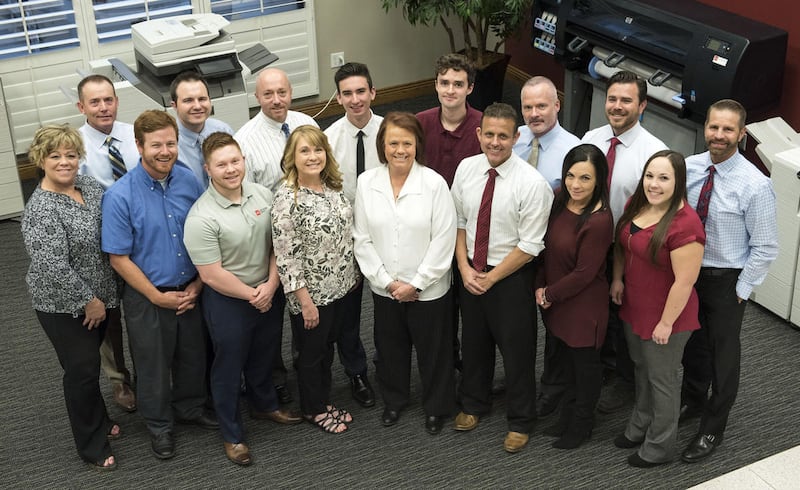
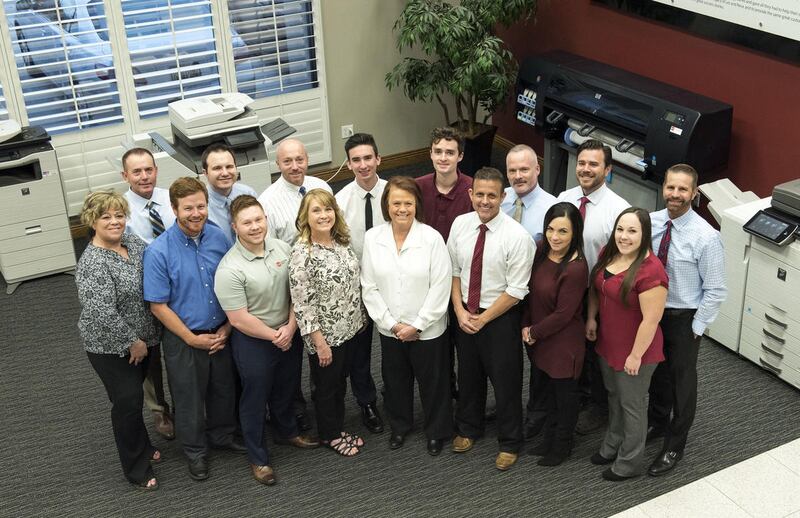
Today, Debbie is the only original Olson sibling still working full time at the company, and at 63 the days until her buyout are numbered. She sits on the board of directors, where Ray’s daughter Lisa Olson Thaller is CFO and chairman of the board. Larry’s son Troy is company president and Jim’s son James is CEO as the third generation settles in. Of the 230 people employed by the company, 30 of them are Olsons.
Every summer and every Christmas the entire Olson extended family — comprised in 2016 of no less than 284 people — unites for a reunion and a party. In between, Les and Reva’s remaining 11 children get together for birthdays, weddings and any other excuse to see one another.
On occasion they’re called out en masse to be honored by this organization or that. In 2013, Intermountain Healthcare’s Heart & Lung Research Foundation presented the Olsons with its Legacy of Life Award “for their contribution to the well-being of people everywhere.” This past October, the Arthritis Foundation honored them at its Evening of Honors Gala “for their leadership and dedication to community and philanthropy.”
They trudge up there on stage — like the Von Trapp Family Singers — and take their bow, understanding that on one level they’re being used to raise funds for good causes. The Olsons have lots of friends and lots of influence.
But on another level they understand it’s pure and simply a shout-out to Les and Reva — hey Mom and Dad, look at us, still standing, still trying to make you proud, still a whole lot stronger together than individually. Living proof that families can and do stick together. And still ready to run and get their piggy banks whenever they’re asked.