

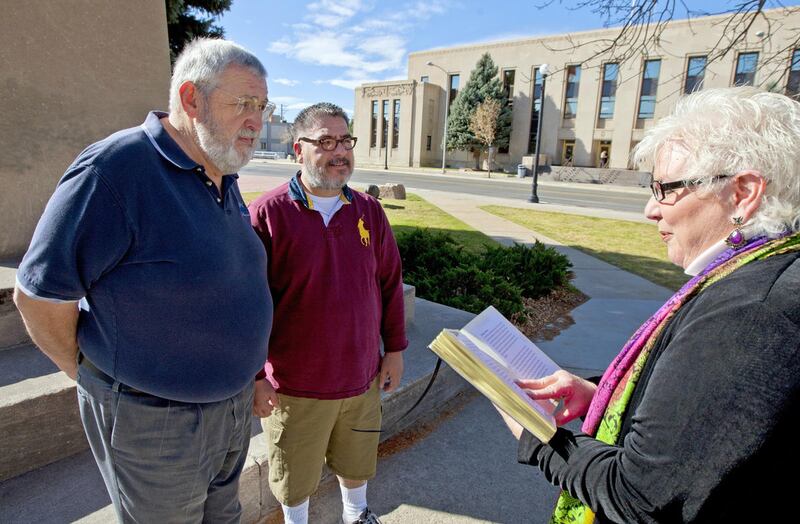
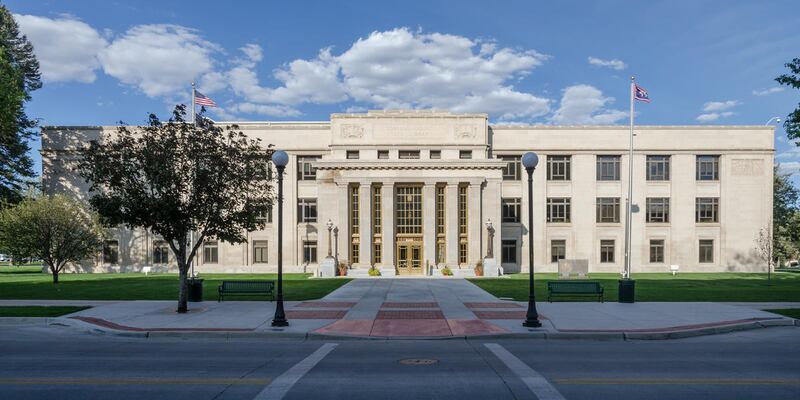
This week’s 3-2 ruling from the Wyoming Supreme Court — allowing a municipal judge, Ruth Neely, to remain on the bench but still censuring her for violating the state’s Code of Judicial Conduct — is an incremental victory for America’s corroding landscape of free speech. Yet, in a strongly worded dissent, Wyoming Supreme Court Justice Keith G. Kautz discusses the danger of unwittingly creating a religious test for serving in the judiciary.
Justice Kautz’s dissent deserves further consideration.
In the fall of 2014, after a federal court enjoined Wyoming from enforcing any “state law, policy, or practice, as a basis to deny marriage to same-sex couples,” Judge Ruth Neely — a devout Christian and a member of the Lutheran congregation in Pinedale, Wyoming — told the town’s paper that she would not perform same-sex weddings.
Judge Neely is a municipal court judge and a part-time circuit magistrate. The Pinedale Roundup contacted her by phone, asking about same-sex marriage, and Judge Neely said, “I will not be able to (perform same-sex weddings). … We have at least one magistrate who will do same-sex marriages, but I will not be able to.”
She continued: “When law and religion conflict, choices have to be made. I have not yet been asked to perform a same-sex marriage.”
Wyoming’s Commission on Judicial Conduct and Ethics recommended that Neely be removed from the bench because, as they argued, refusing to perform same-sex weddings violated the Wyoming Code of Judicial Conduct, which states that “a judge shall comply with the law.”
On Tuesday, however, the Wyoming Supreme Court disagreed with the ethics commission’s conclusion, ruling that while Neely should be censured for her public statements — which, according to the ruling, may have undermined the public’s confidence in an impartial judiciary — the recommended penalty to remove Judge Neely would “unnecessarily circumscribe” the judge’s “protected expression.”
Two of the five judges, however, went further. In their dissent, they argued that Judge Neely never violated the code of conduct, and no censure was necessary. While the majority stated that this case was about maintaining public confidence in an impartial judiciary — not about Judge Neely’s specific religious beliefs or gay marriage — in the dissent, Justice Keith G. Kautz disagreed.
“The issues considered here determine whether there is a religious test for who may serve as a judge in Wyoming,” Justice Kautz wrote. “They consider whether a judge may be precluded from one of the functions of office not for her actions, but for her statements about her religious views."
He concludes: “There is no cause for discipline in this case, nor for concern if Judge Neely is not disciplined or precluded from performing marriages. Same-sex couples have full access to marriage, all persons before the courts can be certain of an unbiased and impartial judiciary, and religious individuals can remain in public office even if they hold a traditional religious view of marriage. … There is room enough in Wyoming for both sides to live according to their respective views of sex, marriage and religion.”
Justice Kautz is right. In Wyoming, Utah and in the nation writ-large, there is ample space in the public square to protect rights on all sides of this and many other issues.
It’s not just judges who feel the tension between religious freedom and emerging LGBT rights. Balancing public religious expression and free speech alongside LGBT rights is a challenge with which the nation will continue to wrestle. The Supreme Court of the United States has stated that “many who deem same-sex marriage to be wrong reach that conclusion based on decent and honorable religious or philosophical premises, and neither they nor their beliefs are disparaged here.”
Their rights should not be disparaged either — especially the rights of those who, like Judge Neely, have served their communities faithfully for decades with no prior indication of bias on the bench.