

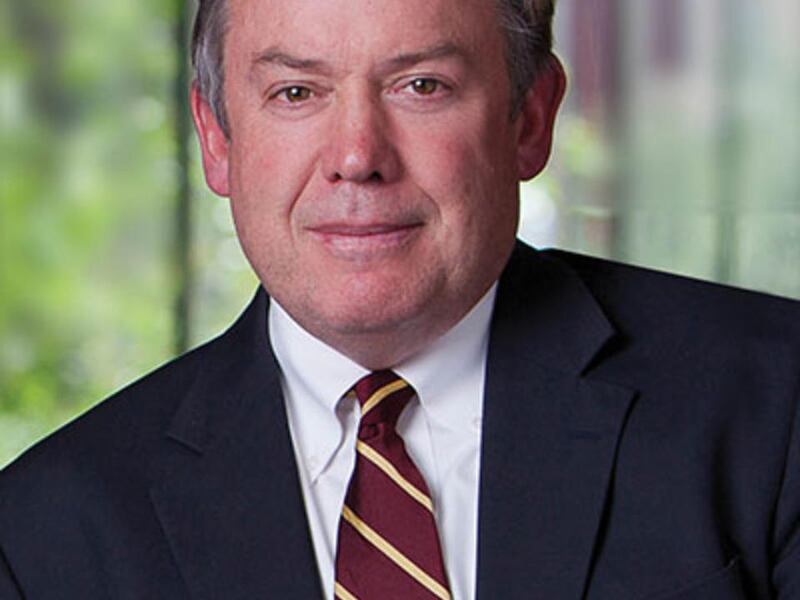

REXBURG, Idaho — Every campus devotional address in BYU-Idaho's long history — 129 years and counting — has been delivered by a Mormon.
Until now.
Arizona State University President Michael Crow will deliver this week's devotional on Tuesday at 2 p.m. in the BYU-Idaho Center. Crow is not a member of The Church of Jesus Christ of Latter-day Saints, which owns and operates BYU-Idaho, but he has developed strong relationships with LDS Church leaders and deep ties to the school's past and current presidents.
"I feel honored by the invitation," Crow said. "It's exciting to speak to 6,000 young people and have a conversation. I'm looking forward to it."
The title of Crow's speech is "Infinite: Your physical, intellectual and spiritual self." BYU-Idaho's administration invited students to prepare for the devotional by considering a question posed by Crow: "What is the most complex creation in the universe and how are you using yours?"
Students have been sharing their response on an online discussion board.
BYU-Idaho devotionals have always been delivered by Mormons with titles or honorifics familiar within the faith, like elder, sister and brother. If "president" appeared before a devotional speaker's name, it was because the speaker was the university or college president (BYU-Idaho was Ricks College prior to 2001), a member of the faith's First Presidency or the leader of another church organization or school.
Non-LDS speakers have appeared at BYU-Idaho forums, but recently, LDS speakers have dominated those events, too.
Crow said he was raised a Methodist. One of the first things he did as the new president of ASU in 2002 was try to repair an ailing ASU-LDS relationship. He'd been told the church's Institute of Religion might be leaving its aging facility on church-owned land on the ASU campus.
"I walked over to see the Institute director," Crow said. "I'd never met the guy, and I said, 'Actually, I don't agree with that. What I'd rather do is have you guys figure out how we're going to build a great new Institute here. We're going to attract more LDS students here. We're going to give the LDS students what they want, whatever they need to feel comfortable at this big, public university.' So we worked that out. That's when I first started interacting with church leaders."
He met with late church President Gordon B. Hinckley and developed an ongoing relationship with President Henry B. Eyring, first counselor in the First Presidency of the church. That led to ties to BYU-Pathway Worldwide President Clark Gilbert, who was succeeded last month as BYU-Idaho's president by President Eyring's son, Henry J. Eyring.
"I've really found great pleasure in finding ways to engage with the church, the church leadership," Crow said. "We now have two brand-new, great Institutes, one our Tempe campus and one on our Polytechnic campus in Mesa."
Two weeks ago, he met with Elder Kim B. Clark, the Church Commissioner of Education and a General Authority Seventy, about ways ASU and the church could colloborate.
"I'm very excited," Crow said.
BYU-Idaho's past two presidents, Elder Clark and Gilbert, along with the new president, Eyring, are among the creators of the Pathway program. Crow has launched a fairly similar program, the Global Freshman Academy, at ASU. Crow and Gilbert appeared on a panel together at the ASU-GSV Education Summit two weeks ago, when Crow said he intended to compete with Gilbert to see which online program could attract the most students.
Crow is a self-taught historian who has studied early LDS history.
"Mormonism is America's really only wholly emerged faith," he said. "It's very fascinating to read about what was going on in New York and Missouri and Illinois and Utah."
He said he has defended Mormons in Arizona.
"I've often felt that the LDS folks get sort of a bad rap, and I don't even know what it's from. It's like the weirdest thing I've ever seen. By my observation, it's a faith that produces some of the most civic-minded individuals I've ever known, people deeply committed to their families, deeply committed to their communities."
Crow became ASU's 16th president in 2002. His stated goal is to transform the nation's largest public school (72,000 enrollment last fall) into one of the nation's top public metropolitan research universities. U.S. News & World Report named ASU the nation's most innovative school in both 2015 and 2016.
Crow previously worked as a professor of science and technology policy and executive vice provost of Columbia University. He is the co-author of "Designing the New American University," published in 2015.