

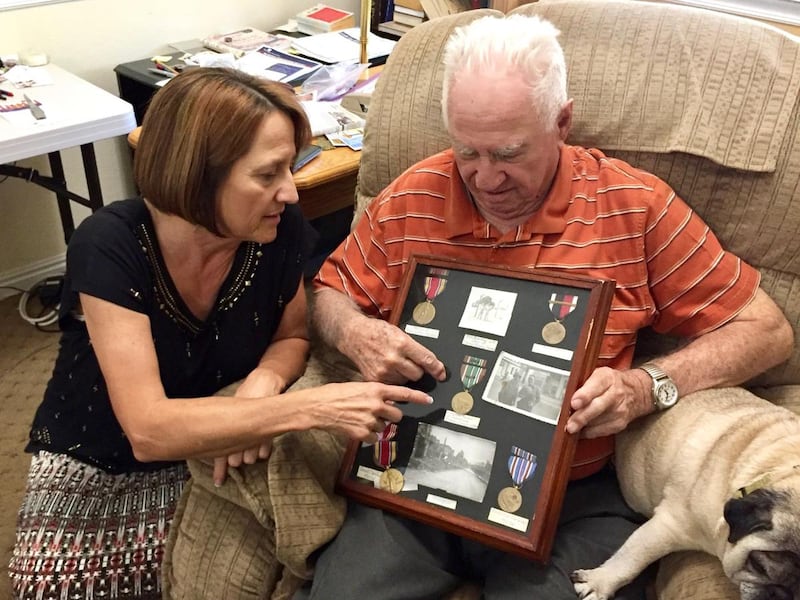
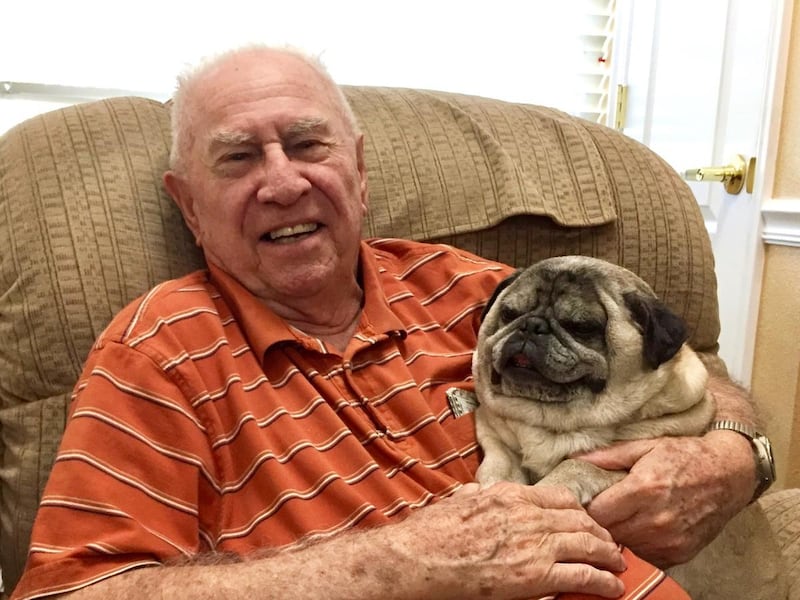

BOUNTIFUL — As is his custom, 92-year-old John Bassarear doesn’t have anything special planned today for Memorial Day, certainly nothing to draw attention to himself.
He may have fought in WWII, doing his part to battle oppression and preserve freedom, but he’s never bragged about it and never will.
What he will do is remember and honor those soldiers who died so the rest of us could live.
In his case, quite literally.
He was just 19 in the summer of 1944 when he joined the Army and was sent to Europe to chase the retreating German army. He landed on Utah Beach in Normandy to a much warmer reception than those soldiers who had come ashore six weeks earlier on D-Day. A few days later, he was on the Champs-Élysées just in time for the liberation of Paris, where French girls showered the G.I.s with kisses and wine.
War didn’t seem so awful when his unit, the U.S. Army’s 285th Field Artillery Battalion, was sent to Belgium to take part in a titanic showdown history knows as the Battle of the Bulge.
Desperate to protect its border, the Nazis were throwing everything they had left to defend the rivers and mountains that separated France and Belgium from Germany.
On a frigid Dec. 17, 1944, a Sunday, some 120 men in Bassarear’s unit arrived in a Belgian village 15 miles from the German border named Malmedy. At the same time, a German panzer tank division arrived in the same place.
Outnumbered and outgunned, after a brief skirmish the Americans quickly surrendered, whereupon they were rounded up and taken to a clearing half the size of a football field on the outskirts of town. First, the German commandant, in perfect English, ordered them to lay down their weapons. Next they were told to take off their warm winter overcoats.
After that, eight machine guns, two each mounted in four trucks positioned on every corner of the field, opened fire.
As bullets ripped into bodies all around him, Bassarear heard one of the American officers shout, “Drop down and play dead!”
Next to him, a soldier whose name he did not know collapsed to the ground, mortally wounded.
“He was a big son-of-a-gun from Pennsylvania, 6 foot 3,” remembers Bassarear, who stood 5 foot 9 and weighed 129 pounds. “I grabbed my helmet and dropped underneath him.”
As blood dripped down from all sides, the next sounds he heard came from enemy soldiers walking through the field, kicking at bodies and shooting anyone found still alive.
Lying in 2 feet of snow in a light field jacket, with temperatures barely above zero, his biggest concern was that they’d see his breath.
“I’d hold it in as long as I could,” he says, “then let it out as easy as I could, with my hand over my mouth.”
After “what seemed like forever but was probably 15 or 20 minutes,” the field went quiet. And still Bassarear held his breath and stayed dead still.
Until someone, probably a U.S. officer, broke the silence another hour or so later by shouting, “Anybody left alive? If you are, on the count of three get up and run to the forest and don’t stop!
“1 … 2 … 3!”
Bassarear leapt to his feet and ran.
In the trees and out of breath, he was able to connect with four other survivors. Together they dodged German transports through the freezing night and into the next day until they heard the distinctive, blessed sound of a Jeep motor.
An Army major and his driver rushed the five frozen soldiers to Allied headquarters – where they joined a total of just 19 men who lived to tell about the Massacre at Malmedy. The survivors were separated, sequestered and questioned by military interrogators over the course of the next four days. Their stories, told independently, jibed completely, corroborating one of the most egregious acts of the war.
Today in the peaceful town of Malmedy, a plaque pays tribute to the 84 American soldiers who didn’t make it.
One of them a big 6-foot-3 man from Pennsylvania.
Seventy two and a half years later — reclining in a rocking chair in his home in Bountiful next to his favorite pug dog Rowdy, reflecting on a rich, full life that’s included a career as a metallurgical engineer, raising a beautiful family of four with his late wife, Rogena, the love of his life, and, not incidentally, making 10 holes-in-one on the golf course — that’s who WWII vet John Bassarear will be honoring and remembering today on Memorial Day.