

Celebrities and former Utah state Sen. Robert C. Steiner have asserted that the Second Amendment’s purpose was to enable slave-state militias to maintain slavery. It wasn’t.
The American Revolution resulted from Parliament and patriots holding mutually exclusive interpretations of colonial Americans’ rights as British subjects. Among these is the 1689 English Bill of Rights’ guarantee against “a standing army within the kingdom in time of peace, unless it be with consent of Parliament.” Patriots grew angry as King George III’s government left 10,000 soldiers in America after the Seven Years War, imposed quartering acts, and sent an army to occupy rebellious Boston in 1768. It’s telling that the Declaration of Independence later called out King George for keeping “among us, in times of peace, Standing Armies without the Consent of our legislatures.”
Now, the Revolution’s main cause wasn’t standing armies; it was taxation. Three parliamentary tax plans between 1763 and 1773 caused protests that culminated in the Boston Tea Party. Parliament felt the pain of this saltwater tea and responded with the nasty, punitive 1774 Coercive Acts. Then things got out of hand.
Fearing war, Massachusetts military Gov. Thomas Gage started seizing arms from militias. On Sept. 1, 1774, his men seized gunpowder in Somerville. In February 1775, he sent Colonel Leslie with the 64th Regiment to seize arms in Salem. This nearly started the war, but cooler heads prevailed; Leslie left empty-handed.
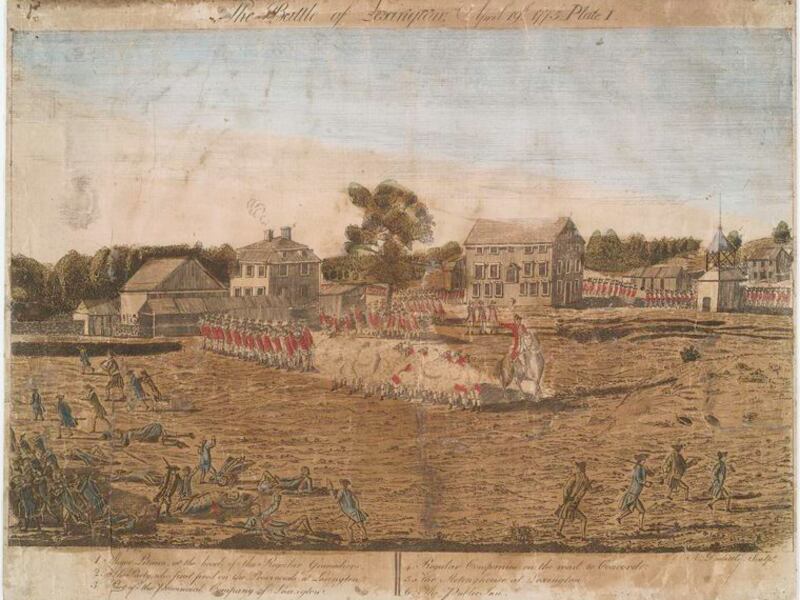
But the third attempt to seize arms didn’t go so smoothly. The night of April 18, 1775, Gage sent a 700-man army to seize arms at Concord. Paul Revere and others rode to give warning. While Dr. Prescott made it to Concord, Paul got caught just past Lexington and spent his night listening to redcoats call him “rebel” between threats to “blow (his) brains out.” By 4:30 a.m., over 60 colonial militiamen awaited the approaching army on Lexington’s Green. “Stand your ground; don’t fire unless fired upon, but if they want a war, let it begin here,” militia Capt. John Parker hollered. The redcoats then arrived. “Ye rebels, disperse!” called out a British officer. Then — boom. A gun went off. Redcoat misfire? Nervous Lexington militiaman? We’ll never know, but the spooked redcoats unleashed a deadly volley before continuing their march to Concord — to seize arms.
No wonder James Madison had to explain to the people in 1788 — then citizens of 13 independent republics allied in a confederation — that if they ratified the proposed U.S. Constitution, they could rest easy knowing a hypothetical U.S. military couldn’t overtake a “militia amounting to near half a million of citizens with arms in their hands” (Federalist 46). No wonder Alexander Hamilton reassured the people that, if betrayed by their federal representatives, they may exert “that original right of self-defense” as “the citizens must rush tumultuously to arms” (Federalist 28). If the anti-slavery, immigrant, Northerner Hamilton is making essentially the same arguments in favor of bearing arms as the slave-owning Southerner Madison, are we really ready to call slavery the Second Amendment’s main impetus?
Given the standing armies, seizure of arms and fear of surrendering state sovereignty, of course the Second Amendment reads: “A well regulated Militia, being necessary to the security of a free State, the right of the people to keep and bear Arms, shall not be infringed.” The history I’ve related is in its very words.
Much ink has been spilt over the Second Amendment’s commas and what “militia” implies. And slavery’s lasting, severe damage to the United States is clear. These are important issues worth discussing. But let’s not misappropriate slavery for short-term gains while debating gun rights. Ultimately, this red herring tactic will undermine the conversation, as well as the gravity of slavery’s history.