

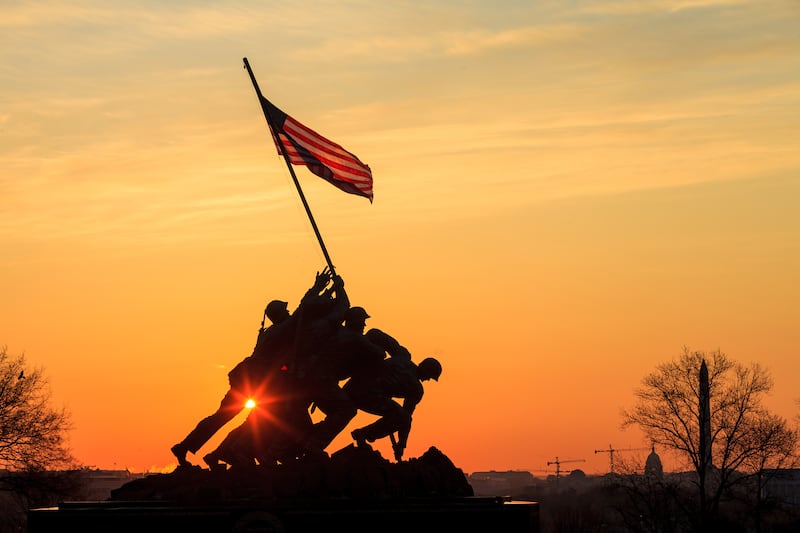
Most Americans have heard of the Battle of Iwo Jima — where the United States Marine Corps fought a brutal and extended battle for a tiny island, making Iwo Jima synonymous with valor.
What does a battle some seven decades in the past have to do with America today? A chaplain with the Marines identified America’s best aspirations in 1945 and taught a lesson about discrimination still salient today.
The reason such a small dot among many in the vast Pacific Ocean was absolutely crucial to Allied forces in bringing an end to war in the Pacific was its location — vital to both Japanese and Americans.
After capturing the Mariana Islands, the U.S. could at last launch a large-scale air campaign against Japanese industrial production. However, a critical barrier to success was the strategically located island of Iwo Jima, a volcanic dot of an island with two airfields and a third under construction, as well as a radar station that gave two hours’ warning of bombing missions. The Americans needed to eliminate the fighter threat to their bombers from Iwo-based aircraft and destroy the radar station that gave early warning to Japan.
After intense naval and aerial bombardment of Iwo Jima, the American infantry moved in. Mount Suribachi, the highest point of the island, offered the Japanese almost unlimited fields of fire toward most parts of the island. The attack on Iwo Jima brought withering fire from Suribachi, with little cover.
After three days of battle, the Marines had already suffered 4,574 casualties, and the campaign was already behind schedule. Although the Americans didn't know it, the situation would worsen.
The Americans had completely underestimated the timescale and cost of the operation as well as the determination and preparedness of the enemy. What had been imagined as a short, decisive battle became the costliest battle in the history of the U.S. Marine Corps.
By March 3, the Americans were in control of some two-thirds of Iwo Jima, but casualty figures continued to mount with some 16,000 casualties on the American side and some 14,000 casualties on the Japanese side.
As the number of war dead grew, American forces found it necessary to build cemeteries on the island.
In mid-March, the 4th Marine Division Cemetery was dedicated. Division Chaplain Warren Cuthriell, a Protestant minister, asked Rabbi Roland Gittelsohn to deliver the memorial sermon at a combined religious service dedicating the Marine Cemetery. According to Rabbi Gittelsohn, the majority of Christian chaplains objected to having a rabbi preach over predominantly Christian graves.
To his credit, Cuthriell refused to alter his plans. Gittelsohn, on the other hand, wanted to save his friend Cuthriell any further difficulty and decided it was best not to deliver his sermon. Instead, three separate religious services were held. At the Jewish service, Rabbi Gittelsohn delivered the powerful eulogy he originally wrote for the combined service:
Here lie men who loved America because their ancestors generations ago helped in her founding, and other men who loved her with equal passion because they themselves or their own fathers escaped from oppression to her blessed shores. Here lie officers and men, Negroes and whites, rich men and poor … together. Here are Protestants, Catholics, and Jews together. Here no man prefers another because of his faith or despises him because of his color. Here there are no quotas of how many from each group are admitted or allowed. Among these men, there is no discrimination. No prejudices. No hatred. Theirs is the highest and purest democracy. …
Whosoever of us lifts his hand in hate against a brother, or who thinks himself superior to those who happen to be in the minority, makes of this ceremony and the bloody sacrifice it commemorates, an empty, hollow mockery. To this, then, as our solemn duty, sacred duty do we the living now dedicate ourselves: to the right of Protestants, Catholics, and Jews, of white men and Negroes alike, to enjoy the democracy for which all of them have here paid the price. …
We here solemnly swear that this shall not be in vain. Out of this and from the suffering and sorrow of those who mourn this will come, we promise, the birth of a new freedom for the sons of men everywhere.
Among Gittelsohn’s listeners were three Protestant chaplains so incensed by the prejudice voiced by their colleagues that they boycotted their own service to attend Gittelsohn’s. One of them borrowed the manuscript and, unknown to Gittelsohn, circulated several thousand copies to his regiment. Some Marines enclosed the copies in letters to their families. An avalanche of coverage resulted. Time magazine published excerpts, which wire services spread even further. The entire sermon was inserted into the Congressional Record, the Army released the eulogy for short-wave broadcast to American troops throughout the world, and radio commentator Robert St. John read it on his program and on many succeeding Memorial Days.
In his autobiography, Gittelsohn reflected, “I have often wondered whether anyone would ever have heard of my Iwo Jima sermon had it not been for the bigoted attempt to ban it.”
By the end of March 1945, fighting had largely ended, although it would continue in small skirmishes well into June, when the last few Japanese were captured by the U.S. Army.
Iwo Jima was such a jolt to American battle planners that they learned to predict greater Japanese resolve, increasing in strength and emotion the closer America got to Japan.
Twenty-seven Americans (22 Marines, four Navy corpsmen and one naval officer) received the Medal of Honor (13 posthumously). A wise people will learn from these great sacrifices.