

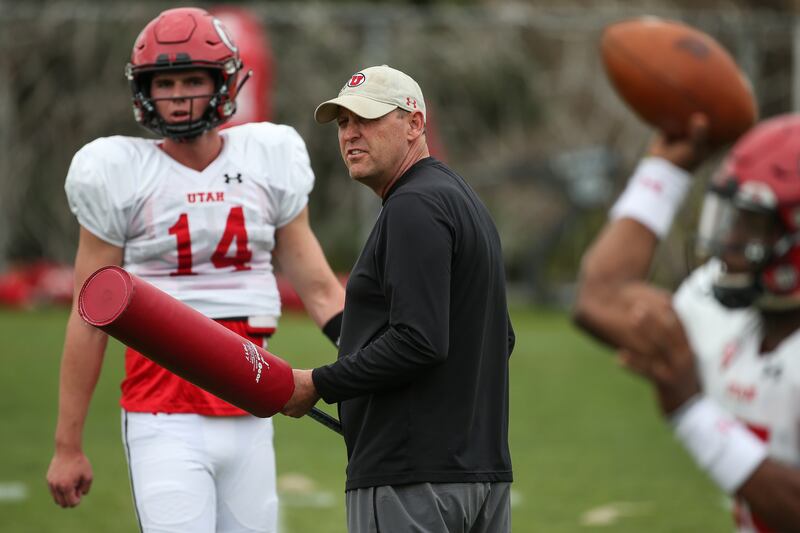
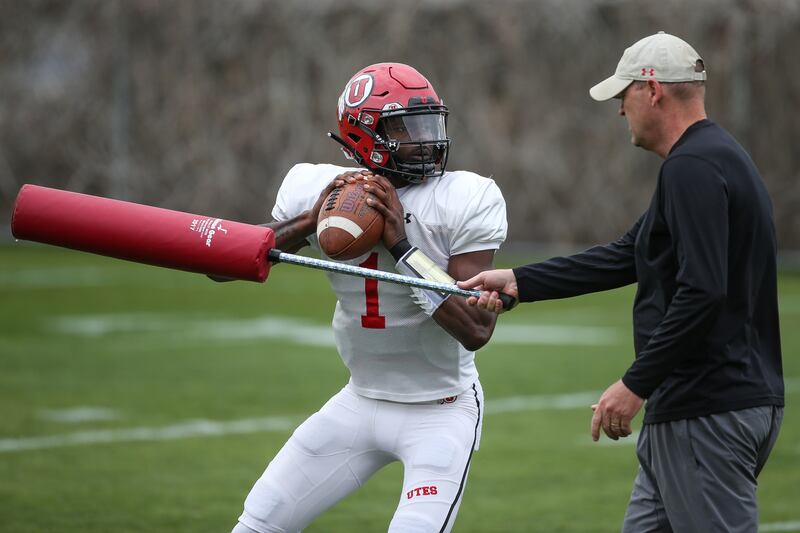

SALT LAKE CITY — As Utah opens training camp Wednesday, no coach will be under more scrutiny this fall than Troy Taylor, the Utes’ passionate and relentlessly upbeat offensive coordinator.
Can he transform Utah into a prolific offensive team? That’s the riddle that head coach Kyle Whittingham has been trying to solve for more than a decade, and a year ago he hired Taylor to figure it out.
The results were mixed, but then Taylor is trying to change a deeply entrenched culture of running the ball, defense and special teams. The passing game that has swept the nation at every level — high school to pro — left the Utes behind years ago, and the Utes have struggled to catch up.
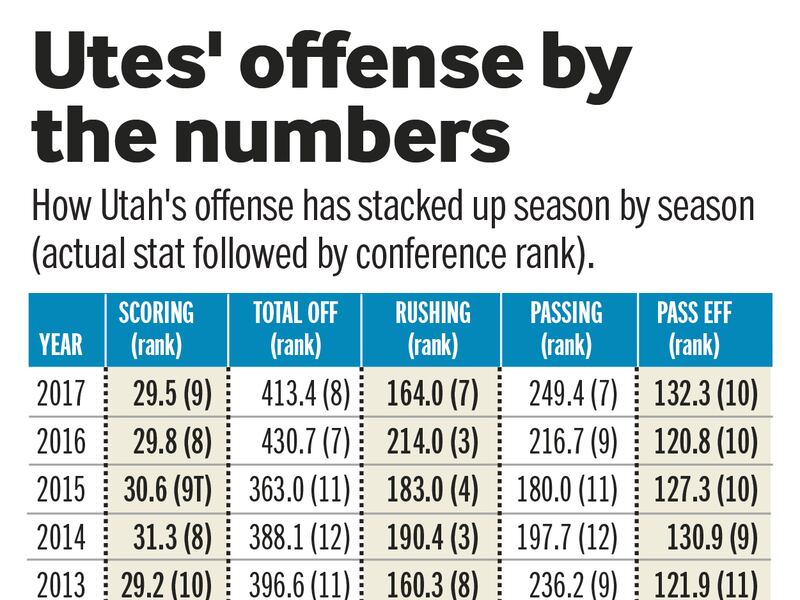
Look at the chart accompanying this story. The Utes have ranked near the bottom of the league — if not the bottom — in almost all offensive categories except rushing. During seven seasons in the Pac-12, their highest finishes have been eighth in scoring, eighth in pass efficiency, seventh in total offense and, until last season, ninth in pass offense.
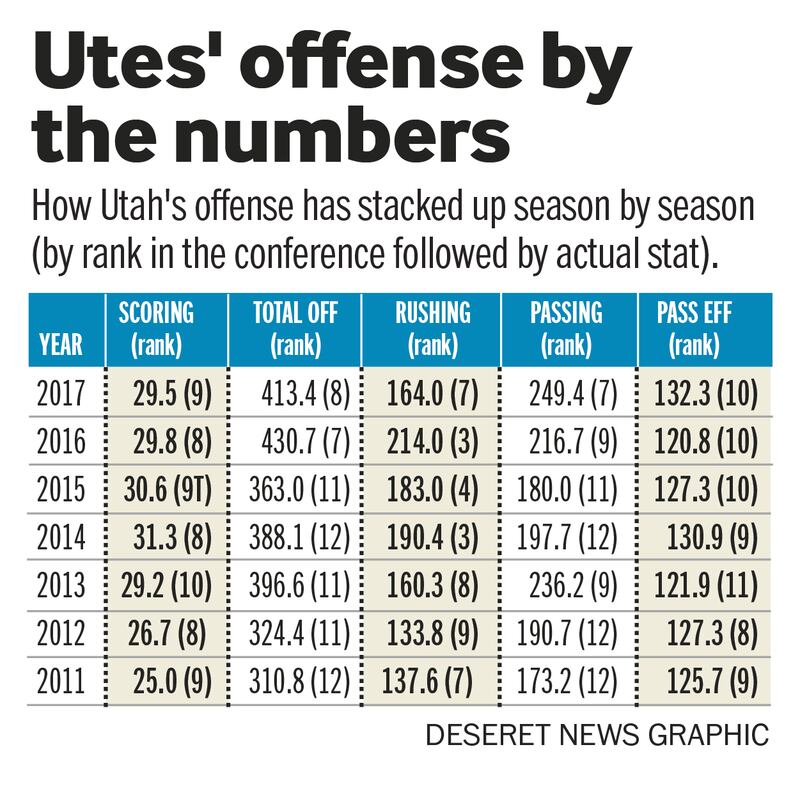
In an era when teams routinely throw for 300 yards per game, the Utes averaged 199 yards passing per game during their first six years in the league (to put that in perspective, 85 of 129 teams passed for more than 200 yards per game in 2017). Since 2005, they have never finished among the nation’s top 50 in total offense.
Their inability to produce a strong passing game has impaired their ability to produce big plays and comebacks. It’s difficult for offenses to thrive when the only way they can score is to assemble long, steady drives free of penalties and turnovers.
Last season, Taylor’s offense did manage to produce Utah’s best passing results since joining the league — 249.4 yards per game, 132.3 pass efficiency. Still, those marks ranked no better than seventh and 10th in the league, and the Utes’ production in the other categories negated any gains in the passing game.
“We had an inexperienced line and quarterback, and it was their first year in a new offense,” says Taylor. “I felt like we struggled early in the year in the red zone and on third down, but we were moving the ball efficiently 20 to 20. We lacked big plays. That was the biggest detriment. We had no chunk plays.”
The Utes ranked 99th in the country in third-down conversions — 62 of 176 attempts, or 35 percent. It certainly didn’t help that the receivers struggled to get open against man coverage, which undoubtedly contributed to the team’s problem with protecting the quarterback.
Utah’s offensive coordinator has already beaten the odds simply by keeping his job for a second year, no small feat at Utah (last season he became the ninth man in seven years to own or share the position). The Utes took a leap of faith in hiring Taylor, who, other than one year at Eastern Washington in 2016, hadn’t coached the college game since 2000. He built a reputation in the California high school ranks, where his teams established eye-popping stats. In one year he made the big jump from high school to the highest level of college football.
The culture and mentality is important. Establishing that on offense has been my priority. And I can feel a difference. Guys are speaking up in meetings. There’s confidence on the field.” – Troy Taylor
Taylor was bold. He immediately overhauled an offensive system that Utah had used for years. He also benched the previous year’s starting quarterback, Troy Williams, in favor of an inexperienced sophomore, Tyler Huntley.
Huntley was solid, but certainly not spectacular, throwing for 15 touchdowns (to 10 interceptions) and 2,411 yards, while missing three games to an injury. A year of experience figures to make him more effective this season, and the return of the team’s top two running backs — Zack Moss and Devonta'e Henry-Cole — as well as four offensive line starters, will help.
The Utes were 7-6 last season, which had to be difficult for a guy who says he gets physically ill and is plagued with bad dreams after losses. He hopes the return of slot receiver Britain Covey addresses the need for big plays. Covey was the Utes’ best offensive player as a true freshman in 2015 before leaving for an LDS Church mission. He returned in March.
“I had remembered him vividly watching him on TV,” says Taylor. “I haven’t seen him (play football) in person. I’ve heard he’s back to normal (fitness). We’ll find out.”
Taylor, the new guy, found himself on the spot last season to prove himself and his offensive scheme and win the confidence of coaches and players (“I don’t think that ever ends,” he says). He also has the added challenge of changing the culture at Utah, one that leans on conservative offenses and aggressive defenses. Taylor’s wide-open, pass-happy offense is a big change.
It takes time to change the culture, but that’s in short supply in a business where you’re only as good as your last season.
“The culture and mentality is important,” Taylor says. “Establishing that on offense has been my priority. And I can feel a difference. Guys are speaking up in meetings. There’s confidence on the field.”
The table is set for better results. Taylor has nine returning starters, or 10 if you count Covey. The coach has had a year of seeing the competition and preaching his offense to the Utes. He just hopes it all adds up to more wins.