

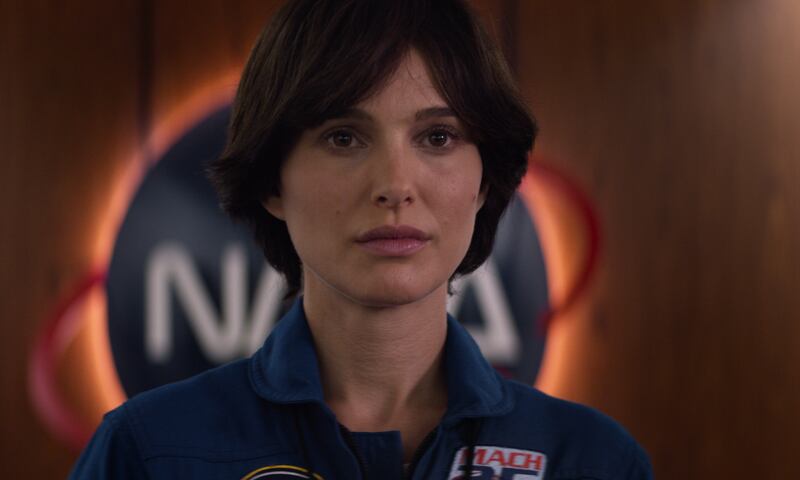
“LUCY IN THE SKY” — 2 stars — Natalie Portman, Jon Hamm, Dan Stevens, Pearl Amanda Dickson; R (language and some sexual content); in general release; running time: 124 minutes
SALT LAKE CITY — “Lucy in the Sky” is the latest example of why you should take a deep breath when the words “inspired by” float across a movie screen.
When it comes to bringing “true stories” to the big screen, the words “based on” suggest that what you are going to see is at least rooted in a true story, and the question is how faithful to the source material the director has been. “Inspired by” pretty much means all bets are off.
Such is the case with Noah Hawley’s “Lucy in the Sky,” a ponderous and confusing drama about an astronaut whose life on Earth falls apart after her first journey into space — “inspired by” an infamous 2007 episode involving an astronaut named Lisa Nowak.
Hawley’s protagonist is Lucy Cola, played with determination by Natalie Portman. The film opens with Lucy floating above the Earth on a space walk, gazing down in wonder at her home planet. She and her crew have spent nearly two weeks in space, and with the mission declared a success, they return to Earth with the satisfaction of a job well done.
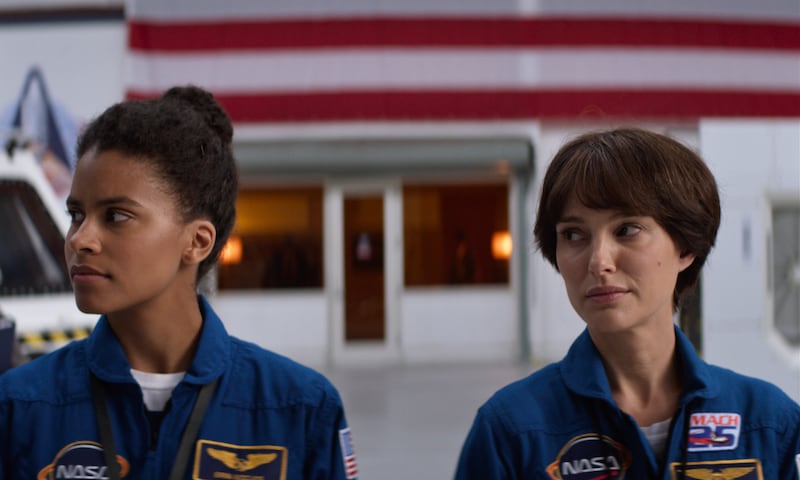
Lucy quickly realizes, though, that her experience has changed her deeply. She’s a career achiever, a top-of-her-class type, and seems to have handled the journey well, to the surprise of all the NASA types who keep asking her how she’s doing. But her return to domestic life with her husband Drew (Dan Stevens) — a fellow NASA employee — and her live-in niece (Pearl Amanda Dickson) just feels off.
Lucy finds solace with a fellow astronaut named Mark Goodwin (Jon Hamm), who introduces her to a special bowling team — The Circle of the Rolling Ball — reserved for astronauts who have, in Mark’s words, “seen the face of God.” In Mark, Lucy finds someone who understands the challenge of seeing the Earth in perspective and struggling to return to the minutiae of daily life.
The kindred spirit relationship quickly evolves into an extramarital affair, and Lucy’s behavior becomes increasingly erratic both at home and the office. As one stumble leads to another — and as Lucy learns that Mark has another girl on the side — she spirals into a mental breakdown.
The best thing “Lucy in the Sky” has going for it is the sympathy the audience feels for the protagonist. Even a big city skydeck will give you a sense of the smallness of it all, and it’s compelling to imagine what it would be like to see the Earth — and the rest of the universe — from outer space.
At the same time, Lucy is still a pretty unlikable character. Not only is it difficult to cheer for her once she starts cheating on a man who seems compassionate and completely devoted to her, but as her story evolves from ponderous think piece to extramarital drama to something entirely different in the third act of the film, it’s unclear whether Hawley wants us to cheer for her or not.

Part of the problem seems to be the “inspired by” dynamic. Because while Hawley has made efforts to fictionalize Nowak’s story, there are enough forced similarities — including the infamous cross-country road trip where she confronts her lover’s new lover — to muddle the narrative. Better to divorce the source material entirely and avoid confusion.
Tack on the strange decision to constantly change the aspect ratio throughout the film, plus a strange musical sequence inspired by the film’s title, and the result just inspires a “nice try, but …no” kind of reaction. “Lucy in the Sky” has enough strengths to deserve some credit, but the sum total makes for a rough re-entry.
Rating explained: “Lucy in the Sky” draws an R rating for some scattered profanity and (mostly implied) sexual content.