

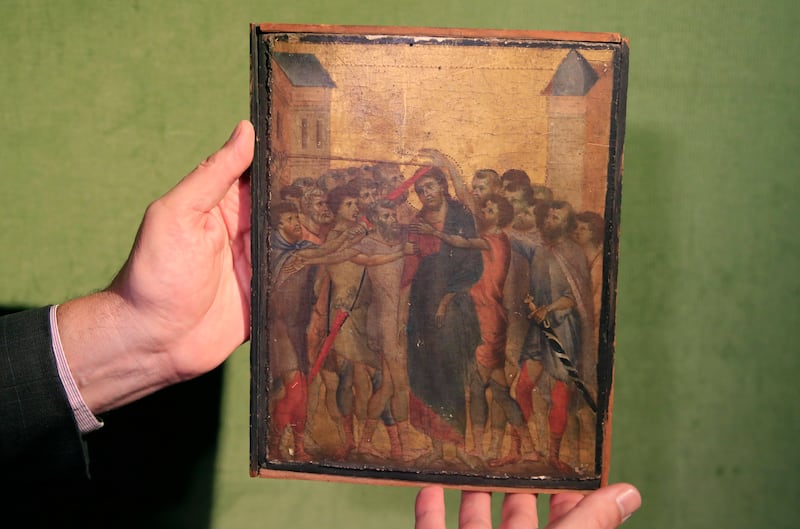

A lost piece of art by the 13th-century Italian painter Cenni di Pepo, also known as Cimabue, has been recovered in Compiegne, France.
Thinking that the painting was a Greek religious icon, an elderly French woman kept it about the hot plate in her kitchen, according to CNN. When experts examined the painting, known as “Christ Mocked,” they immediately noted its resemblance to a Cimabue’s work.
“It didn’t take long for us to see that it was an artwork by Italian painter Cimabue. He’s a father of painting so we know his work very well,” said art specialist Jerome Montcouquil said.
Montcouquil continued by explaining that, as there are only 11 known Cimabue paintings in existence, they are extremely rare. He also explained that he and other experts have determined the painting to be part of a polyptych — a larger work of several scenes painted over multiple panels — that also included the “Flagellation of Christ” as well as the “The Virgin and Child with Two Angels.”
“They are all made with the same technique on the same wood panel so you can follow the grain of the wood through the different scenes,” Montcouquil said. “We also used infrared light to be sure the painting was done by the same hand. You can even see the corrections he made.”
Art expert Éric Turquin also told The Art Newspaper that one way they could tell the paintings were executed on the same piece of wood were the tunnels created by wood-eating larvae.
“Christ Mocked” is slated to be auctioned off at the Acteon auction house on Oct. 27 and will be the first Cimabue painting to be auctioned off, according to CNN.
Cimabue was born in Florence around the year 1240 and was the one to discover and teach fellow Italian painter Giotto. He is also widely recognized as the father of Western painting, according to The Art Newspaper.