

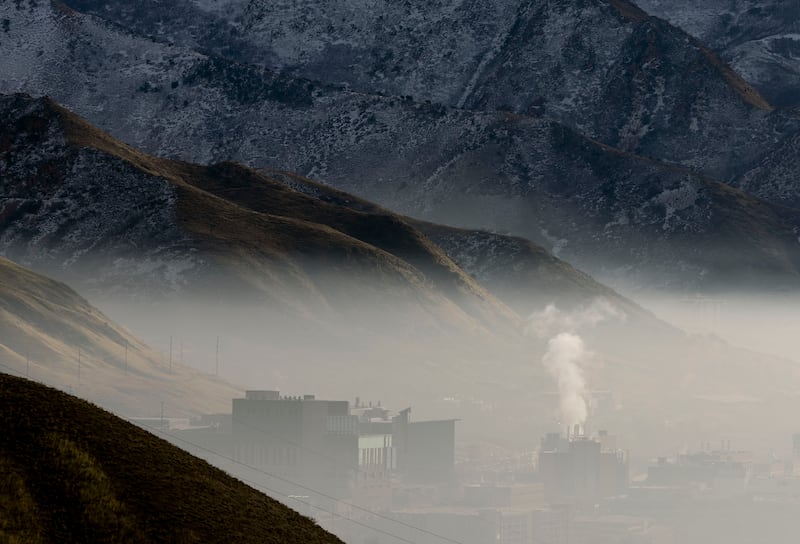

High levels of fine particulate pollution have Salt Lake County in a cold and unhealthy grip, along with fog that just doesn’t seem to want to go away.
The U.S. Environmental Protection Agency’s federal 24-hour threshold for PM2.5 is 35 micrograms per cubic meter. Salt Lake County on Monday sat at 42.9.
Tuesday is not expected to be any better, with the Utah Division of Air Quality forecasting another day of high levels of fine particulate pollution for Salt Lake County.
While Utah, Weber, Tooele and Cache counties seem to be holding their own in the moderate range, the forecast from air quality regulators calls for worsening conditions in Davis County over the next couple of days.
What is an inversion, anyway?
According to the Utah Department of Environmental Quality, under normal atmospheric conditions, air is warmer near the ground and cooler at high altitudes.
“In a temperature inversion, the situation ‘inverts,’ and cold air at the surface gets trapped under a layer of warmer air. During the winter, snow-covered valley floors reflect rather than absorb heat, preventing the normal vertical mixing of warm and cold air that keeps pollutants from building up to unhealthy levels at the surface,” the agency said.
Mountain areas, it noted, are particularly vulnerable.
“The Wasatch Mountains, Oquirrh Mountains, and Traverse Mountain, for example, form a basin that traps cold air in the Salt Lake Valley and shields it from the stronger winds aloft that could clear out inversions”
The agency cautions not to find the easy solution and just blame mountains.
“While Utah’s unique topography, geography, and meteorology are important factors in the buildup of fine particulates during inversions, PM2.5 emissions and their chemical precursors are the primary cause of these pollution episodes,” it said.
The Wasatch Front’s chief culprit for PM2.5 emissions is the tailpipe of automobiles. Area sources such as homes and businesses are projected to eclipse that source in the future as automobiles become cleaner with the adoption of Tier 3 gasoline.
Tier 3 gasoline contains fewer pollutants and has been embraced by Utah’s major refineries.
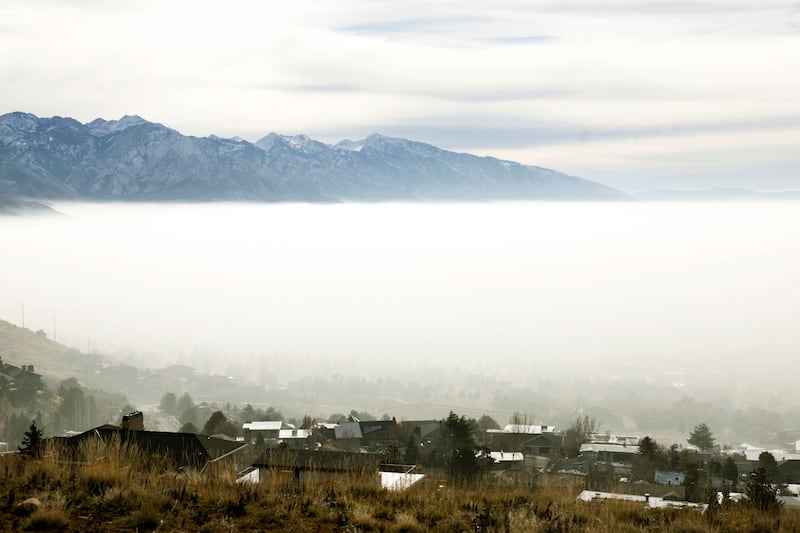
Are we dreaming of a white Christmas or will it be reality?
While the National Weather Service in Salt Lake City said it will remain in the low 30s for the duration of the week and into the weekend, there is hope for snow for Christmas.
Nicole Desmet, a meteorologist with the agency, said a storm front appears to be perched on the Wasatch Front’s doorstep, ready to make its move on Saturday.
“We’re watching a weather system potentially to come in over the weekend. It’s looking perhaps a little more confident headed into Saturday, Sunday and maybe even lingering into Christmas Day.”
On Saturday, it may start out with a mix of snow and rain in valley areas but transitioning to snow later on. Snow will continue into Sunday and perhaps grace us Christmas Day with more snow.
She said that active weather pattern will sweep away the smog.