

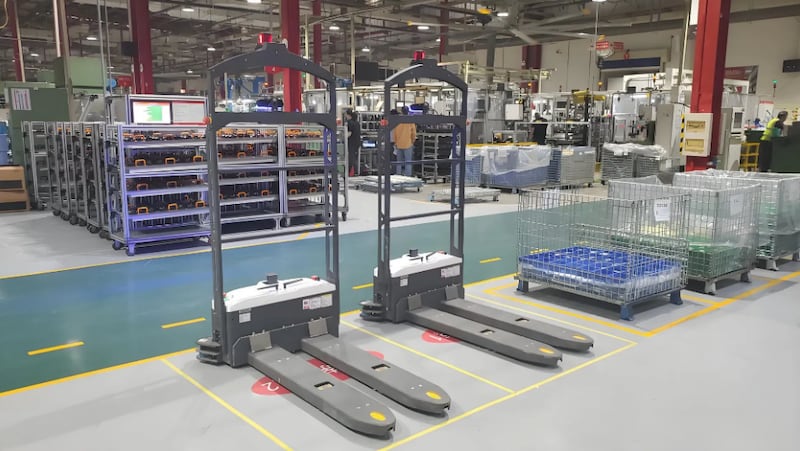

The future of forklifts is in robots.
As artificial intelligence transforms workplace tasks, its impact is expanding to industrial equipment, including forklifts. Once fully human operated, AI is taking the driver’s seat, increasing efficiency and safety on the warehouse floor.
Autonomous forklifts use sensors, software and machine learning to move materials without a human behind the wheel. Automation and digital tech advancements now allow machines to operate continuously across a range of different warehouse conditions, whereas before, they were limited by human operating hours.
SEER Robotics is one company driving the shift. According to China Insights Consultancy, SEER Robotics was ranked No. 1 in robot controller shipments globally in both 2023 and 2024. The company’s website claims it is the world’s only large-scale open platform dedicated to intelligent robotics.
The autonomous forklift market is growing quickly. A recent global forecast report, detailed the market grew from $4.58 billion in 2024 to $5 billion in 2025, an increase of 9.17%. The report projects that growth to continue at a compound annual growth rate of 9.69%, with the market expected to reach $9.61 billion by 2032.
AI Ten shared a few benefits that come from using robotic forklifts like enhanced efficiency, cost savings, safety improvements and more technological advancements.
Where does this leave people?
Autonomous forklifts are used for repetitive and more dangerous tasks, reducing human error and injuries. Advantages for using these forklifts include increased operational efficiency, reduced labour costs, enhanced safety, optimized warehouse management, and data collection and analytics, per AI Ten.
Robotic forklifts come in multiple vehicle types, ranging from pallet stackers, straddle forklifts and counterbalance forklifts, with a range of load capacities designed to meet operational demands of different industries like construction, logistics and warehousing, according to the report.
They can be used in different areas including e-commerce and retail logistics, manufacturing, cold chain and food logistics and healthcare and pharmaceuticals, AI Ten shared. As the warehouses become more automated with different technologies, the need for human supervision will likely go down, AI Ten detailed.
As more warehouses use the advancing technology, autonomous forklifts are becoming less of a future concept and more of a present-day reality in facilities worldwide.