

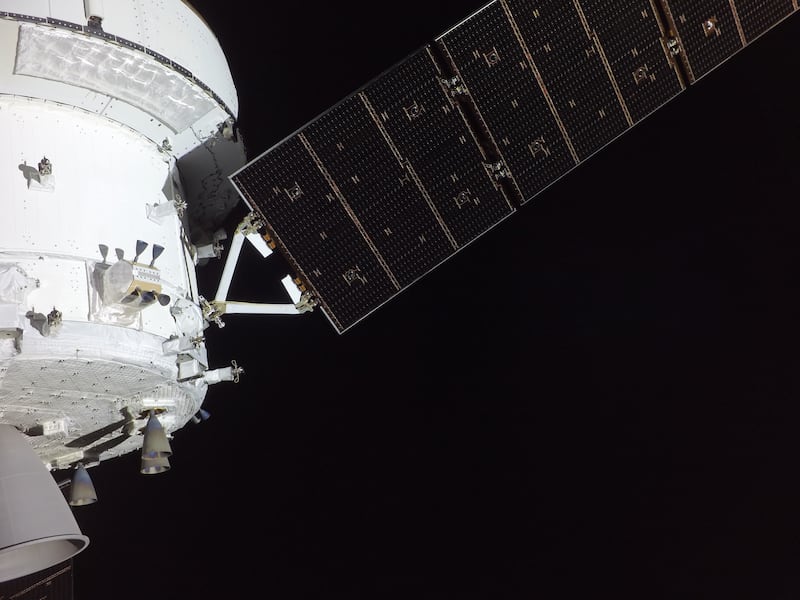

- The Orion space capsule and its four crew members are due to return Friday evening.
- The mission set all-time record for distance traveled from Earth by crewed space flight.
- NASA says it resolved a heat shield issue from 2022 test flight but questions remain.
The four astronauts aboard NASA’s Orion crew capsule just set an epic record for human space flight, traveling over 252,000 miles from Earth in a lunar flyby Monday that surpassed the previous distance mark set over 50 years ago.
But it’s not like that 1970 Apollo 13 mission, a planned lunar landing that was derailed by an onboard explosion that knocked out life support systems and ultimately led to a harrowing change of flight plans and successful return to Earth albeit without touching down on the moon.
The 10-day Artemis II journey has gone mostly as NASA expected and is on track for a Pacific Ocean splashdown off the coast of San Diego on Friday evening.
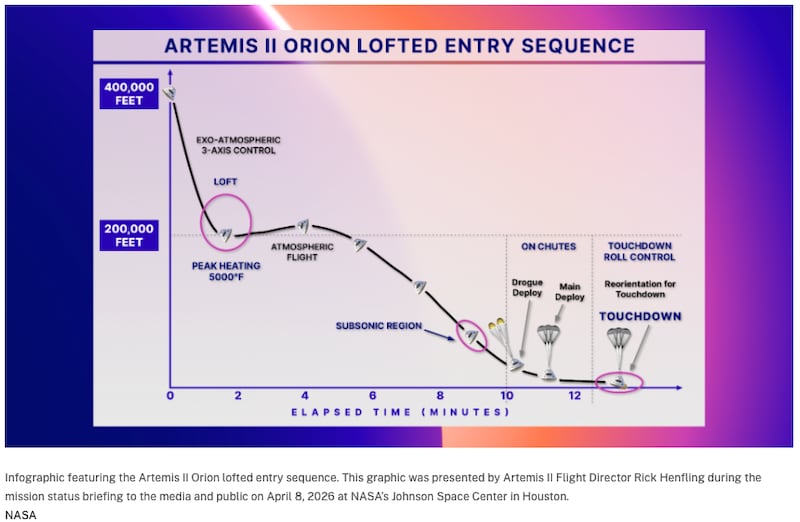
Ahead of that parachute-assisted landing, however, is Orion’s fiery reentry into Earth’s atmosphere, where the capsule’s speed will approach 25,000 m.p.h. and the temperature on Orion’s leading surfaces will reach 5,000 degrees.
Surprisingly, perhaps, the heat protection material deployed to keep Orion and its crew safe during the critical reentry phase has not changed much from the days of the Apollo program.
Orion’s heat shield is made of Avcoat, a mixture of silica, epoxy and resins that was also used for the original Apollo lunar missions, according to a report from Scientific American. Avcoat is designed to degrade when exposed to extreme temperatures, carrying the heat away from space vehicles as it chars and flakes away. While the Apollo-era heat shields were composed of thousands of small cells of Avcoat, Orion is protected by some 200 large tiles of the material.
Concerns about Orion’s heat shield
In its only real world shakedown, an unmanned test flight in 2022, Orion’s heat shield kept the interior of the capsule within an acceptable temperature range but the degradation of the protective material was much more extreme than expected. On inspection after the capsule’s return, NASA engineers found large chunks of the Avcoat tiles had broken off amid the heat and friction of reentry conditions.
While the damage experienced in the Artemis I flight raised serious concerns, NASA says it came up with a solution that will reduce the wear and tear on the heat protection and keep Orion’s crew safe. That fix wasn’t about making modifications to the heat shield itself but instead altering the space capsule’s reentry trajectory, opting for a steeper angle that will lead to higher heat levels but reduce the amount of time Orion and its crew is enduring the most intense atmospheric resistance.
In an interview with The Free Press on Tuesday, NASA administrator Jared Isaacman said Orion’s heat shield issue was definitely a forward concern but expressed confidence that his agency had found the right fix for the problem.
“The heat shield has to work,” Isaacman said. “I’m going to be thinking about that constantly until they’re back in the water.
“I have no doubt the team did the right analysis on this,” he added. “We altered the mission profile — the whole reentry profile is very different than Artemis I to account for what I would describe as the ‘shortcomings’ of the current heat shield on that vehicle.”
Some scientists, however, have shared concerns over NASA’s solution to the heat shield issue for the Artemis II mission.
Heat shield expert Ed Pope said the design of Orion’s heat protection is problematic and NASA is moving forward in spite of acknowledged risk factors.
“This approach doesn’t mitigate the flaws in the design and manufacture of the original heat shield itself,” Pope told Scientific American. He points out that the agency is using a different heat shield design and yet another formulation of Avcoat for the next Artemis mission, currently scheduled for mid-2027. “That change is an acknowledgement that there’s a known risk to the current design and manufacturing method, in my opinion,” Pope said.
On Thursday, day nine of the Artemis II mission, Orion astronauts were stowing gear, reinstalling flight seats and making preparations for the final leg of the journey, according to a Wednesday NASA update. Orion is due to splashdown at 6:07 p.m. on Friday. Stay caught up with the progress of the mission via NASA’s 24/7 live stream below:
Historic mission with a historic crew
The Artemis II crew has three NASA astronauts including mission commander Reid Wiseman, pilot Victor Glover and mission specialist Christina Koch as well as mission specialist Jeremy Hansen from the Canadian Space Agency. The team trained for almost three years for the mission and looks quite different from the astronaut corps of the Apollo program, which was composed of white, male test pilots recruited from U.S. military branches.
The Artemis II crew, collectively, represents the first woman, first person of color and first non-American to travel to the moon.
Koch already holds the record for the longest single spaceflight by a woman, according to an Associated Press report. During her 328-day mission at the International Space Station spanning 2019 and 2020, she took part in the first all-female spacewalk.
Glover, a Navy test pilot, was the first Black astronaut to live and work aboard the space station in 2020 and 2021, per AP. He also was one of the first astronauts to launch with SpaceX.
The Canadian Space Agency’s Hansen, a former fighter pilot, is the lone space rookie. Artemis II mission commander Wiseman is a retired Navy captain who lived aboard the space station in 2014 and later headed NASA’s astronaut corps. They range in age from 47 to 50.